

«Данное сообщение (материал) создано и (или) распространено иностранным средством массовой информации, выполняющим функции иностранного агента, и (или) российским юридическим лицом, выполняющим функции иностранного агента»
 Topic: Air Warfare Blog Brand: The Buzz Region: Europe Tags: Air Defense, Drones, Eastern Europe, Iskander Missile, Missiles, Russia, Ukraine, and Ukraine War What Can Ukraine Do to Stop Russia’s Iskander Missiles? April 19, 2026 By: Stavros Atlamazoglou
Share
Sophisticated air defenses can shoot down the Russian ballistic missiles—but these are few and far between, and busy intercepting hundreds of other projectiles as well.
On Wednesday night, Russia unleashed a massive air attack against Kyiv, launching hundreds of kamikaze drones and missiles at the Ukrainian capital.
The massive air raid, five years into the conflict, underscores Russia’s ability to produce attack drones, ballistic missiles, and cruise munitions even in the face of heavy international sanctions.
About Russia’s Latest Air Raid Against Kyiv
According to the Ukrainian Air Force, the Russian air attack on Wednesday night was one of the largest in the war thus far. It involved nearly 700 one-way attack unmanned aerial systems, also known as loitering munitions or kamikaze drones, as well as 25 cruise missiles, and 19 ballistic missiles.
“Most of the ballistic [missiles] were aimed at Kyiv,” Ukrainian President Volodymyr Zelensky said the following day in a statement posted to X (formerly Twitter). “We managed to shoot down 636 drones and [some] of the missiles. Unfortunately, not all. There are hits and damage to ordinary houses. Unfortunately, there are fatalities in Odesa, Kyiv, and Dnipro. Among the dead is a boy who was 12 years old.”
The top diplomatic priority for Ukraine right now is cooperation for the sake of air defense. We need air defense missiles every single day – every day the Russians continue their strikes on our cities. Just over the past 24 hours there were brutal attacks on Dnipro, Cherkasy,… pic.twitter.com/xNDOcwEDqn
— Volodymyr Zelenskyy / Володимир Зеленський (@ZelenskyyUa) April 15, 2026
More than 100 civilians were also wounded in the attack.
Russian drones and missiles have kept Ukraine on its toes, pushing the tired population hard and destabilizing the country’s economic life. Ukraine’s critical infrastructure has suffered mightily under Russia’s strikes.
Although kamikaze drones can be deadly, they do not compare to the destructive capability and accuracy of ballistic missiles. And Russia is ramping up production of one of its most deadly ballistic missiles.
After Early Setbacks, Russian Iskander Missile Production Is Growing
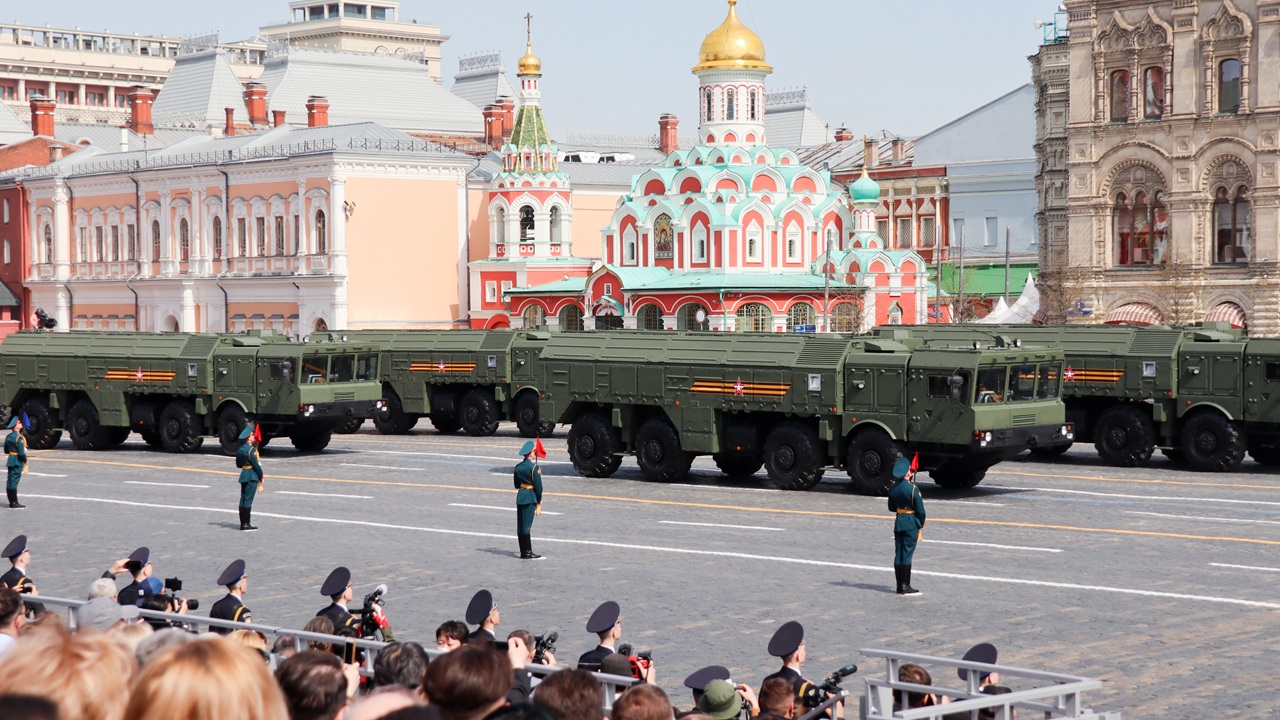
According to Vadym Skibitskyi, the deputy head of Ukraine’s defense intelligence directorate, the GUR, Russia has stepped up its ballistic missile production, with about 60 new Iskander munitions coming off the factory line every month—or around 720 per year.
The 9K720 Iskander-M/SS-26 Stone has a range of up to 310 miles and carries a 1,545 lbs high-explosive warhead. It can also pack a nuclear warhead, although nuclear weapons have not been used in the Ukraine conflict and are unlikely to be.
Due to their speed and advanced capabilities, Iskander missiles require state-of-the-art interceptors to counter, such as the MIM-104 Patriot or the IRIS-T air defense systems. The Ukrainian military does not have sufficient numbers of these air defense weapons to cover the whole of the country.
The imbalance between attacker and defender was not always the case. For a considerable portion of the war, Russia did not have a sufficient number of missiles. However, the advent of cheap and disposable kamikaze drones—first imported from Iran, later manufactured domestically—gave the Russian aerospace industry sufficient space and time to ramp up its production of ballistic missiles.
The Kremlin did not expect the war to last so long. Indeed, military officers and intelligence officials had advised Russian President Vladimir Putin that the “special military operation” in Ukraine would be a short affair, lasting anywhere from three days to two weeks, and Russian forces would be greeted with open arms by pro-Russian civilians in the east.
This vision spectacularly failed to materialize for the Kremlin, and as the war dragged on, its immense demands depleted Russian missile stocks. The Russian military had to scavenge commercial appliances—including microwaves, laundry machines, and refrigerators—for microchips that it could fit to missiles.
But these woes over stocks are going away, and Russia’s long-range capabilities are strengthened once again today.
About the Author: Stavros Atlamazoglou
Stavros Atlamazoglou is a seasoned defense journalist specializing in special operations and a Hellenic Army veteran (national service with the 575th Marine Battalion and Army HQ). He holds a BA from the Johns Hopkins University and an MA from the Johns Hopkins’ School of Advanced International Studies (SAIS). His work has been featured in Business Insider, Sandboxx, and SOFREP.
The post What Can Ukraine Do to Stop Russia’s Iskander Missiles? appeared first on The National Interest.
Источник: nationalinterest.org