

«Данное сообщение (материал) создано и (или) распространено иностранным средством массовой информации, выполняющим функции иностранного агента, и (или) российским юридическим лицом, выполняющим функции иностранного агента»
 Topic: Naval Warfare Blog Brand: The Buzz Region: Asia Tags: Aircraft Carriers, China, East Asia, Fujian, Indo-Pacific, and People’s Liberation Army Navy China’s Third Aircraft Carrier Is Nearly Ready for Combat April 15, 2026 By: Peter Suciu
Share
The Fujian, China’s most advanced aircraft carrier to date, is expected to achieve “full operational capacity” by the end of this year.
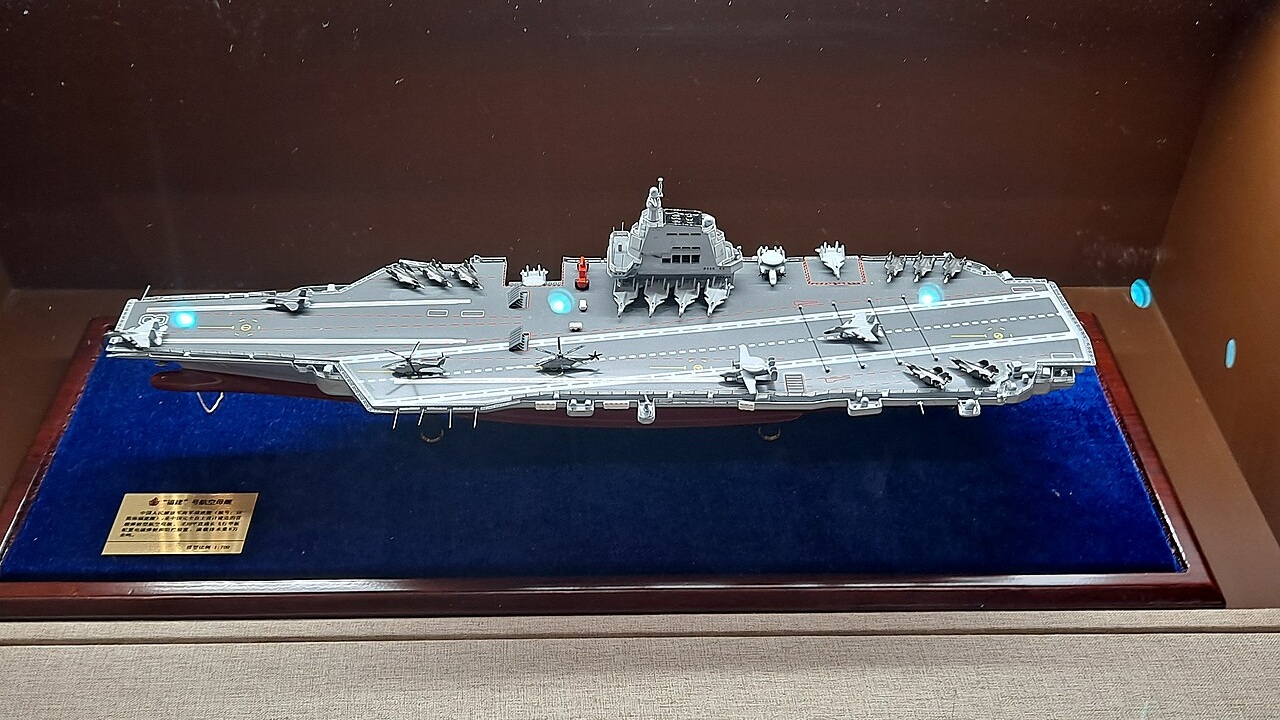
In November 2025, the People’s Liberation Army Navy (PLAN) became the world’s second-largest operator of aircraft carriers after the United States Navy, when it commissioned its third carrier, the Type 003 CNS Fujian (18), into service. The largest and second domestically-built flattop could reach full operational capability (FOC) by the end of this year.
The Fujian will complete the transition from initial operational capability (IOC) to FOC this year, “with far-sea training expected,” according to a report from China’s Global Times state media outlet. The Global Times, citing Chinese military experts, noted that the PLAN’s third carrier has “moved from construction to launch to commissioning at a fast pace, achieving operational capability in a very short time.”
The Type 003 could also conduct its first far-sea training mission, the first undertaken by a Chinese aircraft carrier since the Type 002 CNS Shandong completed its first far-sea training in the Western Pacific three years ago, in April 2023.
The Fujian Is a True Chinese Supercarrier
- Year Introduced: 2025
- Number Built: 1 (sui generis)
- Length: 316 m (1,036 ft 9 in)
- Beam (Width): 76 m (249 ft 4 in)
- Displacement: ~80,000–85,000 tonnes
- Propulsion: Steam turbines
- Speed: ~30 knots (34.5 mph, 55.56 km/h)
- Range: 12,874–16,093 km (8,000–10,000 mi)
- Armaments: Type 1130 gun-based CIWS; HHQ-10 missile-based CIWS; can carry 50+ aircraft, CATOBAR launch configuration (electromagnetic catapults)
- Crew: ~2,000 (plus 1,000 airmen)
The Type 003 Fujian displaces more than 80,000 tons, and is now the largest warship ever built in the People’s Republic of China (PRC). Beyond its size, it is a “great leap forward” for the PLAN, as it is far more technologically advanced than Beijing’s existing carriers; it is the first Chinese catapult-equipped aircraft carrier to enter service. That capability could greatly enhance the PLAN’s naval aviation ambitions in the Indo-Pacific.
Beijing has wasted little time highlighting the functionality of the Type 003 Fujian.
“Shortly after commissioning, the Fujian conducted its first live combat training mission at sea,” the Global Times wrote. “During that mission, multiple types of carrier-based aircraft, including the J-35, J-15T, J-15DT, and KJ-600, conducted multiple rounds of catapult launches and landing drills.”
Although Beijing has carefully controlled the narrative around its naval development, addressing only successes and never speaking of any setbacks, experts have nevertheless noted the progress the PLAN has made in a very short order. At the start of the 21st century, China possessed no aircraft carriers; it purchased the unfinished Soviet-built aircraft carrier Varyag from Ukraine, which was completed as the Type 001 Liaoning, leading to the domestically built Type 002 Shandong.
In less than 14 years from the commissioning of the Type 001, China has emerged as the second-largest carrier operator in the world. It is also making great strides in advanced technology, notably its electromagnetic catapults.
That can increase the number of sorties launched from the carrier. The technology can also enable heavier fixed-wing manned aircraft and unmanned aerial systems (UAS) to operate from the warship.
“When we see the Fujian achieving full aircraft loadouts and demonstrating the ability to launch and recover aircraft across its entire deck, we can consider its combat capability to be fully developed,” Wei Dongxu, a Chinese military affairs commentator, told China’s CCTV state broadcaster.
The Fujian Has Already Conducted Far Sea Training
China has continued its far-sea training, also termed “far seas protection,” designed to test its carrier strike groups (CSG) in open-ocean environments far from land-based support. The goal is to focus on blue-water combat readiness, to carry out joint operations, and to maintain long-range power projection beyond the “first island chain.”
It has included numerous “train-as-you-fight” scenarios featuring drills in air defense, maritime strikes, and day-and-night carrier-based aircraft operations.
“Entering far-sea training requires not only a high level of combat readiness but also comprehensive preparation for emergencies, so that all far-sea training missions can be completed without a hitch,” the Global Times wrote, citing Wei.
China understands the capabilities of the carriers and their ability to project power in distant waters, including “non-combat military operations such as disaster relief, counterterrorism, medical support, and far-sea logistics.” Those are points addressed by Wang Yunfei, another Chinese military affairs expert.
More “Great Leaps” Are Coming Soon for the PLA Navy
With three aircraft carriers in service, the PLAN has already surpassed both the UK’s Royal Navy and the Indian Navy, which each currently operate two carriers. Chinese President Xi Jinping has called for China to operate as many as nine aircraft carriers by 2035 to expand its naval power.
A fourth flattop is already believed to be under construction.
Building as many as three additional carriers, and possibly more if the older Type 001 Liaoning is relegated to training, is highly ambitious. Yet analysts believe the goal could be achievable, albeit at a very high cost. Xi has made it a priority—one that could be crucial if China is able to return Taiwan, which it sees as a breakaway province, back under mainland control.
Wang suggested that China’s fleet of CSGs would be crucial to defending China’s national sovereignty and “achieving reunification,” which points clearly to Taiwan.
About the Author: Peter Suciu
Peter Suciu has contributed to dozens of newspapers, magazines and websites over a 30-year career in journalism. He regularly writes about military hardware, firearms history, cybersecurity, politics, and international affairs. Peter is also a contributing writer for Forbes and Clearance Jobs. He is based in Michigan. You can follow him on Twitter: @PeterSuciu. You can email the author: Editor@nationalinterest.org.
The post China’s Third Aircraft Carrier Is Nearly Ready for Combat appeared first on The National Interest.
Источник: nationalinterest.org