

«Данное сообщение (материал) создано и (или) распространено иностранным средством массовой информации, выполняющим функции иностранного агента, и (или) российским юридическим лицом, выполняющим функции иностранного агента»
 Topic: Trade Blog Brand: Silk Road Rivalries Region: Asia, and Middle East Tags: Armenia, Azerbaijan, Caucasus, Central Asia, Iran War, Nakhchivan, Russia, Trump Route for International Peace and Prosperity (TRIPP), and United States The Iran War Shows Why the “TRIPP” Caucasus Corridor Matters April 1, 2026 By: Joseph Epstein
Share
The Nakhchivan Corridor crossing through Armenia could become an essential American economic lifeline to Asia—and America’s adversaries are taking note.
Five weeks into “Operation Epic Fury,” the war with Iran shows no end in sight. Some 1,500 miles to the north, however, a far more effective peace process is underway. Last week, the foreign ministers of Armenia and Azerbaijan praised “positive developments” in their normalization process. Buried inside the two sides’ peace deal is a 27-mile corridor that may be the most consequential piece of infrastructure the United States has built abroad in a generation—and the war in Iran is proving why.
American power has historically followed the world’s narrowest passages. The Panama Canal is the defining example: a 50-mile strip across the Isthmus of Panama that reshaped global trade, projected US influence across the Western Hemisphere, and remained under American control for nearly nine decades.
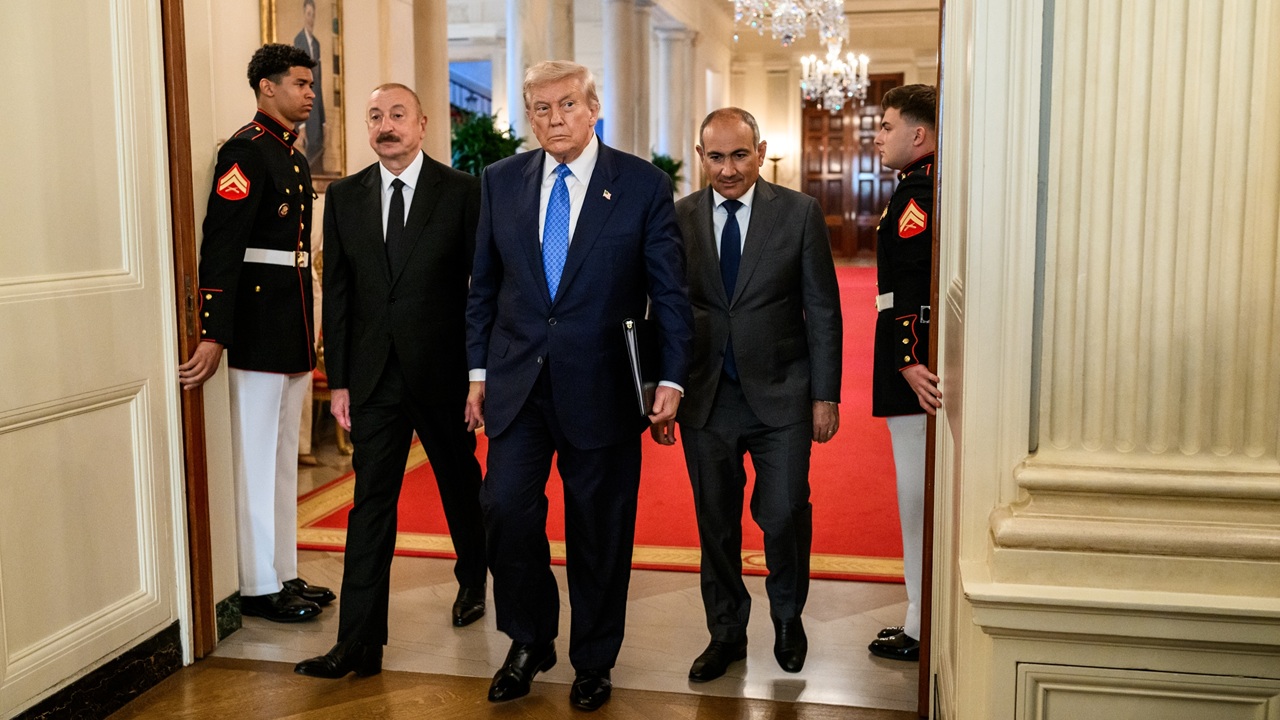
The US-backed “Trump Route for International Peace and Prosperity” (TRIPP) follows the pattern. The TRIPP is a transit corridor linking Azerbaijan’s mainland to its exclave of Nakhchivan through southern Armenia, near the Iranian border. Initialed at the White House last August after 32 years of war between Armenia and Azerbaijan, TRIPP has the potential to become a new Eurasian chokepoint.
Like Panama in its early days, TRIPP is not valuable because of its size, but because of its vital location. The corridor would allow goods to pass from Asia to Europe while skirting both Russia and Iran, giving the West access to Central Asian strategic minerals and rare earths without requiring them to move through China first.
The Iran War Shows the Importance of TRIPP
The crisis in the Strait of Hormuz underscores the importance of such a passageway in real time. Within hours of the first strikes on February 28, Iran’s Islamic Revolutionary Guard Corps (IRGC) began blocking passage through the strait, leading to the worst disruption to global energy supply since the 1970s.
The US Navy’s Fifth Fleet sits permanently in Bahrain in order to keep Hormuz open. When Houthi militants disrupted shipping through the Bab el-Mandeb, Washington responded with military force. TRIPP applies the same logic to an overland corridor—but the logic is no longer theoretical. The maritime chokepoints the global economy depends on are now contested in a shooting war.
Iran’s hostility to TRIPP has also moved from rhetoric to kinetic action. On March 5, Iranian drones bombed Nakhchivan International Airport and a nearby school, injuring civilians and damaging the terminal building, marking the corridor’s first direct encounter with the threat its designers anticipated. An IRGC-affiliated Telegram channel described the target zone as a place where “foreign officials” were planning attacks against Iran—a thinly veiled reference to TRIPP infrastructure. President Ilham Aliyev placed Azerbaijan’s military on full combat readiness in response.
Yet the strike on Nakhchivan did not derail the peace process, but rather accelerated it. Within hours, the Armenian and Azerbaijani foreign ministers discussed the strike, emphasizing the need to avoid escalation. Last week’s call between the two foreign ministers—the second in three weeks—was notably warmer in tone, commending the Armenia-Azerbaijan normalization progress and discussing regional cooperation. NATO, in its annual report released the same day, welcomed “meaningful progress” toward peace.
America Is a More Reliable Partner for Armenia and Azerbaijan than Russia
Russia has a vested interest in prolonging the Iran conflict, as doing so has led to skyrocketing oil prices, allowing Russian exporters to reap a windfall and the Kremlin to devote greater resources to its cash-strapped war machine. For the same reason, Moscow has sought to undermine or shut down the TRIPP—but has so far been unable to.
Russia’s position in the Caucasus has weakened considerably since the end of the Nagorno-Karabakh conflict in 2023. Both Armenia and Azerbaijan replaced Moscow with Washington as their primary mediator last year, and the war in Iran has further exposed the limits of Russian influence in the region. Moscow’s response to the Nakhchivan strike was telling: it called on Azerbaijan and Iran—which it nominally continues to refer to as its “strategic partners”—to “exercise maximum restraint” in their relations with Iran, effectively blaming the victim for actions taken by the aggressor.
Other overland routes remain at risk. Georgia, long considered a key transit hub in the Caucasus, continues its drift toward Moscow. The main East-West highway there runs a mere 400 meters away from Russian troops in South Ossetia, making large-scale logistics vulnerable to disruption. TRIPP offers a secure alternative, complementing the broader Middle Corridor linking Asia to Europe.
For over 30 years, Armenia and Azerbaijan were entrenched in one of the fiercest ethnic conflicts of the post-Soviet era, with more than 30,000 killed on both sides and one million displaced. Russia cynically exploited the conflict to keep both neighbors dependent, selling weapons to both sides and propping up separatists in Nagorno-Karabakh while playing mediator. Both sides grew wise to the Kremlin’s strategy, and swapped Moscow out for Washington, leading to a peace summit in August. The United States agreed to secure TRIPP in exchange for a 74 percent stake in the company that will develop and manage the corridor for the first 49 years. Armenia retains a 26 percent share, but operational control rests firmly with Washington.
The time for the United States to act in securing the corridor is now. The Hormuz crisis has exposed the structural fragility of maritime-dependent energy supply chains. America still relies on China for the lion’s share of its rare earth imports, a strategic vulnerability Beijing exploited twice last year with export controls. Central Asia holds some of the world’s largest critical mineral reserves. But accessing those resources has historically meant moving goods through China, undermining supply-chain diversification. TRIPP creates a secure, US-controlled corridor that links Central Asia directly to European markets outside Beijing’s grasp.
Political Opposition to TRIPP Is Short-Sighted
The corridor has also found a surprising opponent in Armenian diaspora lobbying groups. The Armenian National Committee of America called the route a “surrender of Armenia’s sovereign rights to a neo-colonial US-backed corporate consortium.” The American wing of the Armenian Revolutionary Federation called TRIPP a “calculated loss of sovereignty” and “betrayal without mandate.”
But the war in Iran has made the counterargument plain. Armenia’s 26 percent stake in the corridor provides sustained revenue from a project that will exist regardless of its participation, while US security guarantees offer protection from precisely the regional powers that have historically constrained Armenian sovereignty. For a landlocked country of three million, the alternative to American strategic engagement is not autonomy, but exposure.
Tehran and Moscow see TRIPP as a shift in the balance of influence in Eurasia. The United States should take that opposition as confirmation of the corridor’s value—and ensure it is secured, funded, and operational before the war ends and the window of strategic urgency closes.
About the Author: Joseph Epstein
Joseph Epstein is the director of the Turan Research Center, a senior fellow at the Yorktown Institute, an expert at the N7 Foundation, and a research fellow at the Begin Sadat Center for Strategic Studies at Bar Ilan University. He also sits on the advisory board of the Alekain Foundation, a nonprofit dedicated to providing education to women and girls in Taliban-controlled Afghanistan. He specializes in Eurasia and the Middle East, and his work has been featured in various outlets such as Newsweek, The Wall Street Journal, The Hill, the Atlantic Council, Novaya Gazeta, RFE/RL, Foreign Policy, and others.
The post The Iran War Shows Why the “TRIPP” Caucasus Corridor Matters appeared first on The National Interest.
Источник: nationalinterest.org