

«Данное сообщение (материал) создано и (или) распространено иностранным средством массовой информации, выполняющим функции иностранного агента, и (или) российским юридическим лицом, выполняющим функции иностранного агента»

Illustration of a uranium or thorium rod. The United States should focus on deploying uranium-based reactors now, but build its nuclear industrial base in a way that preserves thorium as a credible future option. (Shutterstock/Parilov)
Topic: Nuclear Energy Blog Brand: Energy World Region: North America Tags: Advanced Nuclear Reactors, China, Nuclear Fuel, Thorium, Thorium Reactor, United States, and Uranium Can US Nuclear Expansion Accommodate Thorium Reactors? May 16, 2026 By: Rashmi Singh
Share
The United States should focus on deploying uranium-based reactors now, but build its nuclear industrial base in a way that preserves thorium as a credible future option.
The nuclear energy renaissance extends beyond the United States and the West, with distinct characteristics in other regions.
The US maintains the world’s largest fleet of nuclear reactors with a total of about 94 gigawatts (GW) of capacity, built over 50 years and based on low-enriched uranium (LEU) fuel systems. Advanced and small modular reactors (SMRs), physically and philosophically embedded in uranium fuel systems, are spurring this nuclear renaissance in the United States, creating demand for new investment in the uranium fuel cycle, particularly for energy-dense high-assay low-enriched uranium (HALEU) and in its safer variant, TRIstructural-ISOtropic particle fuel (TRISO).
China, which added 34 gigawatts of nuclear power in the last decade, is aiming to surpass US nuclear capacity by 2030. Both China and India are pivoting to a different fuel infrastructure—thorium reactors.
Thorium Offers Technical and Strategic Advantages
Thorium reactors utilize Thorium-232 as their primary fuel input, which is converted through a breeding process into fissile Uranium-233. The Uranium-233 then undergoes fission reactions, producing energy for power generation.
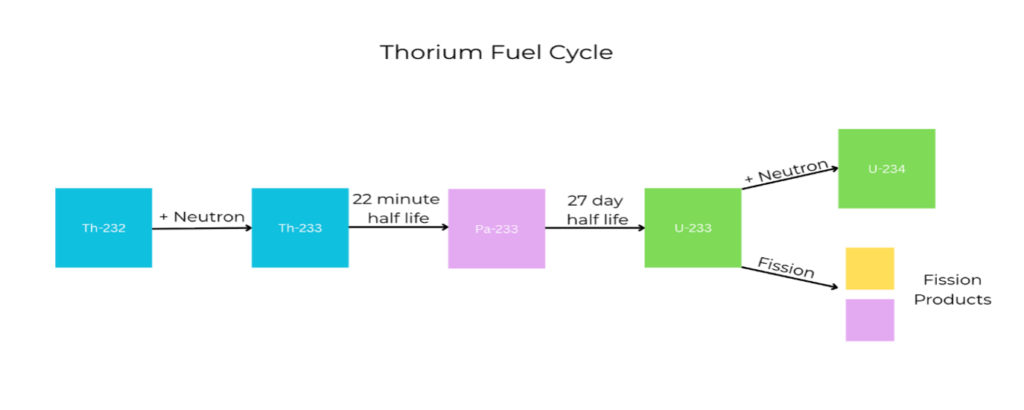 Source: Authors’ analysis
Thorium reactors utilize a more complex breeding process and do not require enrichment, making them relatively proliferation resistant. Additionally, a thorium reactor with molten salt as a coolant can operate at higher thermal capacity and has the potential for high fuel burn-up or utilization, resulting in reduced radioactive waste production, which necessitates extended periods of vigilant storage.
So why haven’t we built thorium reactors in the United States?
Why the United States Chose Uranium Instead
The United States pioneered the thorium molten-salt reactor design at Oak Ridge National Laboratory over 60 years ago. However, subsequent geopolitical priorities led the United States to build out uranium fuel infrastructure, which was seen as holding promise for both civilian and military applications. That framework dominated the nuclear industry for decades, but it is now being challenged by shifting geopolitical dynamics and rising electricity demand driven by artificial intelligence (AI).
At the same time, there is an increased demand for the rapid commercialization of small modular reactors, which require enriched uranium fuel. Over time, much of the global uranium enrichment infrastructure shifted to Russia. As a result, the United States now must deploy substantial capital to rebuild domestic uranium fuel infrastructure, which recent policies have aligned with.
With the US nuclear industry struggling to establish a domestic supply of uranium fuel to meet the demand of current and future reactors, building a thorium fuel system implies a substantial investment in a new infrastructure. Despite strong demand for advanced uranium reactors, US private investors remain hesitant due to past nuclear cycles, making investment in thorium reactors even less likely.
Other Countries Are Moving Thorium Technology Forward
Meanwhile, advanced thorium reactors are progressing abroad.
China’s TMSR-LF1 small molten salt reactor in the Gobi Desert reached full power in 2024, combining two technologies originally pioneered in the United States decades ago: molten salt-cooled reactors and the thorium fuel cycle. China also achieved another milestone soon after by refueling the reactors without shutting them down.
This April, India achieved a reactor breakthrough when its prototype fast breeder reactor reached criticality—an important step toward commercial viability. India’s reactor prototype uses a mixture of uranium and plutonium oxide but is designed to support India’s eventual transition toward a thorium fuel cycle, reducing dependence on imported uranium.India also has some of the world’s largest deposits of thorium.
In Canada, thorium-based fuel designs are being developed for use in CANDU heavy water reactors (HWRs). Typically,heavy water reactors, which use an isotope of hydrogen to form water molecules, are better suited to use thorium as an initial fuel.
In 2024, Copenhagen Atomics in Denmark started testing its mass-manufacturable small molten salt reactors based on the thorium fuel cycle.
South Africa has adopted the thorium molten salt reactor design for its Steenkampskraal rare earth mineral mining location, which also holds significant thorium reserves.
The United States Still Has Relevant Thorium Experience
The US nuclear fleet primarily uses light-water reactors, which are generally less compatible with thorium fuel cycles than the heavy-water reactors used in other countries. Even so, the United States demonstrated the feasibility of thorium-based power generation on a commercial scale decades ago.
The Shippingport Atomic Power Station, the first commercial nuclear power plant in the United States, operated several different reactor cores, including a thorium-based Light Water Breeder Reactor (LWBR) core. That core produced power from 1977 to 1982 and produced over 2.1 billion kilowatt-hours of electricity.
The United States has also considered thorium-based molten salt reactors because of their safety features, but has yet to commit to deploying them at scale. Idaho National Laboratory, in partnership with Clean Core Thorium Energy, announced progress on thorium-based fuel designs that promise higher fuel utilization than conventional fuels used in heavy water reactors such as Canada’s CANDU fleet.
Uranium Will Remain the Near-Term Priority
In principle, nuclear power generated from uranium is projected to achieve cost competitiveness with gas-powered electricity by 2030. Thorium is three to four times more abundant than uranium in Earth’s crust, as well as in the United States. However, the United States is estimated to have roughly a 200-year supply of uranium, even without accounting for potential breakthroughs in fuel recycling. As a result, thorium’s abundance alone may not justify increased attention.
Nuclear reactors are massive industrial structures designed to last for decades. Conceptually, this can create silos among nations pursuing reactor systems based on the uranium or thorium fuel cycle. For thorium-abundant nations, the choice is straightforward.
Today’s Nuclear Buildout Could Enable Thorium Tomorrow
The thorium fuel cycle is not a new innovation; however, there isn’t enough longitudinal data on economical fuel breeding or the physical attributes of high-temperature molten salt reactors. The United States is already building molten salt reactors. Kairos System is constructing Hermes II in Tennessee, which will use enriched Uranium-based TRISO fuel. Supported by deep-pocket hyper scalers, as well as substantial public-private partnerships, the advanced reactor industry is building a nuclear complex that involves material innovation and AI simulations to compensate for longitudinal data. The nuclear renaissance is also driving manufacturing innovations.
Companies such as Blue Energy are developing manufacturing capabilities independent of reactor designs. Once this ‘first of a kind’ nuclear complex is built, incorporating thorium technology and developing a regulatory framework will be easier and allow the United States to compete with nations with limited or no history of reactors, uranium, or thorium.
There are compelling arguments on both sides regarding whether the United States should pursue large-scale implementation of thorium reactors. For now, the United States’ priority is to deploy nuclear capacity quickly to meet domestic demand. At the same time, the United States must consider the role its energy systems will play for decades to come in shaping the global nuclear industry.
About the Author: Rashmi Singh
Rashmi Singh is the chief lending officer of a San Francisco-based commercial bank, with experience in financing tech firms and real estate nationwide. She holds an MIT certificate in Clean Energy Systems and a master’s in Energy Law and Environmental Policies from Texas A&M University.
The post Can US Nuclear Expansion Accommodate Thorium Reactors? appeared first on The National Interest.
Источник: nationalinterest.org