
«Данное сообщение (материал) создано и (или) распространено иностранным средством массовой информации, выполняющим функции иностранного агента, и (или) российским юридическим лицом, выполняющим функции иностранного агента»
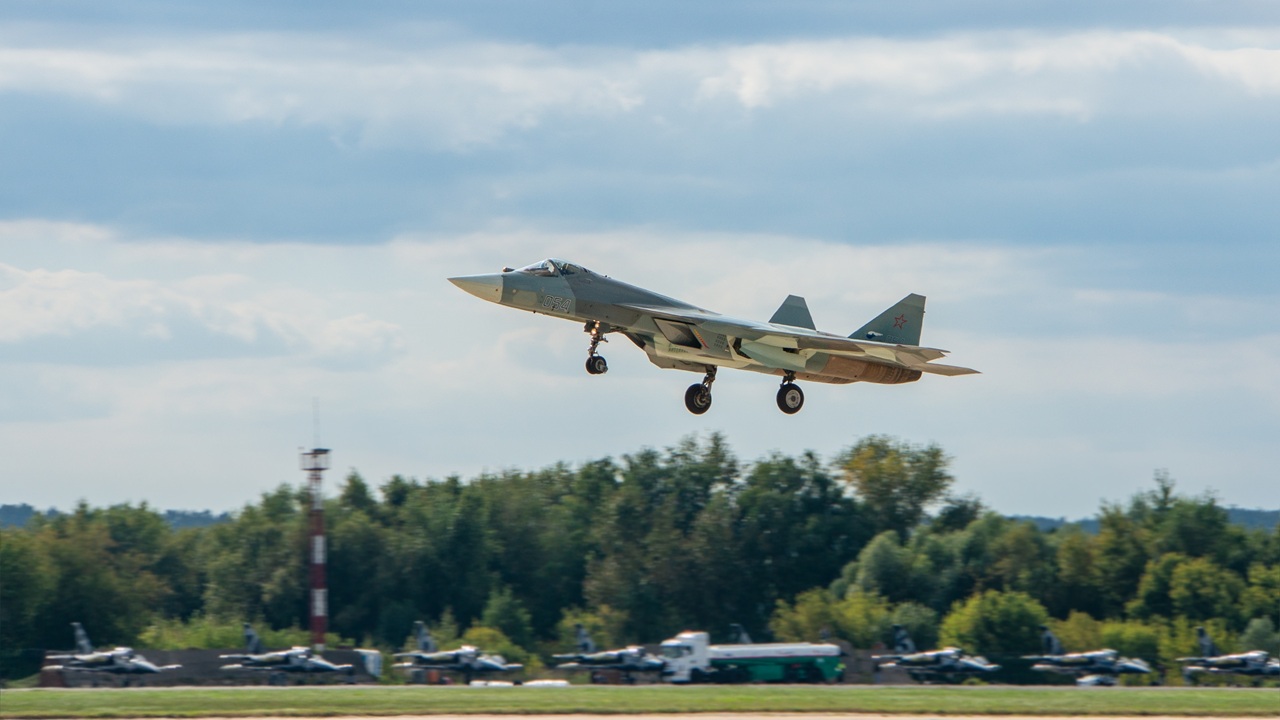
A close-up view of a Russian Su-57 Felon multirole fighter jet at the MAKS-2013 airshow in August 2013. (Shutterstock/Marinodenisenko)
Topic: Air Warfare Blog Brand: The Buzz Region: Eurasia Tags: China, Fighter Jets, Khabarovsk, Operation Spiderweb, Russia, Su-57 Felon, and Ukraine War Why Is Russia Amassing Su-57 Felon Fighters Near the Chinese Border? February 14, 2026 By: Peter Suciu
Share
Russia has apparently moved most of Su-57 fighter jets to a remote airbase in the Far East—as far as geographically possible from the ongoing fighting in Ukraine.
Reports online indicate that the Russian Aerospace Forces have massed most of its Sukhoi Su-57 (NATO reporting name “Felon”) fifth-generation fighter fleet at Dzyomgi Air Base in the Khabarovsk region of Russia’s Far East, approximately 280 kilometers (174 miles) from the border with Manchuria (Heilongjiang). Satellite imagery shared by OSINT air analyst AviVector on social media showed multiple Su-57s at the remote facility.
“The air base housed 15 Su-57 (Felon), 18 Su-35S (Flanker-E), 3 MiG-31BM (Foxhound), and 2 Mi-8 (Hip),” AviVector wrote in its February 9 post on X (formerly known as Twitter). “Satellite imagery captured a record number of Su-57 in the open air for the first time.”
The Kremlin is believed to operate between 20 and 25 of the fifth-generation fighters, indicating that upwards of three-quarters of the entire aircraft fleet is based at Dzyomgi Air Base.
What to Know About Russia’s Su-57 Fighter Jet
- Year Introduced: 2020 (limited operational service)
- Number Built: ~30–40 (est., including test aircraft; production ongoing)
- Length: 66 ft (20.1 m)
- Wingspan: 46 ft 5 in (14.1 m)
- Weight (MTOW): ~77,000 lb (35,000 kg)
- Engines: Two Saturn AL-41F1 turbofans (≈32,000 lbf / 142 kN each with afterburner); future Izdeliye 30 planned
- Top Speed: ~1,550 mph (2,500 km/h) ≈ Mach 2.0
- Range: ~2,200 mi (3,500 km) ferry; ~900 mi (1,500 km) combat radius (est.)
- Service Ceiling: ~65,000 ft (19,800 m)
- Loadout: Internal bays for AAMs and strike weapons; external pylons available for non-stealth missions
- Aircrew: 1
Is the Su-57 Deployment a Warning to China? Not Likely
Even as some on social media speculated that the Kremlin might be preparing to fend off an invasion from China or that it was part of a buildup to deter Beijing’s interest in the Russian Far East, such a deployment of the aircraft was unlikely. Nor was it likely part of a deterrence effort towards Japan, which borders Russia’s Far East and is regarded as an “unfriendly” country by the Kremlin due to its hostile stance on Russia’s war in Ukraine.
Less nefarious reasons probably explain the move. Key among these is that the Dzyomgi air base is located near the United Aircraft Corporation (UAC) Gagarin Aircraft Plant in Komsomolsk-on-Amur, which oversees the assembly of the Su-57. Although it isn’t likely that the aircraft are part of the latest batch of fighters built by UAC, they may be in the region to receive upgrades or undergo testing.
In December, Russia’s state-owned military-industrial conglomerate Rostec announced that its United Engine Corporation (UEC) subsidiary had developed the Izdelye 177 engine, which could replace the Su-57’s current Saturn AL-41F1 power plants.
The Su-57 Is Thousands of Miles Away from the Battlefield in Ukraine
Another possible explanation is that Russia is seeking to protect its prized Su-57s from Ukraine, moving them as far from the fighting as possible—and making it more difficult for Ukrainian drones and saboteurs to reach them.
As United24Media reported, “In June 2024, at least two Su-57 aircraft were damaged during a Ukrainian drone strike on the Akhtubinsk airbase in Russia’s Astrakhan region.” One of those aircraft may have been damaged beyond repair—a hefty loss for Russia, which has struggled to produce even a handful of new Su-57s per year.
Russia may also remember last June’s “Operation Spiderweb,” which saw Kyiv conduct a drone strike that damaged or destroyed around one-third of Russia’s strategic bomber fleet. (Cynical observers note that the placement of the bombers so far from the fighting is a tacit acknowledgement by the Kremlin that Kyiv can strike at many of its bases closer to Moscow.)
The air base in the Khabarovsk region is part of a vast air defense network that could help minimize such an attack.
Sending the aircraft to such a remote base is a reminder of the price Russia has paid in order to keep its prized Su-57 fleet safe. In order to preserve the aircraft, Moscow has kept them far away from combat. But the end result of this has been that it has failed to gain control of the skies over Ukraine—while also failing to attract foreign customers to the Su-57, who are unlikely to buy it unless they can see it tested in combat first.
About the Author: Peter Suciu
Peter Suciu has contributed over 3,200 published pieces to more than four dozen magazines and websites over a 30-year career in journalism. He regularly writes about military hardware, firearms history, cybersecurity, politics, and international affairs. Peter is also a contributing writer for Forbes and Clearance Jobs. He is based in Michigan. You can follow him on Twitter: @PeterSuciu. You can email the author: Editor@nationalinterest.org.
The post Why Is Russia Amassing Su-57 Felon Fighters Near the Chinese Border? appeared first on The National Interest.
Источник: nationalinterest.org