
«Данное сообщение (материал) создано и (или) распространено иностранным средством массовой информации, выполняющим функции иностранного агента, и (или) российским юридическим лицом, выполняющим функции иностранного агента»
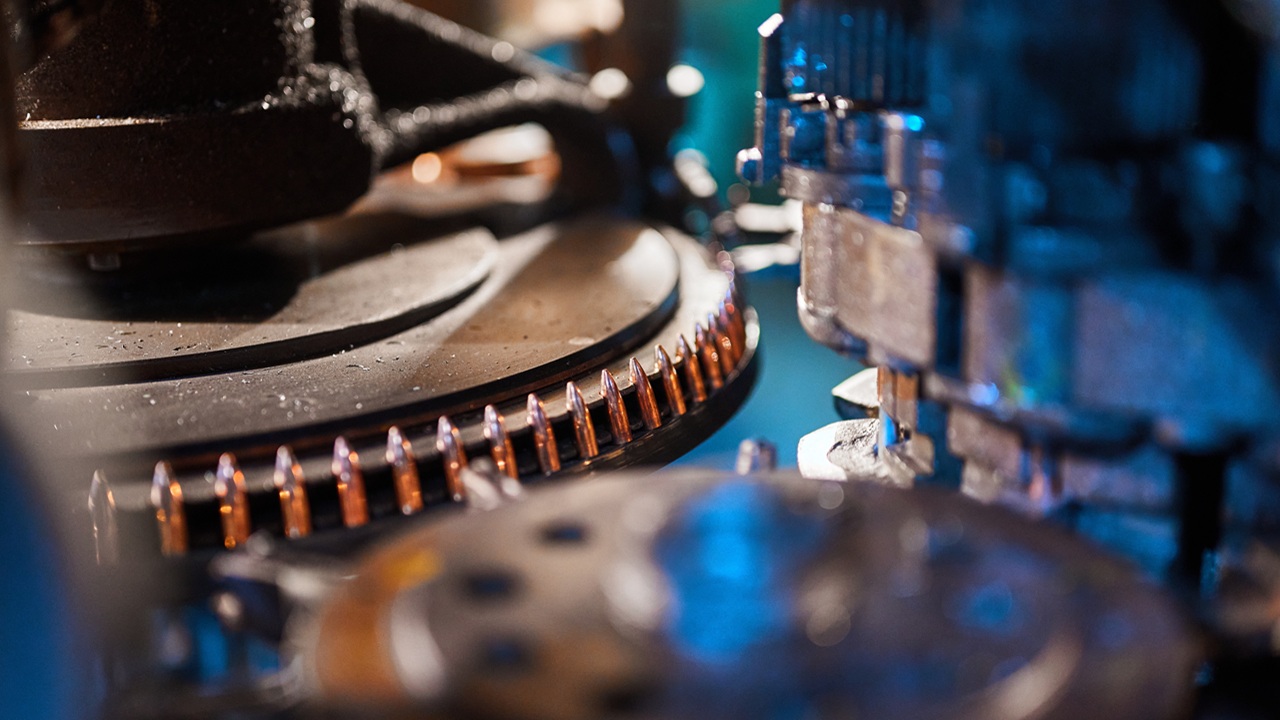
A “carousel” holder for bullet assembly in an ammunition plant. Chinese state-run military firm Norinco has partnered with the government of Kuwait to build an ammunition plant in Kuwait City. (Shutterstock/Nordroden)
Topic: Trade Blog Brand: The Buzz Region: Middle East Tags: Ammunition, China, Defense Industry, Kuwait, Norinco, and United States Why Is China Building an Ammunition Plant in Kuwait? February 20, 2026 By: Peter Suciu
Share
Though China has sought to make military inroads in the Gulf, the United States remains the region’s unrivaled security partner of choice.
Last August, China and Kuwait pledged to maintain closer military ties, with a then-under-construction ammunition facility in the small Gulf emirate at the center of it. This week, Kuwaiti Prime Minister Sheikh Ahmed Abdullah al-Ahmed al-Sabah attended the opening of Kuwait’s first domestic facility to produce small-arms ordnance for the Kuwaiti military. During an inauguration ceremony, Sheikh Ahmed pressed a button to “officially launch production” at the Naif Light Ammunition Factory, the Kuwait News Agency (KUNA) reported.
Also present were Chinese Consul to Kuwait Liu Xiang and Ji Wei, at that time the CEO of the China North Industries Corporation (Norinco), a Chinese state-run arms manufacturer. Ji said the goal of the joint partnership was “to produce high-quality ammunition, transfer managerial technical expertise, and train national cadres.”
China’s Foothold in the Middle East
As the 10th largest arms importer in the world from 2020 to 2024, Kuwait has heavily relied on imports of its military hardware. The United States has long been its prime supplier, accounting for 70 to 75 percent of its defense imports from 2010 to 2019.
The Naif Light Ammunition Factory is Kuwait’s first ammunition manufacturing facility, and its opening is part of the Gulf state’s efforts to bolster self-reliance and expand its domestic military industrial base. It also provides China with a foothold in the Middle East, even as the new factory will primarily produce NATO-standard ammunition, including 9mm, 5.56mm, 7.63mm, and .50 caliber (12.7mm) rounds.
China will provide expertise and aid in the training of local personnel.
Beyond the ammunition plant, Beijing maintains a long-standing strategic partnership with Kuwait, first established in 1971. It has focused heavily on energy and infrastructure; and in recent years, it has placed greater emphasis on defense.
China has invested $4.1 billion in programs in the Middle Eastern nation, including the ammunition plant and the expansion of port facilities. The latter aligns with both China’s Belt and Road Initiative and Kuwait’s Vision 2035.
China Has a Long Military History with the Middle East
The construction of the new ammunition facility also reminds us that although gunpowder was invented in China between the 9th and 11th centuries, it spread westward along the Silk Road, reaching the Middle East in the mid-13th century. Middle Eastern scholars, such as Hasan al-Rammah, refined the formula, enabling its transmission to Europe, where it revolutionized warfare by 1350.
Today, Kuwait is increasingly looking east to China, having closed deals to purchase multiple batches of the Chinese 155mm PLZ 45 howitzer. Kuwait City and Beijing are also likely to expand further their joint military training programs that began in 2019.
Even so, Kuwait will almost certainly seek to maintain its close military partnership with the United States. Kuwait has more reason to do so than any other nation in the Persian Gulf region; in 1991, the United States led a coalition to free it from Saddam Hussein’s Iraq, which had conquered and annexed it the previous year. Kuwait continues to host several US military bases and installations, including Camp Arifjan (Army Central forward headquarters), Ali Al Salem Base, and Camp Buehring.
Those facilities remain crucial for US operations in the Middle East, and there are currently around 13,500 US troops stationed in the country. China is unlikely to displace this presence anytime soon!
About the Author: Peter Suciu
Peter Suciu has contributed over 3,200 published pieces to more than four dozen magazines and websites over a 30-year career in journalism. He regularly writes about military hardware, firearms history, cybersecurity, politics, and international affairs. Peter is also a contributing writer for Forbes and Clearance Jobs. He is based in Michigan. You can follow him on Twitter: @PeterSuciu. You can email the author: Editor@nationalinterest.org.
The post Why Is China Building an Ammunition Plant in Kuwait? appeared first on The National Interest.
Источник: nationalinterest.org