
«Данное сообщение (материал) создано и (или) распространено иностранным средством массовой информации, выполняющим функции иностранного агента, и (или) российским юридическим лицом, выполняющим функции иностранного агента»
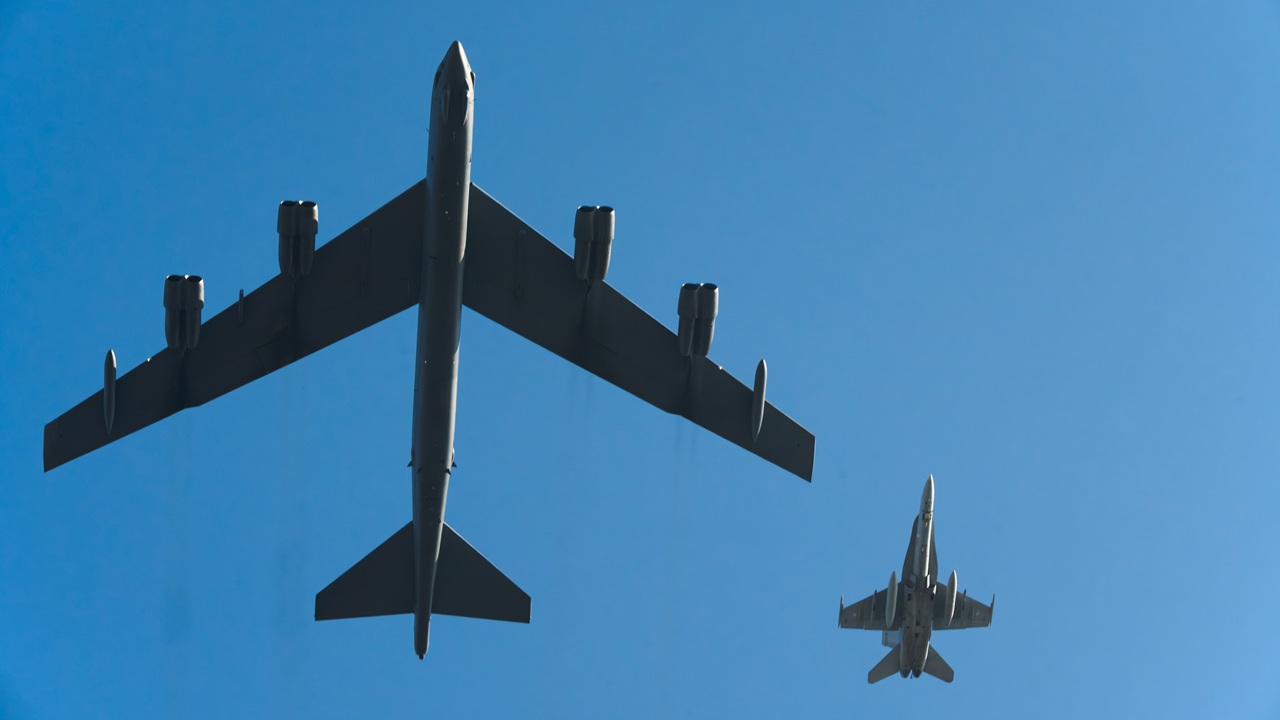
A B-52 Stratofortress and an F-16 fighter jet flying in formation against a clear blue sky. American B-52s recently participated in joint aerial exercises alongside Japan in the East China Sea. (Shutterstock/Dmitri T)
Topic: Air Warfare Blog Brand: The Buzz Region: Asia Tags: Air Defense Identification Zone, AWACS, China, East Asia, Japan, Russia, South Korea, and United States US Carried Out Bomber Drills with Japan in East China Sea February 24, 2026 By: Peter Suciu
Share
The United States and Japan have increased their exercises in response to joint Sino-Russian exercises in recent weeks.
Just days before five Russian aircraft were detected and tracked by the North American Aerospace Defense Command (NORAD) after entering the Alaskan Air Defense Identification Zone (ADIZ), the United States Air Force and Japan Self-Defense Force (JSDF) conducted two days of aerial drills in the western Pacific.
Four Boeing B-52 Stratofortress bombers conducted patrol flights over the Sea of Japan and the East China Sea last week, escorted by JSDF F-2, F-3, and F-15 fighters from the 8th, 7th, and 9th Wings, respectively.
“This bilateral exercise reaffirms the strong will between Japan and the US not to tolerate unilateral changes to the status quo by force. This also demonstrates the readiness of JSDF and US Armed Forces and further strengthens the deterrence and response capabilities of the Japan-US Alliance,” the JSDF announced, per USNI News.
The B-52 bombers had been deployed to Andersen Air Force Base (AFB), Guam, but it is unclear when or from where they arrived in the US territory in the Western Pacific. No Bomber Task Force (BTF) mission has been confirmed, but the US Department of Defense (DoD) has been keeping its cards close to the chest as it redirects military assets to the Middle East amid high tensions between Washington and Tehran.
US Air Force B-52s and Japanese fighters last conducted a joint patrol flight in December.
South Korea Declined to Participate in the Mission
Although US Forces Korea (USFK) also launched more than 100 F-16 Fighting Falcon sorties during the bomber patrol mission, no South Korean aircraft participated in the training drills.
According to The Chosun Daily, “The South Korean government rejected a US-proposed trilateral air exercise.” A reason wasn’t stated, but it was noted that Seoul fears “entanglement in US-China conflicts” as well as “Washington’s push to shift USFK’s role from ‘deterrence against North Korea’ to ‘countering China.’” Seoul is cautious of engagement with Japan for similar reasons, given the two countries’ long enmity and a recent diplomatic spat between Japanese Prime Minister Sanae Takaichi and Beijing.
Last year, South Korea also protested the USFK relocating its F-16s from Gunsan Air Base to Osan Air Base to form two supersized squadrons.
‘Routine’ Russian Patrol Near Alaska Last Week
The US-Japan joint exercises come amid a steady increase in patrol flights in the vicinity of China, with China increasing its joint training flights with Russia. In December, Russian bombers joined a Chinese air patrol near Japan. Two Russian Aerospace Forces Tupolev Tu-95 (NATO reporting name “Bear”) long-range strategic bombers rendezvoused with a pair of Chinese H-6 bombers over the East China Sea.
Last Thursday, two Russian Tu-95s, escorted by two Sukhoi Su-35 (NATO reporting name “Flanker-E/M”) air superiority fighters and a Beriev A-50 NATO reporting name “Mainstay”) Airborne early warning and control (AEW&C) aircraft, were also intercepted by NORAD fighters.
According to the command, two F-16 Fighting Falcons, two F-35 Lightning IIs, and an E-3 Sentry were launched to detect, track, and escort the Russian aircraft “until they departed the Alaskan ADIZ.” Four KC-135 aerial refuelers supported the NORAD aircraft.
“The Russian military aircraft remained in international airspace and did not enter American or Canadian sovereign airspace,” NORAD announced. “This Russian activity in the Alaskan ADIZ occurs regularly and is not seen as a threat.”
About the Author: Peter Suciu
Peter Suciu has contributed over 3,200 published pieces to more than four dozen magazines and websites over a 30-year career in journalism. He regularly writes about military hardware, firearms history, cybersecurity, politics, and international affairs. Peter is also a contributing writer for Forbes and Clearance Jobs. He is based in Michigan. You can follow him on Twitter: @PeterSuciu. You can email the author: Editor@nationalinterest.org.
The post US Carried Out Bomber Drills with Japan in East China Sea appeared first on The National Interest.
Источник: nationalinterest.org