
«Данное сообщение (материал) создано и (или) распространено иностранным средством массовой информации, выполняющим функции иностранного агента, и (или) российским юридическим лицом, выполняющим функции иностранного агента»
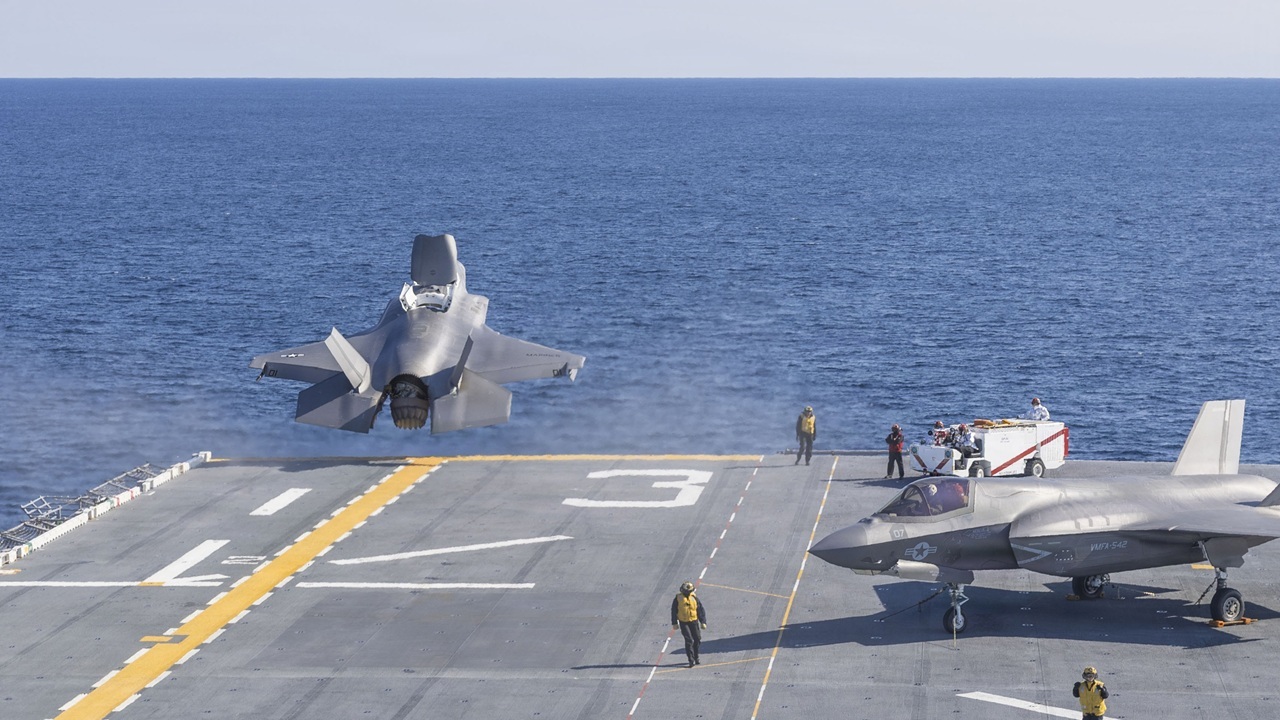
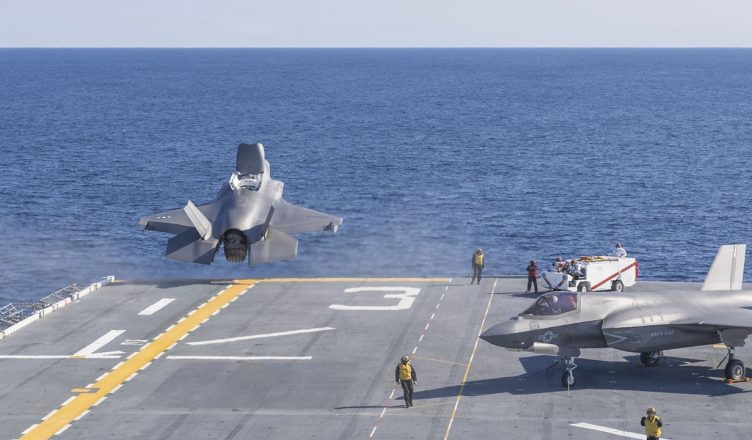
An F-35B Lightning II, assigned to the Marine Fighter Attack Squadron (VMFA) 542, takes off of the flight deck on the Wasp-class amphibious assault ship USS Kearsarge (LHD 3) on February 10, 2026. (US Navy/Mass Communication Spc. 2nd Class Oscar Pichardo)
Topic: Naval Warfare Blog Brand: The Buzz Region: Americas Tags: Aircraft Carriers, Amphibious Assault Ships, North America, United States, US Navy, USS Kearsarge, and Wasp-Class The US Navy Just Landed F-35Bs on an Amphibious Assault Ship February 18, 2026 By: Peter Suciu
Share
The Marine Corps’ recent exercises on the USS Kearsarge (LHD-3) marks the first time that the fifth-generation fighter jet has operated from that vessel.
The United States Navy’s amphibious assault ships aren’t “aircraft carriers” in the true sense, but they can operate short takeoff and vertical landing (STOVL) aircraft, notably the Lockheed Martin F-35B Lightning II. The America-class was even built to serve as so-called “Lightning Carriers” to support amphibious operations in a conflict in the Indo-Pacific.
The US Navy announced on February 10 that it had conducted a series of F-35B operations from its older Wasp-class amphibious assault ships. Early this month, an F-35B attached to Marine Fighter Attack Squadron 542 (VMFA-542) made the first landing on the USS Kearsarge (LHD-3), which is currently underway and conducting basic phase certifications in the Atlantic Ocean.
“Clear skies. Full hearts. Can’t lose!” US Fleet Forces announced on X (formerly known as Twitter).
Clear skies. Full hearts. Can’t lose! 🏆
USS Kearsarge (LHD 3) conducted F-35 flight operations in the Atlantic Ocean Feb. 10, 2026.
This marks the first time an F-35B Lightning II has landed on Kearsarge, enhancing the Navy-Marine Corps joint expeditionary capabilities. pic.twitter.com/XEOHFd3KPh
— U.S. Fleet Forces (@USFleetForces) February 13, 2026
“This marks the first time an F-35B Lightning II has landed on Kearsarge, enhancing the Navy-Marine Corps joint expeditionary capabilities,” the social media post continued.
The US Navy Has a Carrier Shortage. Could Lightning Carriers Be The Answer?
Even as this marks a first for LHD-3, other Wasp-class warships have operated with the F-35B. However, the timing of this certification comes as the United States Navy had announced that its newest nuclear-powered supercarrier, the USS Gerald R. Ford (CVN-78), was being deployed to the Middle East, further extending her deployment.
CVN-78 could spend more than 300 days at sea, surpassing a post-Cold War record.
The issue is that the US Navy has only so many carriers, a situation exacerbated by the upcoming retirement of USS Nimitz (CVN-68) and the delay in the handover of the future USS John F. Kennedy (CVN-79).
“Kearsarge‘s certification signals a broader operational shift within the Atlantic Fleet, where amphibious ready groups are increasingly expected to generate credible fixed-wing combat power alongside traditional Marine assault missions,” Army Recognition explained.
Employing the America-class and the older Wasp-class as “lightning carriers” could ensure the US Navy has a flattop ready to deploy to global hotspots. Yet some critics aren’t convinced by the idea of deploying conventionally powered warships instead of a true carrier.
One consideration is that the LHDs lack the “survivability” of a true supercarrier. Still, the warship’s role wouldn’t be to conduct carrier-based operations against surface combatants, but rather to support a range of maritime and amphibious multi-domain operations.
Currently, the forward-deployed USS Tripoli (LHA-7), the second America-class amphibious assault ship, is the only active flat top operating at sea in the Western Pacific. The warship arrived at its base in Sasebo, Japan, last June.
About the Wasp-Class Amphibious Assault Ship
- Year Introduced: 1989
- Number Built: 8 (7 in active service)
- Length: 843 ft (257 m)
- Beam (Width): 104 ft (31.8 m)
- Displacement: 41,150 tons
- Propulsion: Two boilers (70,000 shp); two geared steam turbines, two shafts
- Top Speed: 22 knots (25 mph, 41 km/h)
- Range: 9,500 nmi (10,900 mi, 17,600 km)
- Armaments:
- Two RIM-116 Rolling Airframe Missile launchers
- Two RIM-7 Sea Sparrow missile launchers
- Three 20mm Phalanx CIWS
- Four 25mm Mk 38 marine guns
- Four .50 BMG machine guns
- Air wing; varies based on mission, but typically includes fixed-wing aircraft, tiltrotor (V-22 Osprey), and attack helicopters
- Crew: 1,070 (66 officers, 1,004 enlisted)
The USS Kearsarge (LHD-3) is the fourth US Navy warship named for New Hampshire’s Mount Kearsarge, which evolved from the native Pannacook tribal name for the mountain “Carasarga,” surmised to mean “notch-pointed-mountain of pines.” The first was a sloop of war that participated in combat operations during the American Civil War but was wrecked off Central America in February 1894.
The second was BB-5, the Kearsarge-class battleship, the only such capital ship not named for a US state. Launched in March 1898, the warship was part of the US Navy’s famed “Great White Fleet.” However, BB-5 is also among the worst warship designs in US naval history. USS Kearsarge (BB-5) and her sister ship, USS Kentucky (BB-6), were each designed for coastal defense and had low freeboard and heavy armor. Completed just after the Spanish-American War in 1900, the two vessels were intended to represent a significant improvement over the Navy’s previous classes of battleships, notably the Indiana-class and the original Iowa-class.
BB-5 ended her career as a heavy crane ship, a role she served in as Crane Ship No. 1 (AB-1) from 1920 to 1955.
It is a bit more confusing that two different Essex-class carriers were laid down as Kearsarge. However, the short-hulled CV-12 was renamed USS Hornet to honor the Yorktown-class carrier CV-8 sunk in the Battle of Santa Cruz in October 1942. A hull-hulled Essex-class carrier, CV-33, was named USS Kearsarge. Launched in May 1945, she served in the Korean War and Vietnam War before being scrapped in 1974.
The current USS Kearsarge was commissioned in 1993 and, despite more than three decades in service, this month she took on a new capability with the F-35B.
About the Author: Peter Suciu
Peter Suciu has contributed over 3,200 published pieces to more than four dozen magazines and websites over a 30-year career in journalism. He regularly writes about military hardware, firearms history, cybersecurity, politics, and international affairs. Peter is also a contributing writer for Forbes and Clearance Jobs. He is based in Michigan. You can follow him on Twitter: @PeterSuciu. You can email the author: Editor@nationalinterest.org.
The post The US Navy Just Landed F-35Bs on an Amphibious Assault Ship appeared first on The National Interest.
Источник: nationalinterest.org