
«Данное сообщение (материал) создано и (или) распространено иностранным средством массовой информации, выполняющим функции иностранного агента, и (или) российским юридическим лицом, выполняющим функции иностранного агента»
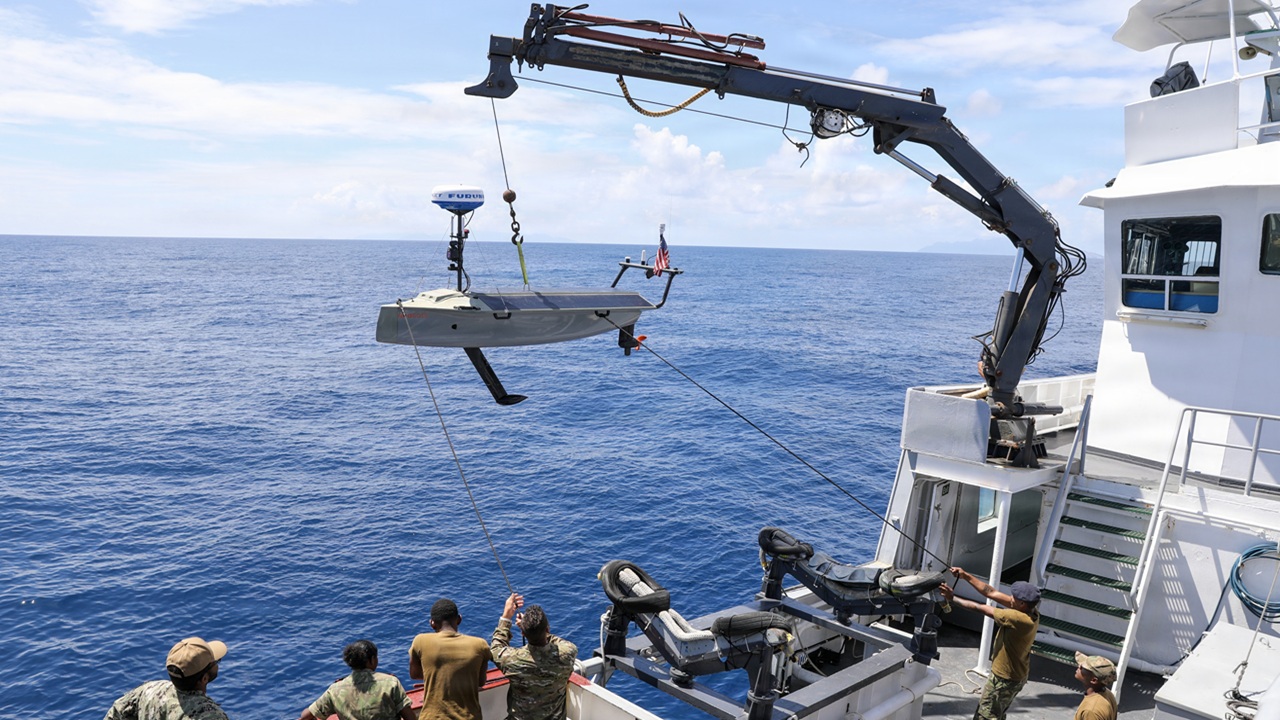
A Lightfish unmanned surface vessel (USV) is hoisted by the crane aboard Seychelles Coast Guard vessel Saya De Malha during Cutlass Express 2026 on February 10, 2026. (US Navy/Mass Communication Specialist 1st Class Stephanie Butler)
Topic: Naval Warfare Blog Brand: The Buzz Region: Americas Tags: Drones, North America, Seychelles, United States, Unmanned Surface Vehicles, and US Navy The US Navy Is Testing a New “Lightfish” Drone February 18, 2026 By: Peter Suciu
Share
Unlike most naval drones, the Lightfish is solar-powered, potentially giving it extended range and greater flexibility in its operations.
A US Navy task force developing cutting-edge drones launched one of its most promising projects for the first time from a partner nation’s vessel.
During Exercise Cutlass Express 26, Commander Task Force 66 launched the Lightfish, an unmanned surface vessel (USV), from a Seychelles Coast Guard ship off the coast of Seychelles in the Indian Ocean earlier in February.
About the US Navy’s Lightfish USV Drone
The launching of the Lightfish unmanned surface vehicle was part of a joint drone training event with the Seychelles Navy. The goal of the event was to test the maritime drone’s capabilities in the open ocean with limited connection.
The Lightfish unmanned surface vessel is a multirole unmanned surface vessel that can conduct intelligence, surveillance, and reconnaissance (ISR) and electronic warfare missions. The drone uses square solar panels to convert energy into electricity to power its systems. This power system allows the Lightfish to transit large bodies of water without any support, acting as the eyes and ears of the fleet.
Commander Task Force 66 is a fully drone task force that designs and tests new advanced technologies, including unmanned systems, artificial intelligence, and machine learning, to improve the combat capabilities of the Navy’s 6th Fleet.
Headquartered in Naples in southern Italy, the 6th Fleet is the Navy’s main combat force responsible for joint and naval operations in Europe and Africa. It is one of the most important commands in the entire Navy due to its proximity to key seaways, including the Suez Canal, Eastern Mediterranean Sea, Red Sea, Arabian Sea, and Indian Ocean.
“We are making history at Cutlass Express 2026 by demonstrating our enhanced warfighting skills through our robotic and unmanned capabilities alongside our maritime partners,” Navy Lieutenant Bryna Loranger, the operations officer of Commander Task Force 66, said in a service press release.
“6th Fleet is seeking new ways to build partner maritime domain awareness capabilities during this exercise by promoting interoperability. Through sharing and experimenting with Seychelles Coast Guard assets and infrastructure, we are enhancing our expeditionary robotic autonomous systems capabilities in the U.S. Africa Command area of responsibility,” Lonager added.
In the ongoing geopolitical competition with China, the US Navy has a central role, closely followed by the Air Force and the Marine Corps. To be sure, the Army will still have an important role but a potential military clash with China would mostly take place at sea and in the air.
The Navy Is Harnessing New Technologies to Stay Ahead of China
“Through exercises like Cutlass Express 2026, we are adapting alongside our partners by integrating unmanned tactics directly into operations,” Navy Rear Admiral Kelly Ward, the commanding officer of Combined Task Force 66, stated.
“We are leaning into this domain hand-in-hand with our partners, translating innovation into warfighting readiness and enhancing maritime security to protect freedom of navigation,” the senior Navy officer added.
This is an important point that Ward made. Technology advances at a rapid pace. And although not every technological development translates into more effective combat capabilities, new technologies are changing the way wars are fought. Unmanned systems, specifically, now play an important role on the battlefield, assuming an increasingly bigger role in kinetic, intelligence, surveillance, and reconnaissance (ISR), and support missions.
US adversaries, including China, are also spending big on drone technologies—forcing the United States to stay flexible in order to remain competitive.
About the Author: Stavros Atlamazoglou
Stavros Atlamazoglou is a seasoned defense journalist specializing in special operations and a Hellenic Army veteran (national service with the 575th Marine Battalion and Army HQ). He holds a BA from the Johns Hopkins University and an MA from the Johns Hopkins’ School of Advanced International Studies (SAIS). His work has been featured in Business Insider, Sandboxx, and SOFREP.
The post The US Navy Is Testing a New “Lightfish” Drone appeared first on The National Interest.
Источник: nationalinterest.org