
«Данное сообщение (материал) создано и (или) распространено иностранным средством массовой информации, выполняющим функции иностранного агента, и (или) российским юридическим лицом, выполняющим функции иностранного агента»
 Topic: Naval Warfare Blog Brand: The Buzz Region: Americas, and Eurasia Tags: Admiral Nakhimov, Battleships, Defiant, Donald Trump, Russian Navy, and US Navy The Trump-Class “Battleship” vs. Russia’s Admiral Nakhimov: Who Wins? February 5, 2026 By: Brandon J. Weichert
Share
Though the hypothetical Trump-class vessel would have advantages in some areas, it has no good answer to the Admiral Nakhimov’s advanced hypersonic weapons suite.
President Donald Trump recently surprised the world—including his own naval chiefs—when he recently announced he was authorizing the construction of what he described as America’s first battleship in decades. Dubbed the Trump-class battleship, the first vessel would be named USS Defiant.
What Exactly Is the USS Defiant?
According to its specifications, this proposed ship would be massive. It would displace anywhere between 30,000 and 40,000 tons—and would effectively be an American “arsenal ship,” featuring 128 vertical launch system (VLS) cells, hypersonic weapons, and even directed energy weapons (DEWs).
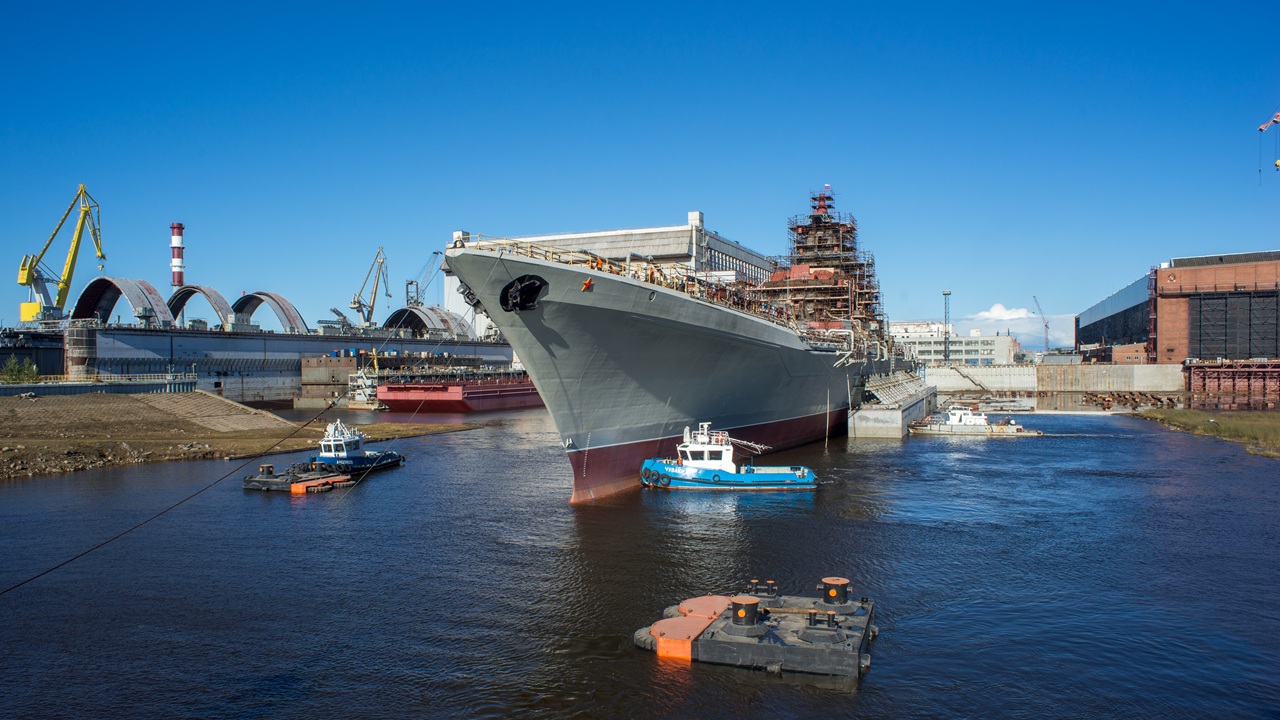
Many experts pointed out that, despite its large size, the proposed Trump-class would not be officially considered a battleship. It’d be more akin to a battlecruiser. This is a very real class of warship that the Russian Navy has operated for years in the form of the Admiral Nakhimov, Russia’s current Kirov-class battlecruiser—which, unlike its decrepit Admiral Kuznetsov aircraft carrier, remains operational.
While technically displacing fewer tons (just 28,000) when compared to the proposed Trump-class battlecruiser, the Admiral Nakhimov has many similar functions.
Russia Has Already Built a Battlecruiser
Of course, unlike the American proposal, the Admiral Nakhimov actually exists today. What’s more, its hypersonic weapons and advanced air defense systems are fully operational and proven to work. The Americans, meanwhile, have yet to build their Trump-class vessel—and are even further from creating working, scalable hypersonic weapons or DEWs. But the Americans are replicating the Russians in their concept for this new warship.
With that in mind, it might be fun to consider what a match-up between the Trump-class USS Defiant and the Kirov-class Admiral Nakhimov would actually look like.
In contrast to actual “battleships”—designed to get up close and personal and dish out pain on enemy vessels and emplacements with massive 16-inch guns, while counting on thick armor to protect them from retaliation—these two ships prioritize saturation attacks from over the horizon. What’s more, at least on paper, they are designed to withstand quite a wallop—especially the Admiral Nakhimov, which employs advanced S-400 air defense systems.
So, to understand how a hypothetical battle at sea between these two monstrosities might play out, one must understand the design philosophies undergirding these similar Russian and American systems.
The USS Defiant vs. the Admiral Nakhimov
| Warship | USS Defiant (USA)** projected specifications only | Admiral Nakhimov (Russia) |
| Year Introduced | Not yet introduced | 1988 |
| Number Built | 0 (unknown number planned) | 3 (1 remaining in service) |
| Length | 260–270 m (840–880 ft) | 251.1 m (823 ft 10 in) |
| Beam (Width) | 32–35 m (105–115 ft) | 28.5 m (93 ft 6 in) |
| Displacement | 35,000+ t | ~28,000 t fully loaded |
| Propulsion | Unknown | Two nuclear reactors, two boilers, two steam turbines + shafts |
| Top Speed | Unknown | ~32 knots (37 mph, 59 km/h) CONAS propulsion |
| Range | Unknown | Unlimited |
| Armaments | Nuclear cruise missiles (unconfirmed); 12-cell Conventional Prompt Strike; 128 Mk 41 VLS cells; 2 RIM-116 Rolling Airframe Missile missile-based CIWS launchers; one railgun (unconfirmed); two Mk 45 62-caliber guns; four 30mm guns; directed energy weapons (unconfirmed); can carry V-22 Osprey and Future Vertical Lift helicopters | 80 anti-ship missile launchers; 96 S-400 SAM launchers; two 4K33 Osa-M SAM launchers; 6 Pantsir-M CIWS; one 130mm dual-purpose gun; 10 533mm torpedo tubes; one RBU-6000 anti-submarine rocket launcher; two RBU-1000 anti-submarine rocket launchers; can carry three Kamov Ka-27 helicopters |
| Crew | 500+ | 710 |
Two Similar Beasts, Two Different Design Philosophies
There are literally hundreds of vertical launch system cells on both warships. As noted above, the Admiral Nakhimov has the S-400, but the Trump-class is supposedly being designed to integrate an AEGIS-derived, next-generation integrated air and missile defense system. These two warships emphasize a layered defense and long-range strike capability, too.
For the Trump-class, one can anticipate the use of SM-6/SM-3 class interceptors for defense paired with the use of LRASM-type maritime strike missiles. The Pentagon says that the Trump-class will eventually be armed with the US hypersonic cruise missile currently under development.
Assuming this theoretical battle occurs sooner rather than later, the Americans sadly must acknowledge that the Russians have outclassed them in the development, production, and deployment of reliable hypersonic weapons.
The strengths of the Trump-class would be its superior sensor fusion and battle-network integration. Most experts assess that the ship would possess a more resilient missile defense architecture. But if the warship is faced with a hypersonic weapons attack from the Admiral Nakhimov, it is likely that no amount of air defenses would protect the Trump-class battlecruiser.
Another strike against the Trump class is its massive size. According to existing projections, the Defiant will displace more than 35,000 tons. That means it will be easy to detect on radar and to track. It’s an expensive boat as well. American leaders would be reluctant to take too many risks with this warship because of its cost and how much damage its loss would do to US Navy surface warfare capabilities. And the warship, like all surface warships today, is woefully vulnerable to saturation attacks.
The Two Warships’ Opening Salvo Might Decide the Battle
On the other hand, the Admiral Nakhimov’s design philosophy maximizes offensive missile firepower. Then there’s the heavy armor that blankets his behemoth. Further, its nuclear propulsion gives it a long endurance over many of its rivals.
The arsenal is the most important aspect of this Russian leviathan. There are P-800 Oniks/Zircon hypersonic missiles onboard along with Kalibr cruise missiles, and the aforementioned S-300F/S-400 navalized air defense systems. This warship is known to carry a large missile payload and has rugged construction. On the other hand, the ship possesses an older sensor architecture, it has less capable networking than US systems do, and its limited numbers means that it is hard to maintain.
In any engagement, the side that achieves first high-confidence targeting gains the decisive advantage. The Americans leverage their satellites, MQ-25-type UAVs, and submarines undoubtedly shadowing the Russian behemoth. Meanwhile, the Russians employ over-the-horizon radar, space-based ocean surveillance, and maritime patrol craft to track and identify the American Trump-class battlecruiser.
During this engagement, neither warship would even get close to visual range. The Trump-class would launch LRASMs at the Russian warship. On the other side, the Admiral Nakhimov would retaliate with Kalibr cruise missiles and likely Zircon hypersonic missiles. At that point, the battle becomes an over-the-horizon missile saturation contest rather than a duel on the high seas.
Both ships would also unleash their respective layered defenses. Long-range interceptors, medium-range surface-to-air missiles (SAMs), point-defense guns and missiles, as well as EW warfare and decoys would smother the battlefield. The main variable would be the quality of fire control for either side and the reliability of the interceptors on both warships.
The Admiral Nakhimov’s Hypersonic Weapons Give It the Edge
But the real decider is the presence of Russian hypersonic weapons. Sure, the Americans will likely enjoy greater intelligence, surveillance, and reconnaissance (ISR) if the Russians cannot degrade those ISR capabilities electronically, but the Trump-class has no known defenses onboard against the Zircon hypersonic missiles. And it is unlikely that the Russians would fire only one of those radically moving, hypersonic weapons at the Trump-class.
So, in this one-on-one fight to the finish, those hypersonic weapons and the lack of a similar American system—or even defenses against those hypersonic weapons—would spell the end of the Trump-class battlecruiser in a relatively short order, if the Admiral Nakhimov and Defiant ever engaged in a battle.
It doesn’t matter about the sensor superiority of the Trump class. What matters is how much pain the Admiral Nakhimov can endure—and dish out. With those S-400 air defenses coupled with the Zircon hypersonic weapons, it can do quite a bit of both—for long enough to ensure that the Trump-class battlecruiser loses an engagement with the Russians.
About the Author: Brandon J. Weichert
Brandon J. Weichert is a senior national security editor at The National Interest. Weichert is the host of The National Security Hour on iHeartRadio, where he discusses national security policy every Wednesday at 8pm Eastern. He hosts a companion show on Rumble entitled “National Security Talk.” Weichert consults regularly with various government institutions and private organizations on geopolitical issues. His writings have appeared in numerous publications, among them Popular Mechanics, National Review, MSN, and The American Spectator. And his books include Winning Space: How America Remains a Superpower, Biohacked: China’s Race to Control Life, and The Shadow War: Iran’s Quest for Supremacy. Weichert’s newest book, A Disaster of Our Own Making: How the West Lost Ukraine, is available for purchase wherever books are sold. He can be followed via Twitter/X @WeTheBrandon.
Image: Shutterstock / Kuleshov Oleg.
The post The Trump-Class “Battleship” vs. Russia’s Admiral Nakhimov: Who Wins? appeared first on The National Interest.
Источник: nationalinterest.org