
«Данное сообщение (материал) создано и (или) распространено иностранным средством массовой информации, выполняющим функции иностранного агента, и (или) российским юридическим лицом, выполняющим функции иностранного агента»
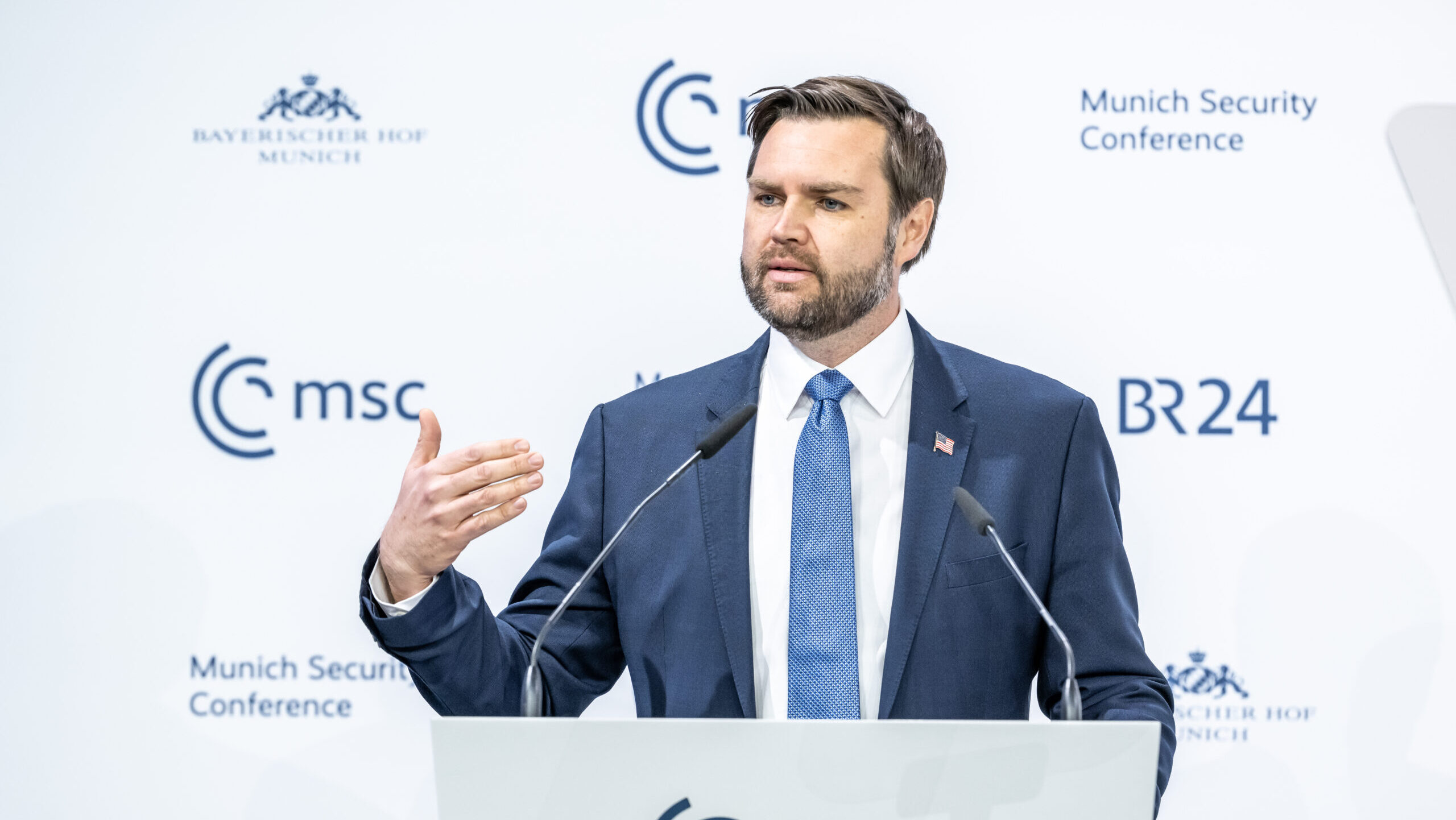
Vice President JD Vance speaks during his speech at Munich Security Conference 2025. (Wikimedia commons/MSC/Preis)
Topic: Artificial Intelligence (AI), and Trade Blog Brand: Techland Region: Americas, and Europe Tags: Elon Musk, European Union (EU), France, Google, JD Vance, Meta, North America, and United States The State of Europe’s Tech Policy One Year After JD Vance’s Reckoning in Munich February 13, 2026 By: James Czerniawski
Share
Europe has doubled down on digital sovereignty and AI regulation, targeting American tech companies and straining transatlantic relations.
Almost a year ago, Vice President JD Vance took the stage at the Munich Security Conference and the Paris AI Summit, and he didn’t hold back when talking to our European allies. He lambasted them, arguing that the “threat from within” Europe was more dangerous than Russia or China, as he, just like many of us, noticed the bloc’s retreat from the fundamental values it shared with the United States, such as freedom of speech, dynamic growth in markets, and individual liberty over the command of bureaucrats in government.
Fast forward to today, and the picture has not improved. In fact, the European Union (EU) and its bureaucratic lackeys have doubled down on the very policies that sparked the rebuke from Vance in the first place, choosing to sacrifice economic dynamism that would yield to stronger trans-Atlantic ties to instead promote what they are now marketing as “digital sovereignty” and “social protection.” The result of this effort is entirely predictable: Both European and American citizens will be left worse off, creating a lane for our shared adversaries to gain ground.
Escalating Scrutiny of US Tech Platforms
Consider the continued escalations against US social media platforms.
Just last week, French authorities conducted a raid on X’s Paris offices as part of an expanding investigation into Grok and the company’s algorithms, daring to summon Elon Musk himself for “questioning.” While French prosecutors and their government response team ironically use the platform to gaslight millions of users, claiming it is simply about ensuring compliance with French laws, the reality is that it is a politically motivated action against one of the most polarizing figures in the world.
This isn’t an isolated incident. A quick high-speed rail train ride over to the United Kingdom paints an equally troubling image, with Britain’s Information Commissioner’s Office and Office of Communications (OFCOM) both separately investigating X and its AI unit.
The relentless assault on X serves as a stark reminder to investors and innovators that the European continent is, at best, an unfriendly legal climate and, at worst, a place where American firms are liable to be singled out just because they are American and successful.
The AI Act and Compliance Costs
At the Paris AI Summit, Vance rightly criticized the European continent’s regulatory approach to artificial intelligence, warning that massive precautionary regulations like the EU AI Act would “kill a transformative industry just as it’s taking off.” Rather than heed the Vice President’s warning, the EU has remained locked on the path he warned against. The bloc insists on a one-size-fits-all AI framework built around the precautionary principle and on empowering bureaucrats to be software engineers; they have no place or expertise in doing so.
Both Meta and Google have come under scrutiny for how they are working with AI, reinforcing a narrative that robust innovation is secondary to appeasing regulators cosplaying as product designers. These moves play a role in calcifying extraordinary compliance costs, leading to slower deployment and diminished global competitiveness as smaller firms will be crowded out.
At the very moment that the United States is actively focused on promoting growth and innovation to drive down costs to consumers, Brussels is erecting a regulatory fortress, eating away at the very cost savings and risks, pushing investment away not just from European firms, but American firms as well, while opening a lane for shared adversaries like China to take on an increased role.
France’s Turn Toward Digital Protectionism
Paris is now the poster child for a trend that embraces digital sovereignty at the expense of global integration. Recently, France announced that by 2027, its 2.5 million civil servants will no longer use Microsoft Teams, Zoom, or Webex, but instead prop up a French alternative called Visio.
The French government is hiding behind President Emmanuel Macron’s aviator sunglasses, insisting that the move is about protecting sensitive communications and about decoupling from US tech. However, the reality is impossible to ignore: the French government is implementing industrial policy masquerading as a national security policy. It’s a protectionist gambit that will raise costs on French taxpayers, remove choice for French civil servants altogether, and put a dent in the productivity gains that American platforms consistently deliver.
The moves by France are about erecting a barrier to competition that comes at the expense of both consumers and innovators on both sides of the Atlantic.
A Defining Moment for the Transatlantic Tech Relationship
By doubling down on these erroneous moves, Europe is forgoing a new technological renaissance, opting instead for a future that harms consumers, undermines innovation, and places further strain on the relationship between the EU and the United States.
If Europe hopes to remain a global leader both economically and philosophically, it must revisit the policies that led to such pushback from Vice President Vance. Regulators and the regulations they enforce play a role in society. However, when oversight becomes arbitrary targeting or de facto protectionism, it betrays the fundamental principles supposedly shared by the United States and Europe.
This year at the Munich Security Conference, Under Secretary of State Sarah Rodgers will speak. Her remarks present a critical opportunity to reiterate the points made just a year ago. The United States must make clear that allies are not pawns in protectionist campaigns. Real leadership embraces robust competition and a regulatory regime that promotes prosperity. Paris and Brussels can and must choose a different path, one that allows them to regain their commitments to the fundamental values they share with the United States.
About the Author: James Czerniawski
James Czerniawski is the head of Emerging Technology Policy at the Consumer Choice Center. His work has been featured in the New York Post, Newsmax, Newsweek, and more. Follow him on Twitter @JamesCz19.
The post The State of Europe’s Tech Policy One Year After JD Vance’s Reckoning in Munich appeared first on The National Interest.
Источник: nationalinterest.org