
«Данное сообщение (материал) создано и (или) распространено иностранным средством массовой информации, выполняющим функции иностранного агента, и (или) российским юридическим лицом, выполняющим функции иностранного агента»
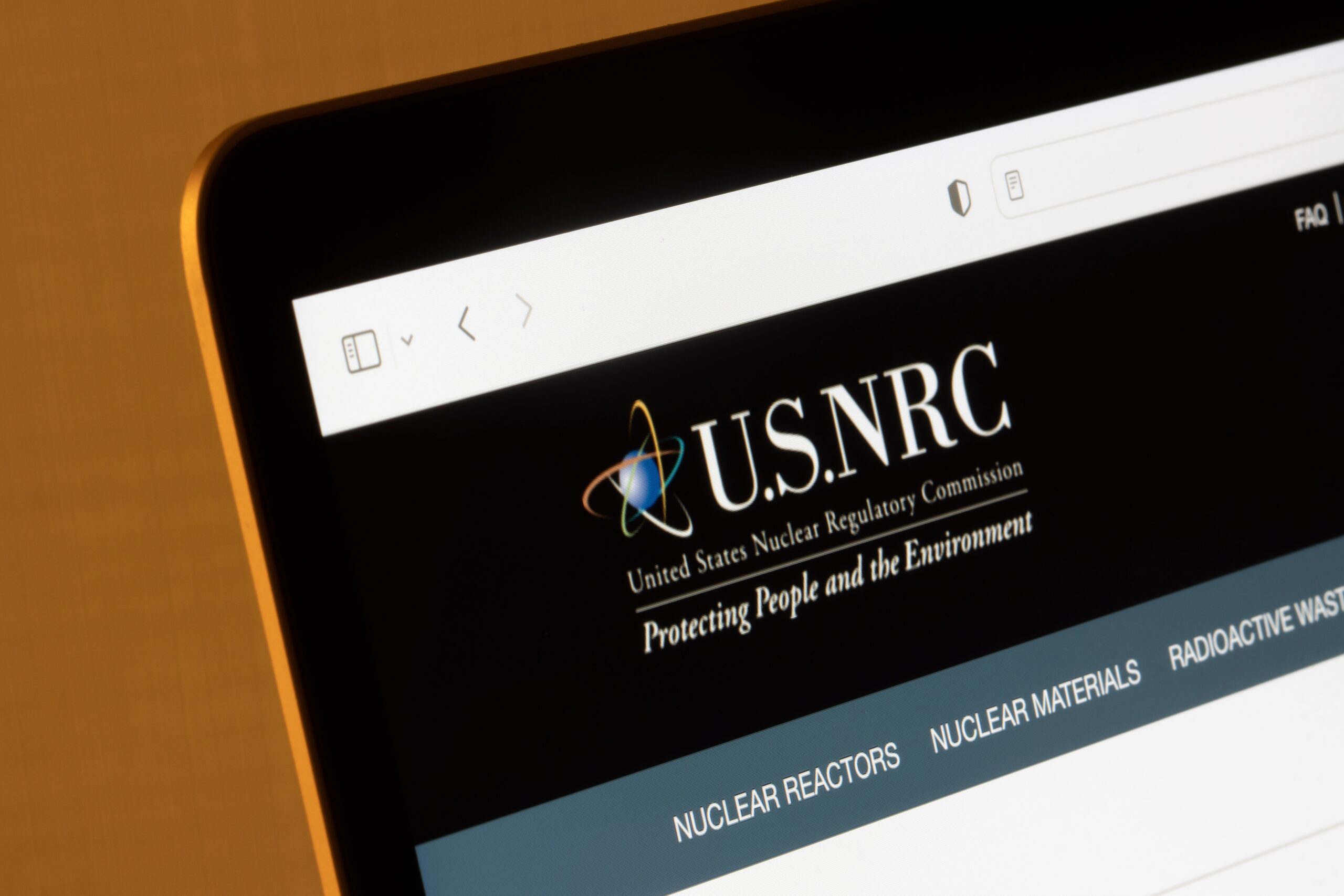
Website homepage of the United States Nuclear Regulatory Commission on a computer. (Tada Images/Shutterstock)
Topic: Nuclear Energy Blog Brand: Energy World Region: Americas Tags: Nuclear Reactors, Nuclear Regulatory Commission (NRC), and United States Streamlining Nuclear Licensing: Faster Approvals Without Sacrificing Safety February 11, 2026 By: William D. Budinger, Ray Rothrock, and Paul Bauman
Share
Excessive regulation has driven nuclear costs and delays without improving safety. Reforming the NRC is essential to ensure America can build the power it needs.
America faces an unprecedented electricity challenge. Data centers, artificial intelligence (AI), electrified transportation, and re-industrialization are driving explosive demand for reliable, 24/7 power. The inability to meet that demand is driving up electricity prices. Yet the one technology that can provide massive amounts of carbon-free baseload electricity—nuclear power—has been bottlenecked by a regulatory process that takes decades and costs billions before a single kilowatt can be produced. The Nuclear Regulatory Commission (NRC) is the agency charged with licensing and permitting all aspects of a nuclear reactor. Since its creation in 1974, the NRC has dramatically changed the economics and availability of nuclear power.
From the 1950s until 1974, the Atomic Energy Commission (AEC) was the licensing authority for nuclear power. Under that authority, 54 reactors were built and were in operation by 1974. And by the end of 1974, 70 more reactors were under construction or licensed. The cost for these reactors was under $3,000 per kilowatt (kW) in 2025 dollars with a median build-time of about six years! Most importantly, those reactors have the world’s best record of public and worker safety. No member of the American public—and no US nuclear worker—has been harmed by radiation exposure from a commercial reactor. And even 40 years after the Three Mile Island accident, and despite early doomsday predictions, there has been no measurable increase in cancer in workers or the surrounding public. This observation has been confirmed by multiple peer-reviewed epidemiological studies.
In 1974, Congress created the NRC amid calls for greater oversight. The change did not measurably improve an already world-leading safety record, but it did trigger a dramatic escalation in regulatory complexity. Documentation requirements exploded, reviews overlapped, and criteria shifted mid-construction, forcing repeated redesigns and rework.
The consequences have been stark: The new NRC regulations introduced in the 1970s and early 1980s tripled costs and construction times, resulting in the cancellation of most of those projects—including some that were well underway. In the following 50 years, the NRC has licensed exactly two reactors from start to finish—Vogtle Units 3 and 4—projects that required more than 14 years and suffered billions in avoidable cost growth, driven in part by regulatory changes and uncertainty. Meanwhile, the original fleet, which was licensed and built under the more streamlined AEC system, continues to operate safely, with many plants now approved for 80-year service. So today we have 92 reactors licensed expeditiously under AEC rules and just 2 reactors licensed under NRC rules.
Nonetheless, anti-nuclear forces are pushing to prevent modernization of the NRC by claiming that long and expensive licensing is necessary and that any change would sacrifice safety. Experience teaches the opposite.
International Evidence: Efficiency and Safety Can Coexist
In addition to the stellar safety record of the pre-NRC licensed reactors, other advanced nations prove that streamlined regulation and high safety standards are entirely compatible.
- France built 55 of its 57 reactors in 15 years using standardized designs and consistent, outcome-oriented safety procedures. Its safety performance is exemplary.
- South Korea regularly completes large reactors in five years, with some of the best operational safety records in the world.
- Canada exports CANDU reactors globally and has operated them for decades with no serious public safety issues.
- China builds AP1000s and EPRs—Western designs—much faster and more affordably than the United States, only possible because its regulatory process is more stable and predictable.
Nuclear fleets in these nations are no less safe. Their records are every bit as good as ours. The global evidence is clear: regulatory complexity does not equal safety. Excessive delay and cost, on the other hand, undermine community safety by denying them clean, safe, affordable, and reliable power.
What Streamlining the NRC Really Means
Donald Trump’s new Executive Order 14300, requiring streamlining the regulatory process, has long been needed. The call for reform does not mean loosening safety requirements. It means focusing on what actually matters and eliminating what does not. For example:
1. True Design Certification
Thoroughly certify a design once, then allow it to be built repeatedly without reinventing the review. Aviation works this way: once a new airliner is certified, airlines can purchase hundreds without recertifying every bolt.
Nuclear plants should work the same way. If the design is safe, the 10th unit should not require a decade-long review.
2. Regulatory Stability
When construction begins, requirements should remain fixed unless real-world operating experience reveals a genuine safety problem. Mid-project rule changes—often triggered by hypothetical risk calculations or a bureaucrat’s fear—are the single most destructive feature of the current system.
3. Risk-Informed Oversight
Not all systems are equally important. Containment structures matter far more than office HVAC systems. Passive safety systems matter more than redundant paperwork. Regulators should focus on what is safety-significant, not what is administratively attractive.
4. Technology-Aware Licensing
Many new reactors will use physics—gravity, natural circulation, negative temperature coefficients—to shut themselves down without operator action or external power. We should not treat these inherently safer technologies as if they were 1960s-era reactors.
A Practical Path Forward for Modernizing the NRC
Recognize that the status quo fails the nation’s safety mission. A regulatory system that makes safe nuclear power economically impossible denies a community’s need for reliable power and thus fails to protect public health and safety.
Under new leadership, the NRC has recently embarked on significant changes to decades-old rules and procedures, working towards a licensing process that will safely, efficiently, and expeditiously streamline licensing the new fleet of reactors that must be built. That is great work, and it must be allowed to continue.
In short, speed and safety aren’t opposing values. When implemented thoughtfully, they’re complementary. The question isn’t whether we can streamline nuclear licensing safely. The question is whether we can afford not to.
About the Authors: W. D. Budinger, Ray Rothrock, and Paul Bauman
William D. (Bill) Budinger is a physicist, author, and founder of Rodel, Inc., a global manufacturing company, where he served for 33 years as its chairman and CEO. He did postgraduate work at Sandia National Labs and was named a Hero of Chemistry by the American Chemical Society. Bill holds more than three dozen patents, including the key processing technologies that enabled the return of semiconductor manufacturing to the United States in the 1990s. Rodel is now the Semiconductor Materials division of the restructured DuPont Company. Bill is also a founder of the Rodel Foundations and creator of the Rodel Fellowships in Public Leadership. He is a trustee of the Aspen Institute and serves on the boards of Third Way, the Breakthrough Institute, the Public Policy Institute, and The Democracy Journal, and was an early trustee of the Democratic Leadership Council.
Ray Rothrock is a venture capitalist and partner emeritus at Venrock, the venture capital arm of the Rockefeller family’s efforts. In his earlier career, he was a professional nuclear engineer. Rothrock holds a BS in Nuclear Engineering, Summa Cum Laude, from Texas A&M University, an MS in Nuclear Engineering from the Massachusetts Institute of Technology, and an MBA with Distinction from the Harvard Business School. He also is a distinguished alumnus of the MIT Nuclear Science and Engineering Department, and distinguished member of Tau Beta Pi.
Dr. Paul Bauman is an advisor to public, private, and non-profit organizations, focusing on energy and the environment. He is presently directing the Rodel Foundation’s clean energy project. Paul spent 15 years working on landscape-scale conservation, including the world’s largest donation of private land for the creation of national parks in Chile and Argentina for Tompkins Conservation. For the Nature Conservancy’s Global Priorities team, Paul helped complete conservation projects in Asia, Central and South America, Canada, and the United States. Prior to his conservation career, Dr. Bauman was a faculty member and administrator at the University of Colorado, including multiple publications and NGO consultancies through the Center for Public Management in the Graduate School of Public Affairs. In the early 1980s, Paul served as a conservation projects manager for the US Department of Energy’s Region VIII office. He holds a PhD in Public Policy and lives in Boulder, Colorado.
The post Streamlining Nuclear Licensing: Faster Approvals Without Sacrificing Safety appeared first on The National Interest.
Источник: nationalinterest.org