
«Данное сообщение (материал) создано и (или) распространено иностранным средством массовой информации, выполняющим функции иностранного агента, и (или) российским юридическим лицом, выполняющим функции иностранного агента»
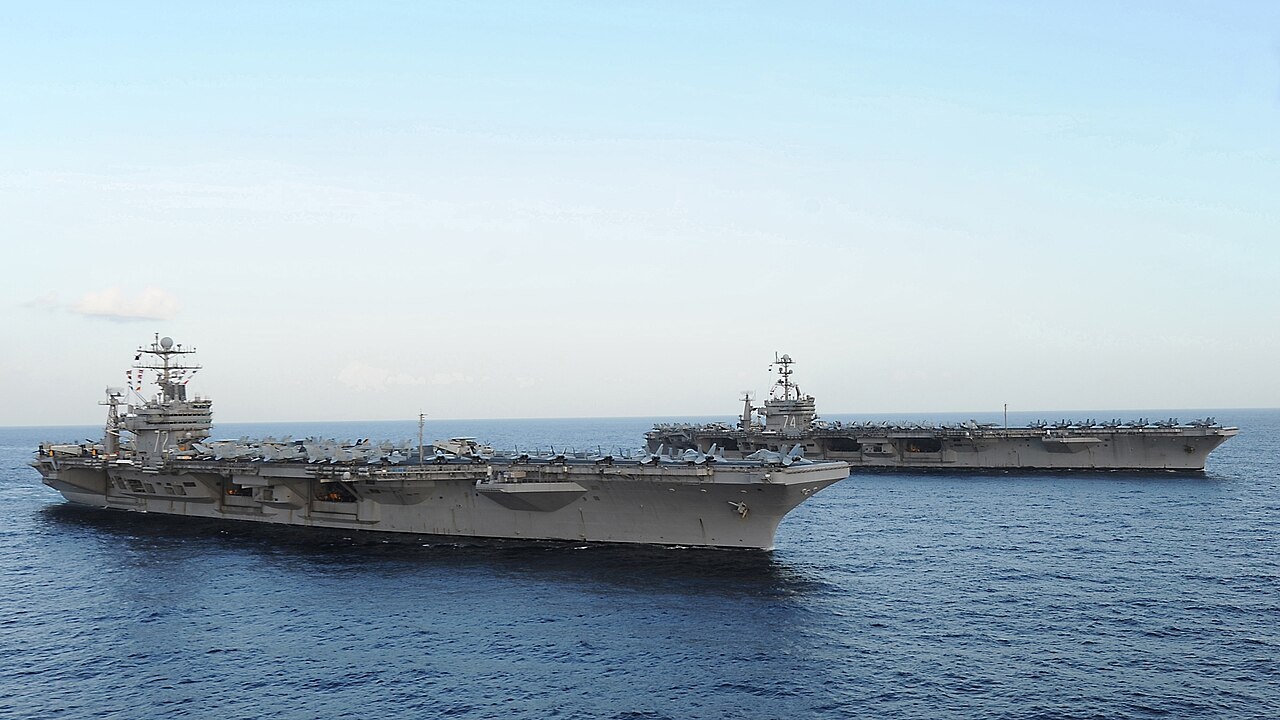
The Nimitz-class aircraft carriers USS Abraham Lincoln (CVN 72) and USS John C. Stennis (CVN 74) join for a turnover of responsibility in the Arabian Sea in January 2012. (US Navy/Chief Mass Communication Spc. Eric S. Powell)
Topic: Naval Warfare Blog Brand: The Buzz Region: Middle East Tags: Aircraft Carriers, Ali Khamenei, Iran, Persian Gulf, United States, US Navy, USS Abraham Lincoln (CVN-72), and USS Gerald R. Ford (CVN-78) Iran Is Threatening to Sink a US Aircraft Carrier. Can It? February 20, 2026 By: Peter Suciu
Share
No aircraft carrier has successfully been sunk by enemy action since the end of World War II.
As the United States military continued its buildup of forces in the Middle East, Iranian Supreme Leader Ayatollah Ali Khamenei threatened on Tuesday to sink a US Navy warship in retaliation.
“The Americans constantly say that they’ve sent a warship toward Iran. Of course, a warship is a dangerous piece of military hardware. However, more dangerous than that warship is the weapon that can send that warship to the bottom of the sea,” Khamenei wrote on X (formerly Twitter). The post on the social media platform has been viewed more than 3.5 million times as of Wednesday afternoon.
The Americans constantly say that they’ve sent a warship toward Iran. Of course, a warship is a dangerous piece of military hardware. However, more dangerous than that warship is the weapon that can send that warship to the bottom of the sea.
— Khamenei.ir (@khamenei_ir) February 17, 2026
Khamenei’s saber-rattling came even as US and Iranian officials met in Geneva for a second round of discussions regarding the future of Iran’s nuclear program. Washington has pushed for a new deal since President Donald Trump withdrew from the Joint Comprehensive Plan of Action (JCPOA) nuclear agreement during his first term. The Obama-era nuclear deal had placed limits on Tehran’s enrichment of uranium, for which the Islamic Republic received limited sanctions relief.
Trump has warned that it could be a “bad day for Iran, very bad,” if a deal can’t be reached.
Iran Has Reacted Negatively to the US Buildup
Last month, the United States Navy’s Nimitz-class nuclear-powered supercarrier USS Abraham Lincoln (CVN-72) and her escorts of Carrier Strike Group 3 (CSG-3) were deployed to the Middle East after previously conducting operations in the South China Sea. On Thursday, Trump also ordered the USS Gerald R. Ford (CVN-78) to the region.
CVN-78, which began her deployment at the end of June, had previously been operating in the Mediterranean Sea when she was ordered to the Caribbean as part of the US military build-up to support the anti-narcoterrorist mission against Venezuela.
The warnings from Ayatollah Ali Khamenei come as Iran conducted live-fire drills in the Strait of Hormuz and carried out joint naval exercises with a Russian Navy corvette in the Arabian Sea near Oman. Further exercises with the Russian warship were scheduled for Thursday.
Tehran further announced that it was “temporarily closing” part of the Strait of Hormuz during its live-fire drills, the first time the Islamic Republic has closed the key international waterway since the 1980s. Approximately one-fifth of the world’s oil passes through the strait.
Khamenei also pushed back on Trump’s claims of US military supremacy, writing in a second post on X, “The US President keeps saying that they have the strongest military force in the world. The strongest military force in the world may at times be struck so hard that it cannot get up again.”
The US President keeps saying that they have the strongest military force in the world. The strongest military force in the world may at times be struck so hard that it cannot get up again.
— Khamenei.ir (@khamenei_ir) February 17, 2026
It’s Really, Really Hard to Sink an Aircraft Carrier
The key question is whether Iran could actually sink a US warship, specifically a Nimitz- or Ford-class supercarrier, with its existing arsenal.
Unfortunately, there is no simple, straightforward answer to that question.
It should be noted that nearly 81 years have passed since a US Navy flattop was lost in battle. During the Battle of Iwo Jima on February 21, 1945, the Casablanca-class escort USS Bismarck Sea (CVE-95) was hit by multiple Japanese kamikaze aircraft. The attacks caused extensive fires, fueled by damaged torpedoes and explosive ordnance, which spread uncontrollably across the ship.
Today’s nuclear-powered supercarriers are vastly larger and more capable, with far more redundant designs, and sinking one wouldn’t be easy.
One notable precedent for any Iranian attempt came in 2005, when the US Navy attempted to sink the Kitty Hawk-class conventionally-powered supercarrier USS America (CV-66) during a SINKEX that was designed to simulate underwater attacks.
“Attempted” is the key word. While USS America lacked the thick steel armor of past battleships, the supercarrier was significantly larger than her World War II counterparts, and equipped with a double hull. In addition, her internal compartmentalization was far better than the older battlewagons. The carrier was able to absorb far more damage than expected, and it was only after four weeks of bombardment that the carrier finally went to the bottom.
The controversial tests helped the US Navy determine how a modern supercarrier would withstand attack. The findings from the study informed the design of future carriers, including the then-still-in-development Gerald R. Ford-class.
Given the vast amount of punishment that USS America was able to take, it is unlikely that Iran has any weapon that could actually sink a supercarrier. However, a drone swarm or another attack could still be devastating to a modern carrier’s air wing and crew.
It is also worth remembering that the Ukrainian military sank the Russian Navy’s Black Sea Fleet flagship, the frigate Moskva, with a land-based anti-ship missile. The greater danger for the US Navy may be that Tehran doesn’t aim for the most obvious target, the supercarrier, but rather for one of its more weakly defended escorts.
Still, the US Navy succeeded in countering drones and missiles during its months-long standoff with the Tehran-backed Houthis. But a warship needs to get it right every time it counters such a threat. The adversary only needs to get lucky once.
But this leads to another vital question: if Khamenei’s forces were able to successfully damage or sink a US warship, could he survive the retaliation that would inevitably follow? The Iranian supreme leader may wish to consider that thought as he weighs his options in the weeks to come.
About the Author: Peter Suciu
Peter Suciu has contributed over 3,200 published pieces to more than four dozen magazines and websites over a 30-year career in journalism. He regularly writes about military hardware, firearms history, cybersecurity, politics, and international affairs. Peter is also a contributing writer for Forbes and Clearance Jobs. He is based in Michigan. You can follow him on Twitter: @PeterSuciu. You can email the author: Editor@nationalinterest.org.
The post Iran Is Threatening to Sink a US Aircraft Carrier. Can It? appeared first on The National Interest.
Источник: nationalinterest.org