
«Данное сообщение (материал) создано и (или) распространено иностранным средством массовой информации, выполняющим функции иностранного агента, и (или) российским юридическим лицом, выполняющим функции иностранного агента»
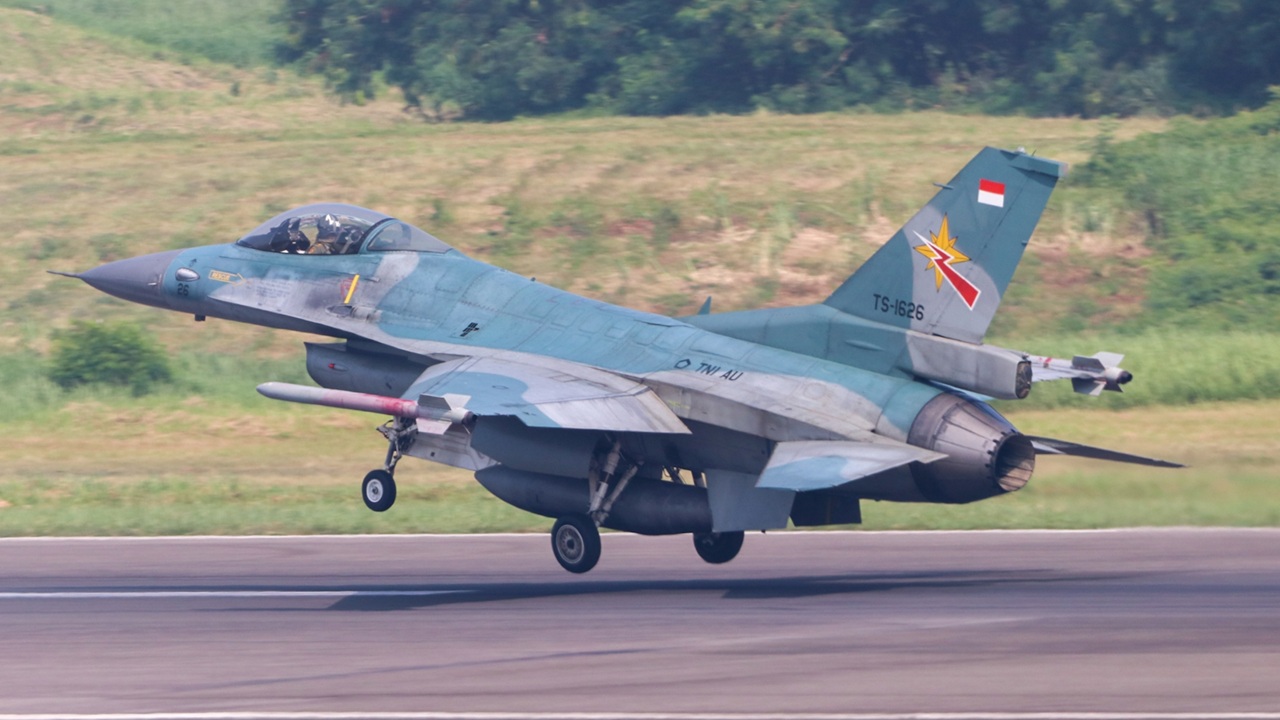
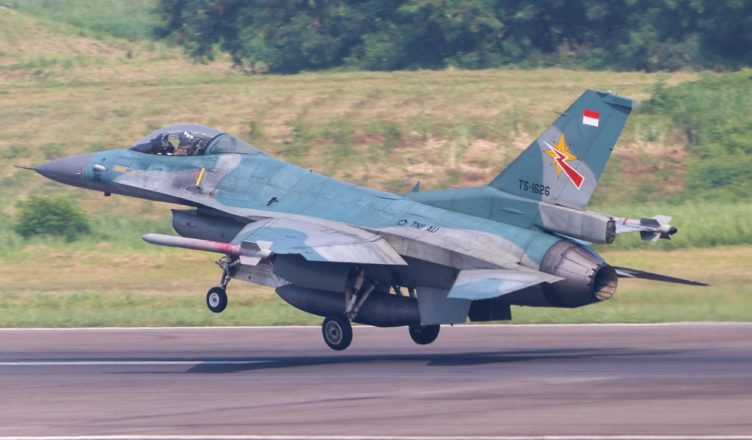
An Indonesian Air Force F-16 taking off from Halim Perdanakusuma AFB near Jakarta in October 2021. (Shutterstock/Gilang Putraditya Purba)
Topic: Air Warfare Blog Brand: The Buzz Region: Asia Tags: Aircraft, China, Highways, Indo-Pacific, Indonesia, and South China Sea Indonesia’s Toll Roads Could Become Runways for Fighter Jets February 14, 2026 By: Peter Suciu
Share
Indonesia lacks the industrial capacity to build or maintain an aircraft carrier fleet—but it has thousands of islands across the South China Sea that fighter jets could operate from.
Indonesia has continued its push to acquire the former Italian Navy aircraft carrier Giuseppe Garibaldi (C-551). Indonesian state media outlet Antara News reported this week that the Indonesian Navy (TNI AL) Chief of Staff Admiral Muhammad Ali has called for the Maritime Southeast Asian nation to receive the warship by October 5th, the 81st anniversary of the founding of the country’s armed forces.
“The annual TNI anniversary is usually marked by a large-scale military parade and sail past, often used to showcase new acquisitions and major defence assets to the public,” Naval News explained.
However, even as Jakarta seeks to finalize a deal with Rome for the transfer of the warship, the Indonesian Air Force has been conducting landing and takeoff test flights from the Trans-Sumatra Toll Road. The goal is to employ many toll roads across the country as de facto runways for fighter jets during a crisis.
Indonesia Is a Rising Indo-Pacific Power—and China Doesn’t Like It
As the world’s largest archipelagic state, Indonesia comprises more than 17,000 islands and shares maritime borders with seven other countries, including Australia, Singapore, the Philippines, India, Malaysia, Thailand, and Vietnam. Its vast archipelagic territory extends into the exclusive economic zones (EEZs) of other countries, and it has several active, mostly diplomatic, border disputes.
Moreover, although Indonesia doesn’t have any formal territorial border disputes with China, the two nations have overlapping maritime claims in the South China Sea. Beijing’s “nine-dash line” does overlap with Indonesia’s EEZ around the Natuna Islands.
Jakarta lacks the domestic industrial capability to build a modern aircraft carrier, which is why it has turned to Rome to acquire one. Although Indonesia also has a sizable navy by hull count, with more than 245 vessels in service, most of its fleet consists of small patrol craft, along with just four submarines, seven frigates, and 25 corvettes—far from enough to challenge Beijing for primacy in the South China Sea. An aircraft carrier would therefore significantly increase its naval capabilities.
Admiral Ali and other officials have also indicated that a true carrier could also be employed for “non-war military operations.” Yet the country clearly appears to be focused on national security, as evidenced by the tests of its aircraft on toll roads.
This week, an Indonesian Air Force F-16 Fighting Falcon and an EMB-314 Super Tucano were able to land and take off again from the Trans-Sumatra Toll Road in Lampung Province.
Indonesia’s Growing Road Network Is Useful for Air Operations
Even as Indonesia may not yet have any massive warships, it does have a large and rapidly growing network of toll roads that could serve as unsinkable aircraft carriers in an armed conflict, protecting critical infrastructure and urban centers from remote locations. Since 2018, nearly $70 billion has been invested in roads.
The government has generally remained focused on connecting islands and cities to facilitate faster movement of goods and people. Recent projects, including the Trans-Java and Trans-Sumatra toll roads, were designed and built with logistical considerations in mind and to drive regional economic development.
The roads were also developed through collaborations with state-owned enterprises and private investors to overcome budget constraints, thereby enabling faster construction than relying solely on state funding.
Still, from the outset, some roads were also designed to double as emergency runways for military aircraft, thereby enhancing national defense capabilities and providing a less costly alternative to traditional airbases.
The Chief of Staff of the Indonesian air forces, Marshal Tonny Harjono, told CNN that Jakarta’s goal was for each of Indonesia’s 38 provinces to have at least one toll road section that could be used as an emergency runway in the event of an air crisis.
Roads Often Work as Runways in a Pinch
Indonesia is hardly alone in weighing the use of its roads as crude runways. Roads generally fulfill all the same conditions that runways do; they are solid, typically constructed in straight lines, and almost always wide enough to accommodate small aircraft such as fighter jets, as long as they stay straight on takeoff and landing.
Although it is an urban myth that the United States highway system was developed to serve as runways in wartime, the US military has conducted tests of remote roads serving as austere runways.
During the Cold War, the Royal Air Force (RAF) also conducted tests on a newly completed section of the M55 motorway near Blackpool.
Other countries, including Taiwan, Sweden, Finland, South Korea, Poland, India, Germany, and Switzerland, have practiced taking off and landing fighter jets on roads and highways during air exercises. Still, Indonesia has taken the lead in this effort—and there is little doubt that with sufficient road coverage, its thousands of Pacific islands could function as unsinkable aircraft carriers.
About the Author: Peter Suciu
Peter Suciu has contributed over 3,200 published pieces to more than four dozen magazines and websites over a 30-year career in journalism. He regularly writes about military hardware, firearms history, cybersecurity, politics, and international affairs. Peter is also a contributing writer for Forbes and Clearance Jobs. He is based in Michigan. You can follow him on Twitter: @PeterSuciu. You can email the author: Editor@nationalinterest.org.
The post Indonesia’s Toll Roads Could Become Runways for Fighter Jets appeared first on The National Interest.
Источник: nationalinterest.org