
«Данное сообщение (материал) создано и (или) распространено иностранным средством массовой информации, выполняющим функции иностранного агента, и (или) российским юридическим лицом, выполняющим функции иностранного агента»
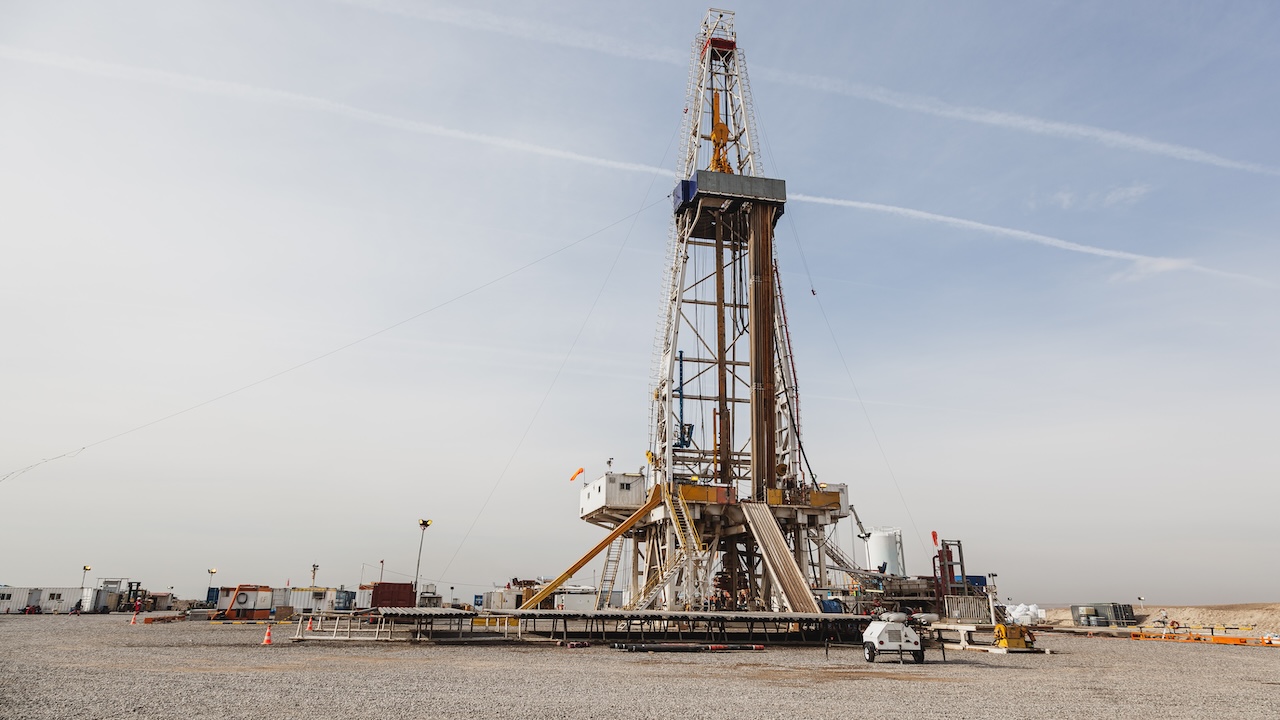
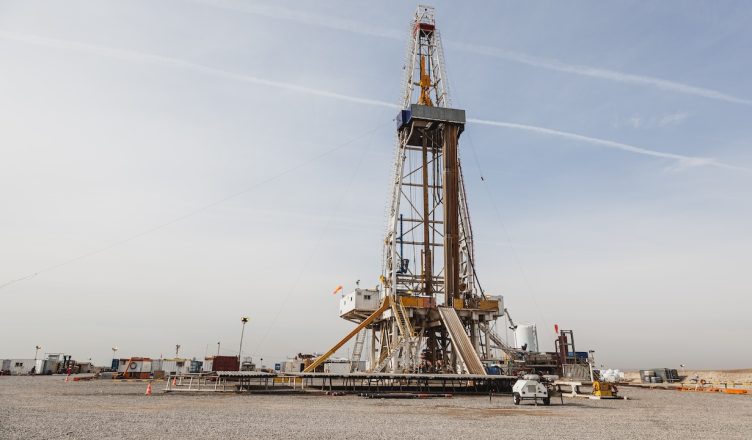
A large onshore oil drilling rig operates in Iraq, reflecting the importance of fields such as West Qurna 2, where sanctions, ownership shifts, and geopolitical competition are reshaping control over energy assets. (Shutterstock/Bertrand Godfroid)
Topic: Oil and Gas Blog Brand: Energy World Region: Americas, Eurasia, and Middle East Tags: China, Energy Security, Iraq, Russia, Sanctions, and United States How America Can Leverage Iraq’s West Qurna Oil Field February 27, 2026 By: Fyodor Dmitrenko
Share
Sanctions did more than punish Russia—they reshaped control of a key oil field in Iraq.
While energy analytics have focused on Washington’s campaigns in Venezuela and Iran, a no less significant development for the energy sector occurred in southern Iraq. By late autumn 2025 American sanctions pressure on Russia’s largest private oil firm—Lukoil—led to the firm declaring force majeure, leading to Iraq nationalizing operations at the firm’s flagship oil project with intent to sell, which could have far reaching repercussions for the energy sector beyond this one field, and act as a litmus test for a shift in US overseas energy policy.
For context, West Qurna 2 produces around 470,000 oil barrels daily—about 0.5 percent of world oil production and about 9 percent of Iraq’s total. The broader West Qurna complex, which said field is a part of, contains 43 billion barrelsof recoverable reserves, thus belonging to the top five largest oil fields in the world.
In November 2025, Lukoil announced force majeure at West Qurna 2 after US-led sanctions over Russia’s war in Ukraineimpaired its ability to fulfill operational and financial tasks, causing Iraq to partially cease its transactions with Lukoil due to the rise of compliance risks.
Furthermore, due to the importance of this field, in January 2026, Iraq’s cabinet of ministers nationalized operations per the terms of the Technical Service Agreement (TSA) with Lukoil—a move that has been interpreted as an attempt to maintain a stable output, with a stated intent to sell the field to a firm better able to meet its responsibilities under the TSA within a time period of 12 months.
But how did we get here, and why does this field matter on a geopolitical as well as a commercial level?
Cold War Data Advantage: Soviet Geological Intelligence and Lukoil’s Entry into Iraq
The founder of Lukoil—Vagit Alekperov—served as deputy oil and gas minister in the Union of Soviet Socialist Republics (USSR) in 1990, which gave him access to Moscow’s geological survey data on Iraqi reserves gained during the Cold War. This institutional knowledge on the reservoirs and about Baghdad’s unique political economy gained through his work in the similarly labyrinthine Soviet bureaucracy, as well as his Azerbaijani heritage—gave Lukoil a competitive advantage when entering Saddam Hussein’s Iraq in March 1997, giving the firm access to a Production Sharing Agreement (PSA) that few other western firms were able to get at the time, yet one it would temporarily lose when suspicions of Alekperov hedging his bets through discussions with US officials and Iraqi opposition prior to the 2003 invasion of Iraq came to light leading to Hussein cutting the contract short in 2002.
The 2003 US Invasion of Iraq and Licensing Competition
After the 2003 US Operation Iraqi Freedom that toppled Saddam Hussein, Iraq’s oil landscape underwent a significant revision in the direction of Technical Service Contracts (TSCs), where firms paid by the barrel, while Iraq maintained equity control over reserves.
This reconstruction of the sector forced firms bidding for extraction rights to provide increases in production with relatively thin profit margins, a difficult environment to operate in—but one Lukoil was perfectly adapted to.
This assumption proved prophetic when, in 2009, Lukoil bid for a contract under which it would pay $1.15 per barrel for West Qurna 2—raising numerous eyebrows, as the per-barrel price was 40 percent lower than competing bids.
However, despite the surface level analysis suggesting this would prove unprofitable, Lukoil would allow itself such low revenues—unlike its Western competitors—due to its soviet survey data vastly lowering prospecting risks and removing a large part of operational uncertainty—a fact it would exploit to make West Qurna 2 one of the most prospective fields in Iraq.
ExxonMobil vs. Lukoil: Operational Success and External Limitations
West Qurna 1, which was then operated by ExxonMobil—despite higher prices (at $1.90) per barrel—reflective of its international prestige, would struggle to meet its targets of raising production from the initial 270,000 barrels a day to 2.25 million barrels a day over 7 years—with production instead plateauing at 500,000-550,000 barrels a day, causing it to gradually lose the confidence of Baghdad.
While Lukoil raised output from 400,000 to 480,000 barrels a day between 2014 and 2019 despite a smaller reserve, with plans to raise production further to 800,000 barrels by 2045, ExxonMobil was announcing exit plans in 2020, with stakes being fully transferred to Iraqi, Indonesian, and Chinese bidders in 2023.
While ExxonMobil struggled with applying Western compliance standards to a confusing Iraqi system where formal bureaucracy co-existed with informal patronage frameworks, Lukoil managed to stay ahead of the curve through its use of experience of similar post-Soviet frameworks, which gave it a greater capability to operate in gray areas that its Western competitors were less skilled in managing.
Yet this operational success proved fragile when external legal complications appeared, as the core question ceased to be whether or not Lukoil could make a profit despite low per barrel revenues—as experience showed that it could.
Why Distressed Energy Assets Matter
Iraqi TSAs create certain difficulties—limited payment schedules, high capital investments, and consistent above-ground risks. Thus, Lukoil’s stake became a distressed asset due to legal limitations imposed by sanctions, forcing a sale on very unfavorable conditions.
On January 29, 2026, Lukoil revealed an agreement with the Carlyle Group—an investment firm specializing in distressed and special situations based in Washington DC—to sell its subsidiary Lukoil International GmbH, which owns the group’s international assets, including the 75 percent stake in West Qurna 2. The agreement, which is subject to regulatory approvals from the US Department of the Treasury’s Office of Foreign Assets Control (OFAC) until it can be put into effect, excludes Lukoil’s minority stakes in Kazakhstan-based assets such as the Tengiz and Karachaganak oil and gas fields, and the Caspian Pipeline Consortium. Carlyle’s American expertise in managing financially or operationally challenged assets positions it as a natural buyer for sanctions-impaired holdings such as Lukoil’s West Qurna 2 stake. However, the agreement is non-exclusive, and Lukoil continues negotiations with other potential buyers.
Given the 470,000 barrels daily currently extracted at the field and the potential for a near doubling of output to 800,000 shown by Lukoil’s own plan and partial OPEC influence gained through operational control of almost 10 percent of Iraq’s oil production (an important figure given Iraq is the second largest producer in said cartel after Saudi Arabia), this strategic interest is unsurprising despite the aforementioned narrow profit margins.
While the evidence does not establish direct coordination between US sanctions policy and corporate interests, the sequence of events created market conditions that appear to favor American firms. The Carlyle Group, founded in 1987 and managing approximately $426 billion in assets under management as of 2023, has built a reputation through its Distressed and Special Situations practice—launched in 2004—investing in firms experiencing financial, operational, or cyclical distress. This specialization in acquiring and restructuring underperforming or sanction-impaired assets, combined with the firm’s Washington headquarters and longstanding ties to US policy circles, makes it a strategic match for Lukoil’s forced divestment. Comments made by US officials, according to Bloomberg, supporting Iraq’s plan to transfer the field to an American company, suggest how the coupling of government policy, compliance rules, and corporate strategy can achieve favorable outcomes for one’s own firms while dissuading rival operators.
Effects of the Sale of West Qurna 2 on China
As such, West Qurna 2 offers lessons for other great powers with significant stakes in Iraq’s energy sector—first and foremost, China.
PetroChina holds the largest stake in West Qurna 1 (previously held by ExxonMobil), and China National Petroleum Company (CNPC) leads the exploration at Halfaya and holds stakes in other fields, contributing over one-third of Iraqi oil output, making the People’s Republic of China (PRC) the second most important energy partner to Iraq after the United States.
The West Qurna 2 case could thus be interpreted as a cautionary precedent for Beijing—as it demonstrates that even productive, operationally successful oil fields can become vulnerabilities when external financial and legal frameworks are weaponized (whether on purpose or by sheer chance) to force a change in operators, and suggests that overseas investments in energy assets are not protected from geopolitics just because the asset is profitable or critically important for the host country’s budget.
This precedent could suggest that control of overseas extraction serves as but one form of energy systems resilience. Access to stable and consistent legal frameworks, favorable compliance terms, and uninterrupted, sanctions-proof financing could be just as important, and the success of these frameworks often depends on political alignment and international relations beyond the powers of the host country.
How Sanctions Reshape Strategic Assets
The West Qurna 2 case illustrates how sanctions and compliance frameworks can rapidly transform productive energy assets into distressed assets, potentially reshaping control over strategic infrastructure. The agreement between Lukoil and the Carlyle Group, as of January 2026—and pending regulatory approval—further exemplifies how specialized investment firms with expertise in distressed situations can capitalize on sanction induced asset sales. Thus, if the American firm does indeed acquire Lukoil’s stake, the episode may offer a template—whether intentional or circumstantial—for how regulatory pressure can complement strategic interests in contested energy markets.
About the Author: Fyodor Dmitrenko
Fyodor Dmitrenko is a geopolitical analyst and researcher specializing in sustainable development, energy policy, and governance on the Eurasian continent. He is affiliated with Sciences Po Paris, where he conducts research under the supervision of Professor Tatiana Mitrova. He has contributed articles on developments in energy markets and international trade flows at Reuters News Agency’s CIS office and for emerging think tanks such as India’s TheGeostrata and the Paris section of the French-MFA-affiliated Andalus Committee, which deals with EU-global south relations. He has also engaged with leaders in the sustainable development field at the Guiyang Ecological forum as a Sciences Po delegate to the Tsinghua Global Youth Dialogue, and interviewed policy makers such as former Brazilian central bank head Gustavo Franco and former Swiss President Simonetta Sommaruga as the Sciences Po delegate to the Warwick Economic Summit.
The post How America Can Leverage Iraq’s West Qurna Oil Field appeared first on The National Interest.
Источник: nationalinterest.org