
«Данное сообщение (материал) создано и (или) распространено иностранным средством массовой информации, выполняющим функции иностранного агента, и (или) российским юридическим лицом, выполняющим функции иностранного агента»
 Topic: Naval Warfare Blog Brand: The Buzz Region: Asia Tags: China, Defense Industry, Indo-Pacific, People’s Liberation Army Navy, Russia, Russian Navy, Ships, and Vladivostok Could China Crush Russia in a Sea War? February 6, 2026 By: Brandon J. Weichert
Share
Russia’s navy in the Far East has a long and meritorious service record—yet would almost certainly be crushed under China’s industrial might.
At present, the People’s Republic of China (PRC) and the Russian Federation are enjoying a moment of flowering, positive relations. Both President Xi Jinping of China and Vladimir Putin of Russia have extolled the virtues of their growing “friendship without limits.”
Historically, however, neither China nor Russia have been friends. In fact, they’ve been just as prominent adversaries as Russia and the United States. And, in the Eurasian landmass, historical memory is not so easily forgotten as Xi and Putin would have us believe.
While there is little diplomatic daylight between Beijing and Moscow today, it would not take much for the natural contradictions of these two neighbors to return to the fore and end the “friendship without limits,” replacing it with the usual historical animosity and territorial disagreements. Indeed, recently Chinese state-run media published maps indicating that parts of the Russian Far East were—or, rather, should be according to Beijing—part of China. These maps understandably caused quite a stir in Moscow.
Russia’s Naval Strength Is Qualitative, Not Quantitative
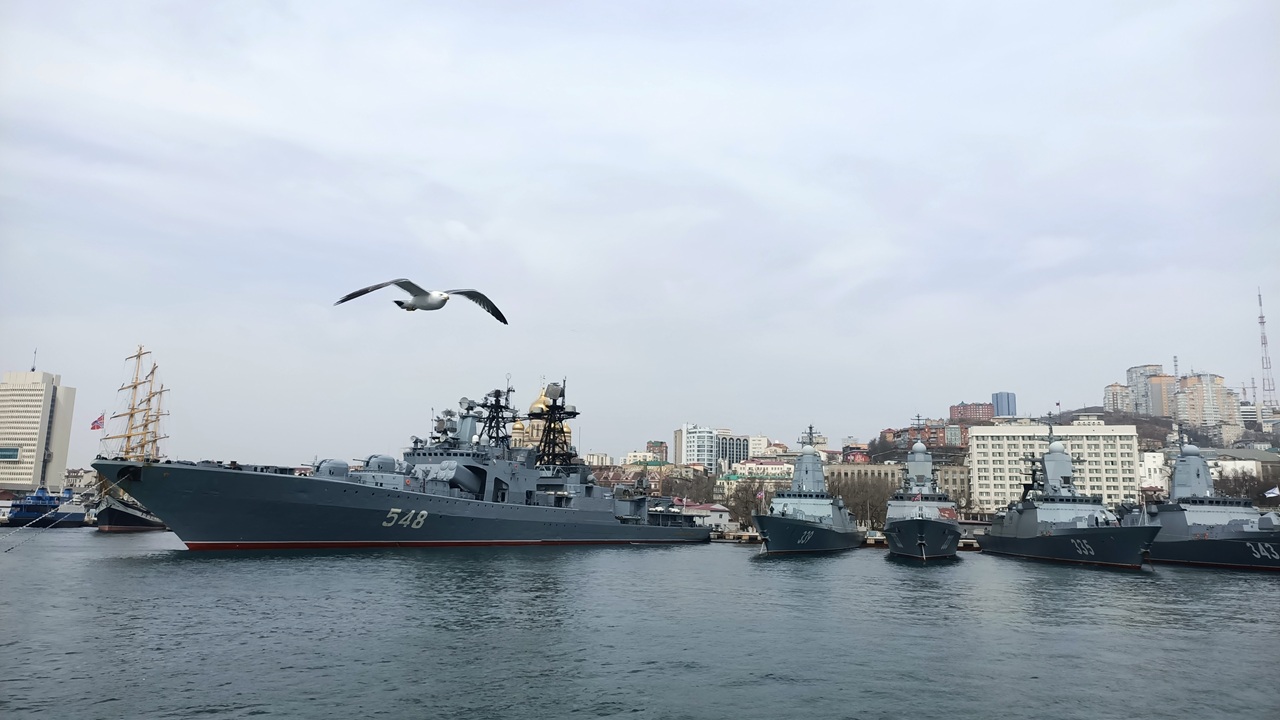
When one looks at the map, the most important feature of the Russian Far East is its strategic warm water port of Vladivostok, adjacent to both North Korea and China’s Heilongjiang region. What might happen if, for whatever reason, the alliance between China and Russia broke down and conflict erupted between the two sides for control over Vladivostok?
First, let’s look at the relative strengths of the two navies.
For the Russian Navy, its major strength is the small but advanced submarine force it has cultivated over the decades. With that submarine force has come decades of highly skilled seamanship among their cadre of submariners. The skill and capability of those Russian submariners far surpass that of their still-developing Chinese counterparts.
The Russian Navy also possesses powerful cruise missiles, such as the Kalibr cruise missile, Oniks, and Zircon hypersonic missile. There are even some heavyweight surface warfare ships, such as Russia’s Kirov-class battlecruiser, the Admiral Nakhimov.
The Russian Navy beyond their submarine force, is smaller and, in some cases, older. And their surface fleet, despite their superior submarine capabilities, is ailing and the sailors there are not as well-trained or experienced as their submarine counterparts.
But those are qualitative advantages.
China’s Navy Vastly Outguns the Russian Fleet
On the quantitative side of the ledger, the People’s Liberation Army Navy has a massive advantage over their potential Russian rivals. The Russian Navy might have more skilled sailors and better submarines, but the Chinese have more of everything. They are the greatest mass-producing industrial power since the United States in the 1940s. In fact, China’s industrial might surpasses 1940s America. The Chinese are today producing advanced systems at scale in ways that ought to frighten American designers.
When it comes to their navy, China has between 370 and 390 combat ships, now accounting for the largest navy on Earth (by hull count, although America still holds the edge in total displacement volume). Two of the major surface combatants the Chinese People’s Liberation Army Navy (PLAN) has under their belt are the Type 055 cruisers and the Type 052D destroyers, both of which are armed to the teeth.
Moreover, while aircraft carriers are no longer as relevant as they once were in the modern maritime battlefield, the fact remains that the Chinese have built for themselves three increasingly complex aircraft carriers—and are on track to have six more within the next decade. They are now marrying more sophisticated warplanes, such as the J-35 fifth-generation multirole stealth warplane, to the carriers they’re developing, too.
China’s submarines, while certainly becoming more advanced with each iteration, remains the weak point of their navy. Here is where Russia—for now—has some serious advantages. But those advantages, again, are qualitative, whereas China has real quantitative advantages in this domain.
Understanding the PLAN’s Missile-Centric Way of War
The PLAN has a missile-centric doctrine. It possesses a massive (and growing) arsenal of long-range anti-ship cruise missiles, and intends to rely on these in the event of war with either Russia or the United States. Beijing enjoys a dense layer of air defense, too. What’s more, it has done an excellent job in integrating its navy with land-based intelligence, surveillance, and reconnaissance (ISR) capabilities (and missile forces).
What this means, essentially, is that the Russian naval foothold in the Pacific is at risk of immediate evaporation at any given time. China would undoubtedly enjoy superior surveillance and long-range anti-ship capabilities that would overwhelm the few aging Russian Navy surface vessels defending Vladivostok or some other Russian territory, like the Kamchatka Peninsula.
On the other hand, the Russian submarine threat would be acute. But the PLAN’s strategy would be to control the sea lanes. Chinese admirals would have likely eliminated Russian surface vessels and shore-based systems with their missile and hypersonic weapons attacks at the start of any conflict.
Even if the Russians managed to hold their own against China’s initial attacks, the fact remains that they would be terribly outnumbered. The loss of even a small number of Russian Navy warships and/or submarines in a potential battle with the Chinese PLAN would result in a catastrophe for Moscow, because Russia lacks the industrial capacity that China possesses.
Unlike the Chinese, the Russians cannot replace their lost warships or submarines without significant investment and diversion of finite resources. The Ukraine War, which has consumed Russia’s defense-industrial base, has diverted those vital resources away from the shipbuilding sector—and restarting dormant shipyards is no easy task.
At the start of such a naval conflict, it is likely that the Russians would inflict disproportionate damage with their submarines. But attrition favors China’s larger fleet and the aforementioned productive capacity. Ultimately, China would win.
For Now, the US Navy Is the Greater Threat to China
In all, the balance of power in the Indo-Pacific has fundamentally shifted away from the Russians to the Chinese. For now, this doesn’t matter, given their alliance. But China and Russia’s shared history is one of animosity and distrust rather than friendship and mutual respect.
If the two ever came to blows, and the dispute was naval in nature, regardless of the Russian Navy’s history of being a highly dominant force in that part of the world.
Like the Americans are learning now, the Russians might find out the hard way that China has achieved regional dominance in the Indo-Pacific. Until the breakdown between China and Russia ever occurs, though, it won’t be the Russian Navy learning this hard lesson. It would likely be the United States Navy in any potential fight with China in the First Island Chain experiencing this reality.
About the Author: Brandon J. Weichert
Brandon J. Weichert is a senior national security editor at The National Interest. Weichert is the host of The National Security Hour on iHeartRadio, where he discusses national security policy every Wednesday at 8pm Eastern. He hosts a companion show on Rumble entitled “National Security Talk.” Weichert consults regularly with various government institutions and private organizations on geopolitical issues. His writings have appeared in numerous publications, among them Popular Mechanics, National Review, MSN, and The American Spectator. And his books include Winning Space: How America Remains a Superpower, Biohacked: China’s Race to Control Life, and The Shadow War: Iran’s Quest for Supremacy. Weichert’s newest book, A Disaster of Our Own Making: How the West Lost Ukraine, is available for purchase wherever books are sold. He can be followed via Twitter/X @WeTheBrandon.
Image: Shutterstock / Zinaida Irklienko.
The post Could China Crush Russia in a Sea War? appeared first on The National Interest.
Источник: nationalinterest.org