
«Данное сообщение (материал) создано и (или) распространено иностранным средством массовой информации, выполняющим функции иностранного агента, и (или) российским юридическим лицом, выполняющим функции иностранного агента»
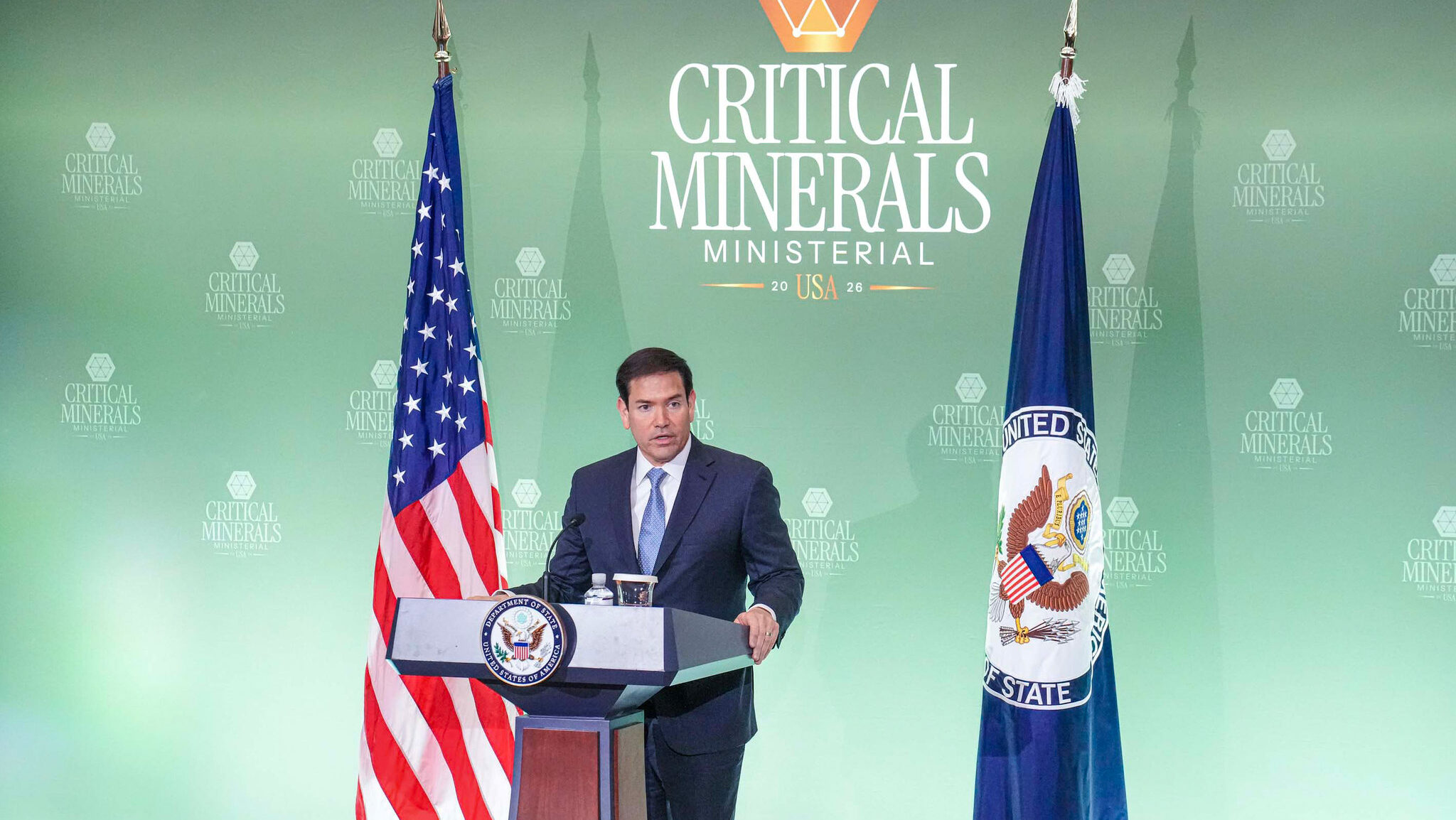
Secretary of State Marco Rubio announced the creation of the Forum on Resource Geostrategic Engagement (FORGE) at the Critical Minerals Ministerial in Washington, DC, on February 4, 2026. The new initiative reflects the Trump administration’s goal to reduce China’s dominance in critical mineral supply chains. (US Department of State/Freddie Everett)
Topic: Critical Minerals, and Trade Blog Brand: Techland Region: Americas Tags: Forum on Resource Geostrategic Engagement (FORGE), North America, Project Vault, United States, and US-China Relations Breaking China’s Hold on Critical Minerals Requires More than Tariffs February 19, 2026 By: Elaine Dezenski, and Daniel Swift
Share
Project Vault tackles investment risk directly, while FORGE will falter unless it becomes an enforceable trade regime.
The Trump administration has unveiled two new initiatives to break China’s grip on critical minerals. One has a high likelihood of success. The other needs a strong dose of enforcement to work.
At a ministerial meeting in Washington this month, the administration introduced the Forum on Resource Geostrategic Engagement (FORGE). The initiative seeks to establish price floors for critical minerals through coordinating tariffs with partner countries, preventing China from undercutting competitors through subsidies and dumping. Vice President JD Vance described it as a way to stabilize markets and blunt Beijing’s ability to weaponize price volatility.
A day earlier, the administration announced Project Vault, a public-private partnership that would secure advance purchase commitments from US manufactures for critical minerals at defined prices. The two initiatives reflect very different theories of change, but both initiatives start with a realistic diagnosis.
China’s Price Suppression Makes Critical Mineral Investment Unbankable
Mining and processing projects fail to materialize not because prices are too low today, but because investors cannot rely on what prices will be years from now. China’s ability to flood markets and suppress prices through unfair trading practices has made long-term investments unbankable. No financial institution will commit to a project when China can effectively make the output worthless overnight. As a result, China now supplies more than 50 percent of US demand for 21 critical mineral commodities—and controls processing capacity that makes diversification difficult even when minerals are sourced elsewhere.
Project Vault tackles that problem directly. Participants commit to future purchases at agreed volumes and prices. Those commitments send credible demand signals to investors and lenders. By reducing revenue uncertainty, the program lowers financing risk and unlocks private capital. It strengthens supply chains without requiring fragile diplomatic coordination or non-market prices for manufacturers.
FORGE attempts to solve the same problem from the supply side. Coordinated tariffs would sustain price floors and block artificially cheap Chinese exports—effectively a type of import substitution. To work, however, FORGE will require formalization and hefty doses of trade enforcement.
FORGE’s Coordinated Tariffs Require Binding Enforcement
Coordinated price floors only work if participants don’t cheat—or “defect” in the language of game theory. Under FORGE, countries would incur higher input costs in exchange for long-term diversification. Yet each participant would also face a strong incentive to quietly allow cheaper Chinese minerals into its market, giving domestic manufacturers a short-term edge. Enforcement under a non-binding framework is difficult, and the gains from defection are real.
The diplomatic context compounds that risk. Cooperation is harder when trade relations are under pressure. Even committed allies may hesitate to raise manufacturing costs and risk the ire of China without a more formal US commitment. South Korea, for instance, might publicly support FORGE while quietly allowing discounted Chinese graphite to flow into its battery plants
The economic sequencing also works against FORGE in its current state. Manufacturing responds quickly to higher input costs. Mining responds slowly to price signals. Political resistance from downstream industries will surface before FORGE delivers meaningful supply diversification. Over time, that resistance translates into carve-outs, exemptions, and selective enforcement across member states.
Project Vault Aligns Market Incentives
Project Vault avoids these vulnerabilities by aligning incentives. Manufacturers gain supply security. Investors get predictable revenue streams. The US government catalyzes mining and processing without imposing tariffs. The model functions even if diplomatic coordination falters because it is anchored in enforceable commercial contracts, not political promises.
Trade policy still has a role. Over the long term, the best way to diversify supply is to build a formal trade regime among market-oriented economies, with lower barriers inside the bloc and clear enforceable rules against Chinese dumping, subsidies, and coercive practices. A “near-global” economy grounded in reciprocity across goods—not just for critical minerals.
FORGE moves in that direction but does not yet achieve it. The administration now needs to do the hard work of establishing binding commitments, verification mechanisms, and clear consequences for non-compliance. Non-binding agreements are not enough.
The administration should move quickly on Project Vault while transforming FORGE into a formal, enforceable trade regime that can endure political stress. Anchoring demand will unlock capital. Enforcing discipline will protect it. Without both, China’s grip will only tighten.
About the Authors: Elaine Dezenski and Dan Swift
Elaine Dezenski is the senior director and head of the Center on Economic and Financial Power (CEFP) at the Foundation for Defense of Democracies (FDD), a Washington, DC-based, nonpartisan research institute focusing on national security and foreign policy. Follow Elaine on X @ElaineDezenski.
Daniel Swift is a senior research analyst at the Foundation for Defense of Democracies (FDD), a Washington, DC-based, nonpartisan research institute focusing on national security and foreign policy, and a retired US Diplomat.
The post Breaking China’s Hold on Critical Minerals Requires More than Tariffs appeared first on The National Interest.
Источник: nationalinterest.org