

«Данное сообщение (материал) создано и (или) распространено иностранным средством массовой информации, выполняющим функции иностранного агента, и (или) российским юридическим лицом, выполняющим функции иностранного агента»

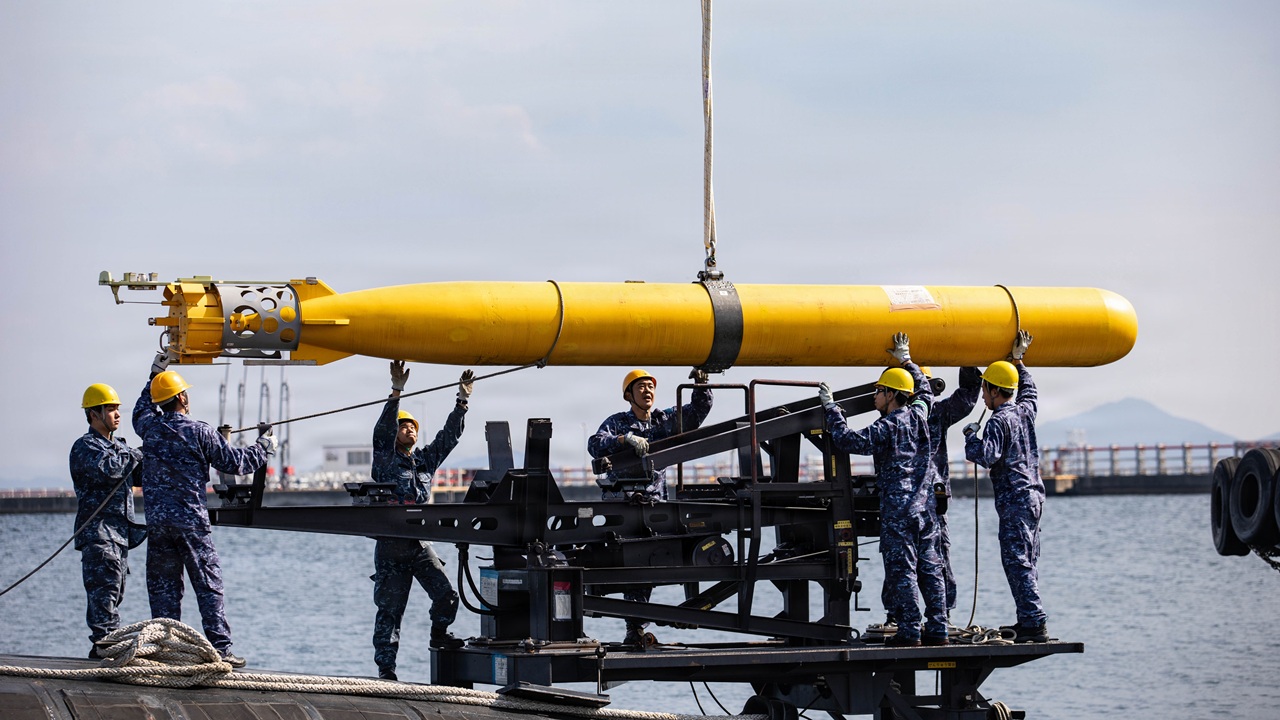
A group of Japanese sailors loading a torpedo onto the JS Unryu (SS-502) at Marine Corps Air Station Iwakuni, Japan, on October 27, 2025. Advances in underwater detection technology have led to an arms race between homing torpedoes and submarine countermeasures. (US Marine Corps/Lance Cpl. Donald Dugger)
Topic: Naval Warfare Blog Brand: The Buzz Region: Americas Tags: North America, Submarines, Torpedoes, United States, and US Navy The US Navy’s Submarines Are Getting a New Acoustic Decoy February 28, 2026 By: Stavros Atlamazoglou
Share
The Acoustic Device Countermeasure, or ADC, is designed to mimic the sound of a submarine, diverting acoustic torpedoes to attack it rather than its host.
The Navy awarded Ultra Maritime, a Massachusetts company, with a development contract for the next-generation Acoustic Device Countermeasure (ADC) MK6 last week.
The ADC MK6 is intended to provide technology that can address the threat posed by a new generation of smart torpedoes.
An Acoustic Countermeasure Against Smart Torpedoes
Torpedo technology is moving forward as militaries develop increasingly more sophisticated munitions that use artificial intelligence and stealth to outsmart decoy systems and other countermeasures. This new generation of torpedoes can identify a decoy, ignore it, and re-acquire their targets with precision. The threat to warships and submarines is great—requiring new countermeasures designed to outsmart the “smart” torpedoes.
Enter the ADC MK6, which generates a range of acoustic signatures that aim to confuse and divert incoming torpedoes, protecting the host warship or submarine. The countermeasure can be deployed rapidly, generating powerful, tailored acoustic signatures to confuse and divert incoming torpedoes.
“Keeping today’s fleets protected in an increasingly contested maritime domain requires systems that are smarter, faster and fully adaptive,” the company said in a press release.
The ADC MK6 can add an important layer of undersea protection to the existing countermeasures found on Navy vessels. There is a wide range of available countermeasures in the market, including sonobuoys, sonar systems, and acoustic countermeasures.
“Ultra Maritime’s design delivers mission-ready performance, improved acoustic output and robust compatibility that is built upon a decades-long record of delivering countermeasure systems to navies worldwide, providing a trusted layer of undersea defense in high-threat environments,” the company added.
The Navy’s investment in submarine warfare countermeasures highlights the promise and danger coming from underwater.
A Short History of the Submarine-Torpedo Arms Race
The idea of submarines dates back to antiquity, and early models were used without success during the Revolutionary War. The first successful submarine attack took place during the American Civil War, when the CSS Hunley successfully sunk a Union warship. But submarines truly came of age as a viable weapon system during World War I, when the French Navy, Royal Navy, and Imperial German Navy all used submarines with varying success.
The German in particular, seeking a weapon that could challenge the powerful Royal Navy at sea, showcased the potential and limitations of the submarine. Undersea warfare continued to develop in the years before and during World War II. Up until then, submarines relied on torpedoes and artillery guns to sink enemy warships and merchant vessels. Interestingly, in many cases, it was the artillery gun that sank the most enemy shipping rather than torpedoes.
The great leap forward for submarines came after World War II when navies gradually incorporated missiles onboard submarines. The addition of ballistic and cruise missiles on submarines greatly extended the range of subs and their ability to hold targets hundreds and thousands of miles away at risk. The ability to fit nuclear warheads on these missiles turned submarines into a strategic weapon that can ensure the dreaded mutual assured destruction.
Today, submarines are a versatile weapon system that offer policymakers and military commanders a wide-range of choices for many different scenarios.
The US Navy has the largest and most capable submarine fleet in the world, with fast attack, missile strike, and ballistic missile subs.
The strategic importance of the submarine makes the need for effective countermeasures that much more important. If the ADC MK6 delivers as promised, then the addition of the countermeasure is a step in the right direction for the Navy—and could give it a vital edge over China’s anti-submarine weapons, at least until it catches up.
About the Author: Stavros Atlamazoglou
Stavros Atlamazoglou is a seasoned defense journalist specializing in special operations and a Hellenic Army veteran (national service with the 575th Marine Battalion and Army HQ). He holds a BA from the Johns Hopkins University and an MA from the Johns Hopkins’ School of Advanced International Studies (SAIS). His work has been featured in Business Insider, Sandboxx, and SOFREP.
The post The US Navy’s Submarines Are Getting a New Acoustic Decoy appeared first on The National Interest.
Источник: nationalinterest.org