

«Данное сообщение (материал) создано и (или) распространено иностранным средством массовой информации, выполняющим функции иностранного агента, и (или) российским юридическим лицом, выполняющим функции иностранного агента»
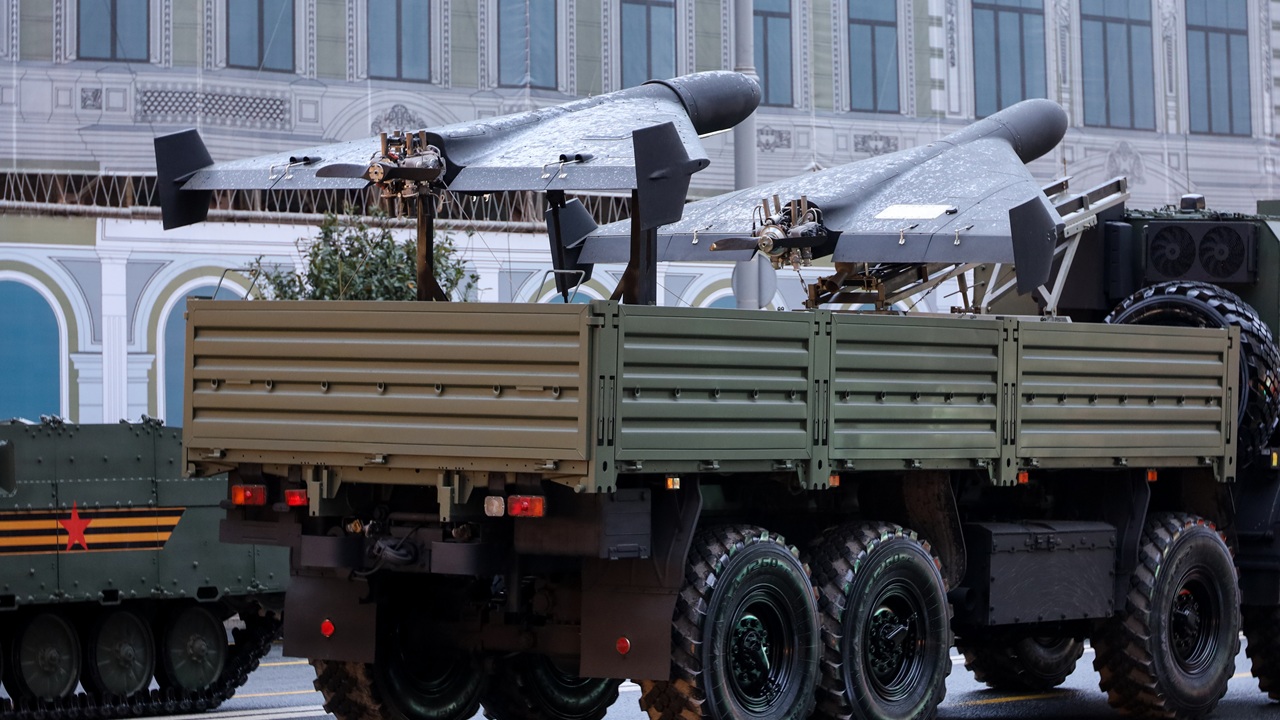
A truck carrying two mounted Geran (Shahed) kamikaze drones in Moscow on April 29, 2025, in preparation for the city’s annual Victory Day parade. (Shutterstock/Oleg Elkov)
Topic: Air Warfare, and Critical Infrastructure Blog Brand: The Buzz Region: Eurasia Tags: Drones, Kamikaze Drones, Russia, Ukraine, and Ukraine War Russia Is Catching Up to Ukraine in the Drone War February 24, 2026 By: Stavros Atlamazoglou
Share
Russia’s drone attacks against Ukraine’s critical infrastructure have mostly been conducted by variants of the Iranian-made Shahed kamikaze drone.
The Russian military continues to rely on one-way attack unmanned aerial systems, also known as kamikaze drones or loitering munitions, for the majority of its tactical, operational, and strategic long-range fires missions. The Kremlin has made clear that it has a single, overriding target: Ukraine’s energy grid and critical infrastructure, without which the country will be left at the mercy of the winter cold.
Russia’s Kamikaze Drone Attacks
In January, the Russian forces launched approximately 4,400 kamikaze drones against Ukraine. This was a slight decrease from December, when the Russian forces launched approximately 5,100 loitering munitions—but that was largely due to the poor weather conditions of last month, which make it difficult for propeller-powered drones to fly.
Judging from the daily launches in the first half of February (approximately 190 kamikaze drones per day), there will likely be an increase from last month.
The Russian forces utilize four main types of kamikaze drones: the Shahed 136, Shahed 131, Geran-2, and Geran-3. The drones are all based on the same fundamental design, a warhead with two wings on either side and a rear propeller. The Shahed drones are designed by Iran, while the Gerans are the Russian version of the Iranian drones.
Drones are the “hottest” weapon in the war in Ukraine. Both the Ukrainians and Russians use unmanned aerial systems profusely for a wide range of mission sets, including kinetic strikes, intelligence, surveillance, and reconnaissance (ISR), artillery spotting, and even resupply of troops on the frontline.
Russian one-way attack unmanned aerial systems predominantly target Ukrainian critical infrastructure. For the past three winters, the Kremlin has targeted its neighbor’s energy grid in a brazen attempt to make the Ukrainian people suffer—and thus increase the pressure on Ukrainian President Volodymyr Zelensky and his government to negotiate.
Since October, the Russian forces have fired over 20,000 kamikaze drones and more than 300 advanced ballistic and cruise missiles against Ukraine’s critical infrastructure, the British Ministry of Defence assessed in a recent intelligence estimate on the Ukrainian conflict.
“[The kamikaze drones and missiles are] fired by its long-range bomber fleet, in attempts to systematically destroy Ukraine’s electrical grid and heat generation capacity,” the British Ministry of Defence estimates.
By relying on one-way attack unmanned aerial systems, the Russian military has diversified its long-range fires capabilities, buying the country’s pressured defense and aerospace industries valuable time.
Drones Help Alleviate Russia’s Missile Shortage
Russia’s capacity to produce advanced new weapon systems has been seriously degraded since the large-scale invasion of Ukraine almost four years ago. Using kamikaze drones offers the country’s industry some valuable breathing space.
“Any pause in this missile usage allows Russia to build its stocks for future strikes with its primary target almost certain to remain energy CNI [critical national infrastructure],” the British Ministry of Defence stated.
International sanctions have seriously degraded the capabilities of the Russian defense and aerospace industries to produce advanced precision-guided munitions for the Russian forces. Russian companies have had to resort to extreme measures, including cannibalizing domestic appliances, such as microwaves, fridges, and washing machines, for their microchips so that they can be used on missiles.
“Russia can also offset any gaps in long-range bomber usage by drawing on its arsenal of deep strike weapons. Short-range ballistic missiles have been heavily relied upon by Russia for this purpose, used in far greater numbers during this winter strike campaign than previously in the conflict,” the British Ministry of Defence concluded in its recent intelligence assessment.
As the fighting continues, reliance on kamikaze drones by both combatants will persist.
About the Author: Stavros Atlamazoglou
Stavros Atlamazoglou is a seasoned defense journalist specializing in special operations and a Hellenic Army veteran (national service with the 575th Marine Battalion and Army HQ). He holds a BA from the Johns Hopkins University and an MA from the Johns Hopkins’ School of Advanced International Studies (SAIS). His work has been featured in Business Insider, Sandboxx, and SOFREP.
The post Russia Is Catching Up to Ukraine in the Drone War appeared first on The National Interest.
Источник: nationalinterest.org