

«Данное сообщение (материал) создано и (или) распространено иностранным средством массовой информации, выполняющим функции иностранного агента, и (или) российским юридическим лицом, выполняющим функции иностранного агента»

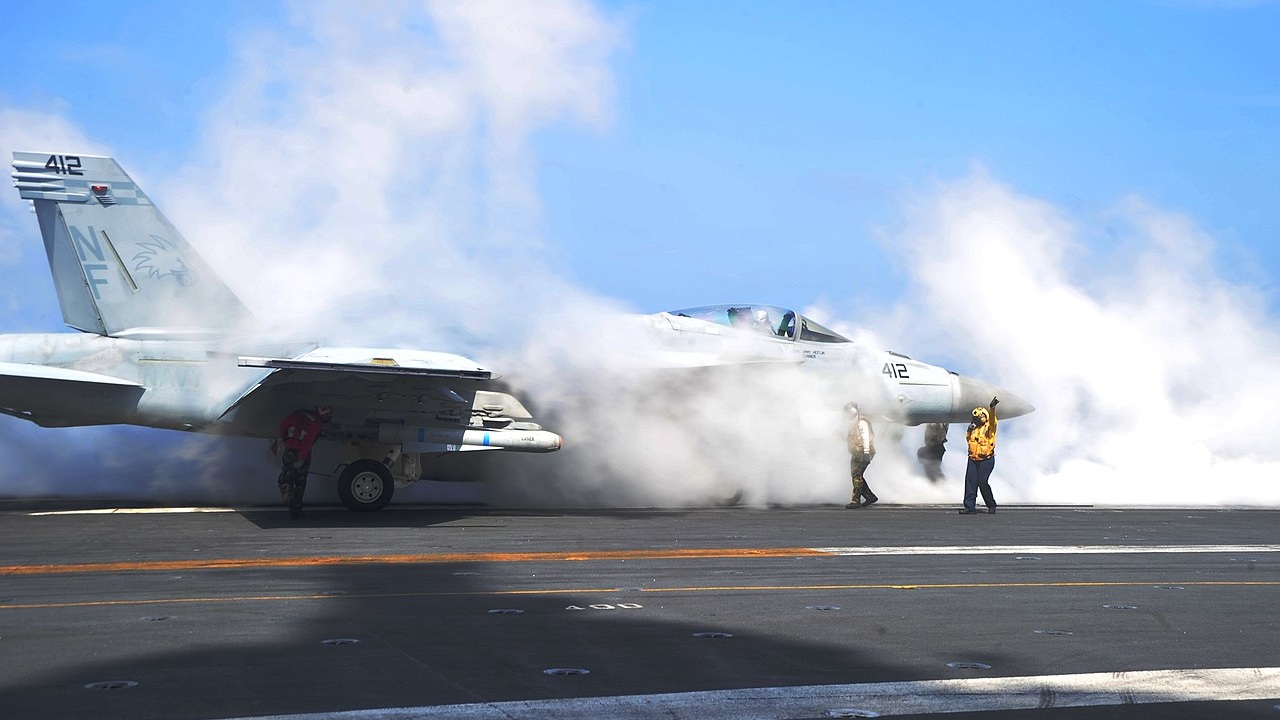
US sailors prepare an F/A-18E Super Hornet aircraft assigned to Strike Fighter Squadron (VFA) 195 for takeoff aboard the aircraft carrier USS George Washington (CVN 73) on November 7, 2013, in the South China Sea. (US Navy/Mass Communications Spc. 3rd Class Paolo Bayas)
Topic: Naval Warfare Blog Brand: The Buzz Region: Americas Tags: Aircraft Carriers, North America, United States, and US Navy How Do Aircraft Carrier Flight Decks Actually Work? February 22, 2026 By: Harrison Kass
Share
Landing a plane on a small flight deck is far harder than on a large runway—and requires a much larger support crew.
Aircraft carrier flight decks are arguably the most complex operational environment in the military. Every launch and recovery cycle is tightly choreographed. A carrier is not just a floating runway—it is an integrated aviation ecosystem. And carrier ops blend physics, logistics, and discipline—enabling sustained air power projection far from land bases.
The Basics of Carrier Operations
Modern US carriers use steam (Nimitz-class) or EMALS (Ford-class) catapults, which accelerate aircraft from zero to 150-plus miles per hour in roughly two to three seconds. Launch weight, wind over deck, and aircraft configuration determine the energy required for each launch. Procedurally, the aircraft taxis into position, nose gear attaches to the shuttle, the holdback bar prevents premature roll. Then, the launch officer, or “shooter,” performs final checks. The aircraft sits with full throttle (or afterburners for fighters) before being launched. Wind over deck is critical; carriers often turn into the wind and increase speed to generate optimal airflow—just like land-based aircraft take off into the wind.
On landings, aircraft approach at 130 to 150 miles per hour. The tail hook catches one of four arresting wires. Hydraulic (Nimitz) or electromagnetic braking systems (Ford) absorb the energy. The landing window is measured in seconds; the approach is guided by a Fresnel lens “meatball” system and Landing Signal Officers (LSOs). When an aircraft misses all four wires, they go around and try again (when an aircraft touches down, the pilot applies full power at the last moment, as a contingency for maintaining enough energy to go around a second time in the event of missing all four wires). On a successful landing, the arresting system must absorb the energy equivalent to a small car crash every time.
Carrier Operations Need a Giant Support Crew
Navy personnel wear color-coded jerseys to signify their role on the flight deck.
- Yellow: aircraft directors
- Green: catapult and arresting gear crew
- Red: ordnance
- Purple: fuel
- Blue: plane handler
- Brown: aircraft captains
Each role is meticulously rehearsed and coordinated, each vital to successful aircraft operations. Between each launch and recovery cycle, the aircraft is repositioned. Limited deck space forces tight sequencing. Operations run in cycles, continuously flowing.
When not in use, the aircraft are stored below deck in a hangar bay. Elevators move aircraft between the hangar and the flight deck. The hangar deck is used for maintenance, repairs, and major systems checks.Space constraints mean maintenance must be efficient.
Fuel is stored deep within the ship in protected tanks and pumped through pressurized lines to the flight deck. Strict grounding procedures are followed to prevent static discharge. Ordnance is stored in armored magazines and elevated via weapons elevators before being assembled and loaded under strict protocols. Both ordnance and fuel operations are conducted meticulously; strict sequencing reduces fire risk.
Why Carrier Operations Matter
Carrier air operations, while difficult and inherently dangerous, allow for rapid power projection, flexible repositioning, and sustained air presence without host-nation permissions. A carrier strike group is ultimately only as effective as its flight deck efficiency. And though launching jets is the primary feature, carrier air operations are about more—synchronized logistics, engineering, and human coordination under extreme constraints. The effectiveness of a carrier in war depends upon deck discipline and maintenance cycles and choreographed coordination between hundreds of sailors.
About the Author: Harrison Kass
Harrison Kass is a senior defense and national security writer at The National Interest. Kass is an attorney and former political candidate who joined the US Air Force as a pilot trainee before being medically discharged. He focuses on military strategy, aerospace, and global security affairs. He holds a JD from the University of Oregon and a master’s in Global Journalism and International Relations from NYU.
The post How Do Aircraft Carrier Flight Decks Actually Work? appeared first on The National Interest.
Источник: nationalinterest.org