
«Данное сообщение (материал) создано и (или) распространено иностранным средством массовой информации, выполняющим функции иностранного агента, и (или) российским юридическим лицом, выполняющим функции иностранного агента»
 Topic: Naval Warfare Blog Brand: The Buzz Region: Asia Tags: China, Great Power Competition, Indo-Pacific, United States, and US Marine Corps Why the US Marine Corps Is Not Ready to Fight China December 10, 2025 By: Brandon J. Weichert
Share
The Marine Corps is America’s strongest fighting force—but is utterly unprepared for a major war in the Indo-Pacific.
China is priming the First Island Chain for a major conflict. This war will determine the geopolitical future of the First Island Chain. Indeed, Beijing has already initiated conflicts with the Philippines for dominance in the South China Sea. It continues what amounts to a massive military buildup that is clearly directed against Taiwan, a nation it has long viewed as a breakaway province.
Understanding China’s Aims in the Indo-Pacific
Beijing’s ultimate goal with capturing Taiwan is to be able to better squeeze Japan to the north. After all, Japan has long been China’s biggest threat—and the Chinese Communist Party (CCP) has never gotten over the ontological shock inflicted upon the country by the Japanese during World War II. Taking Taiwan is but a means to an end. The end is for China to box Japan in and force it to kowtow to Beijing after being cut off from the United States, guaranteeing regional primacy for China.
On from there, the Chinese will push into the Second and, finally, Third Island Chains so that they can squeeze and penetrate the Western Hemisphere, putting the Americans on the defensive. That’s the Chinese long-term ambition. For now, they are confined primarily to seeking dominance in the First Island Chain.
Right now, the United States is nominally opposed to China taking the lead in the First Island Chain, although the recent National Security Strategy put out by the Trump administration suggests there is a real reassessment underway among US defense leaders on this point. But until Washington decides it wants to reverse the policy of the US military—which is currently to assist in resisting Chinese aggression in the First Island Chain—the Pentagon continues planning for military contingencies there.
The Marines Will Stop China… or Will They?
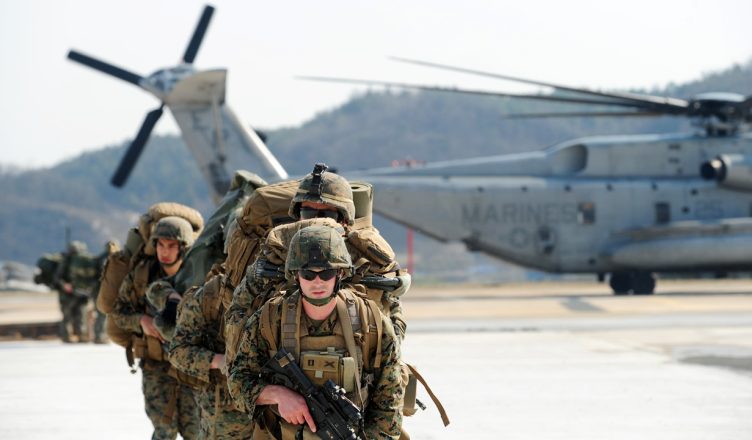
The tip of any American military spear into that region will be the United States Marine Corps. The Indo-Pacific is a tricky geographical region in that it is dominated by a vast expanse of oceanic geography interspersed with difficult island archipelagos. That’s why the US Marines are the best suited for any combat in this area, just as they were during the fight against Imperial Japan in World War II.
There’s only one problem. The US Marine Corps needs way more missiles, troops, and ships than it currently has…or that it is set to have with the recently passed 2026 defense budget—which is set to hit around $1 trillion for the entire defense budget, with $57.2 billion of that going toward modernization that focuses on the development of advanced drones and Indo-Pacific readiness.
In essence, the Marine Corps isn’t ready for a fight that’s coming sooner than anyone in Washington expects. Again, that’s if Washington decides to uphold its current spate of defense commitments with the Philippines, Taiwan, and Japan, which this author remains skeptical that Washington will uphold those agreements at the end of the day.
A recent op-ed in Defense News written by three former US Marine Corps commandants, Charles Krulak, Michael Hagee, and James Conway, illustrates how poorly prepared the Marine Corps is for the fight at hand. According to these experts, the Marine Corps has suffered through a “loss of combined arms capabilities and resilience, reductions in requirements for amphibious ships, emasculation of the Maritime Prepositioning Force, and disregard for an integrated and disciplined combat development process.” The Marines need to work more closely with their brothers and sisters in the Navy to “move beyond the requirement for 31 traditional amphibious ships as well as rebuilding the depleted Maritime Prepositioning Squadrons.”
Moving forward, the USMC leadership must “turn the two Marine Littoral Regiments back into traditional regiments; replace the concept for small, isolated and widely separated Stand-in Forces with forces that are survivable and sustainable; halt the Navy Marine Expeditionary Ship Interdiction System (NMESIS) and Naval Strike Missile programs; and move away from the Landing Ship Museum.”
Finally, Krulak, Hagee, and Conway state that “There is no need to continue down the current path of a largely purpose-built, regional defense force that is neither survivable nor sustainable inside hotly contested areas.”
In other words, the Marines are planning to fight the wrong war, at the wrong time, and with the wrong equipment.
America’s Allies Need a Backup Plan
When the Chinese finally decide to initiate their final war of aggression against Taiwan as part of a larger grand strategy of dominance in the First Island Chain, under current conditions, it is unlikely that the US Marine Corps will be prepared to fully fight—and repel—such an attack.
That’s why the Pentagon’s new NSS memo is becoming such a point of contention in the capitals of places, like Taiwan and Japan.
Because, fundamentally, the defense of these nations rests upon a robust US military response to any attack upon them by China. That defense is unlikely to come—especially if the US military itself is incapable of fighting such a war.
Washington would rather simply turn away from these troubled regions rather than face military defeat at the hands of an enemy force, like that of China.
About the Author: Brandon J. Weichert
Brandon J. Weichert is a senior national security editor at The National Interest. Recently, Weichert became the host of The National Security Hour on America Outloud News and iHeartRadio, where he discusses national security policy every Wednesday at 8pm Eastern. Weichert hosts a companion book talk series on Rumble entitled “National Security Talk.” He is also a contributor at Popular Mechanics and has consulted regularly with various government institutions and private organizations on geopolitical issues. Weichert’s writings have appeared in multiple publications, including The Washington Times, National Review, The American Spectator, MSN, and the Asia Times. His books include Winning Space: How America Remains a Superpower, Biohacked: China’s Race to Control Life, and The Shadow War: Iran’s Quest for Supremacy. His newest book, A Disaster of Our Own Making: How the West Lost Ukraine is available for purchase wherever books are sold. He can be followed via Twitter @WeTheBrandon.
Image: Shutterstock / Yeongsik Im.
The post Why the US Marine Corps Is Not Ready to Fight China appeared first on The National Interest.
Источник: nationalinterest.org