
«Данное сообщение (материал) создано и (или) распространено иностранным средством массовой информации, выполняющим функции иностранного агента, и (или) российским юридическим лицом, выполняющим функции иностранного агента»
 Topic: Air Warfare Blog Brand: The Buzz Region: Americas Tags: Caribbean, F-16 Fighting Falcon, Sanctions, South America, United States, US Air Force, and Venezuela Should America Be Worried About Venezuela’s F-16 Fleet? Not Really. December 8, 2025 By: Harrison Kass
Share
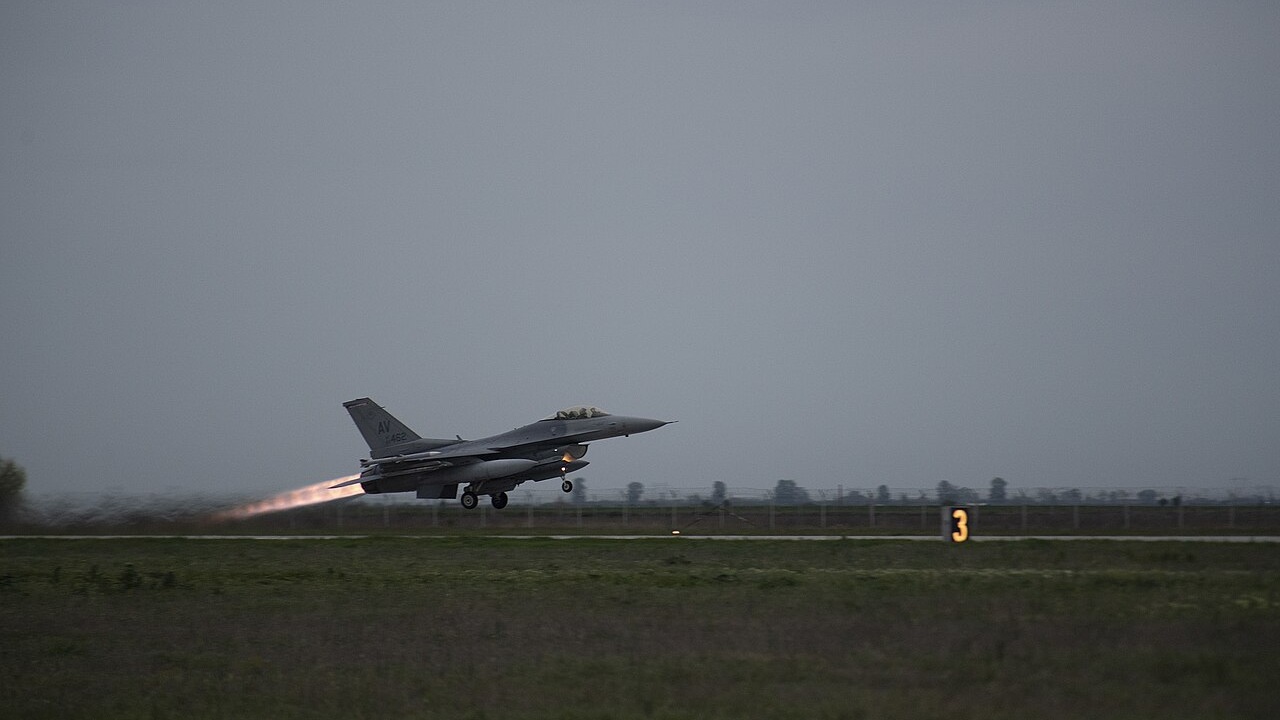
Of the 24 F-16 Fighting Falcons in Venezuela’s air force, as few as five remain airworthy today.
Before it bought the more modern Su-30MK2 Flanker fighter jet from Russia, Venezuela’s most advanced combat aircraft was the F-16A/B Fighting Falcon. Indeed, the F-16 was the most advanced combat aircraft in the entire region. Purchased during a period of close US-Venezuelan cooperation, the F-16s symbolized Venezuela’s efforts to modernize and align with the US. Yet four decades later, the fleet is a shadow of its former self—a physical reminder of how drastically the US-Venezuelan relationship has changed.
The (Venezuelan) F-16 Fighting Falcon’s Specifications
- Year Introduced: 1983
- Number Built (Venezuela): 24 F-16A/B Block 15
- Length: 49 ft 5 in (15.06 m)
- Wingspan: 32 ft 8 in (9.96 m)
- Weight (MTOW): ~42,300 lb (19,187 kg)
- Engines: One F100-PW-200 turbofan (23,830 lbf thrust with afterburner)
- Top Speed: 1,176 kn (1,353 mph, 2,178 km/h) / Mach 2.0
- Range: Combat radius ~500 mi (800 km); ferry range ~2,200+ mi (3,540 km)
- Service Ceiling: ~50,000 ft (15,200 m)
- Loadout: 9 hardpoints; ~17,000 lb (7,700 kg) payload; AIM-9P/L Sidewinders, unguided bombs, 20mm M61A1 Vulcan cannon
- Aircrew: 1 (A model) / 2 (B model)
Why Does Venezuela Have F-16 Fighter Jets in the First Place?
In the early 1980s, Venezuela faced regional instability, notably guerrilla conflicts and border tensions with Colombia. The United States, always eager to export its technology to other nations and build up supply linkages, encouraged Latin American partners to modernize with Western equipment. Venezuela opted to replace its aging F-5 and Mirage fleet with the F-16A/B Block 15, becoming the only Latin American country to receive F-16s directly from the United States.
In 1984, Venezuela ordered 24 F-16s under the Peace Delta program. Deliveries occurred between 1983 and 1984, with the US providing full logistics and parts support, pilot training, and armament packages that included the AIM-9 Sidewinder, a short-range air-to-air missile for close-in engagement. The transaction signaled a strong, mutually beneficial relationship between the US and Venezuela, during the Cold War, a time when international courtship held extra weight.
The F-16A (single-seat) and F-16B (two seat) fighters represented a significant upgrade for the Venezuelan Air Force. The F-16 was a bona fide fourth-generation aircraft. Historically, Venezuela used its F-16s extensively for air sovereignty missions and for interception of unidentified aircraft. The platform served as Venezuela’s premier air combat platform through the 1980s and 1990s. Notably, when charismatic army officer Hugo Chavez launched a coup attempt in 1992, rebel pilots used the F-16 to attack government positions.
Venezuela Can’t Fly Most of Its F-16 Fleet Any Longer
After Chavez won election to the Venezuelan presidency through lawful methods in 1998, Venezuela’s relationship with the United States soured sharply. Washington imposed an arms embargo on Caracas in 2006, halting all F-16 support. Venezuela attempted alternative maintenance paths, like cannibalizing existing aircraft for parts, attempting to buy components through third countries, and limited local refurbishment efforts. But without official support, avionics and engines began to fail, and combat readiness declined. By 2010, fewer than half of the F-16 fleet remained airworthy; current reports estimate that only between 5 and 8 jets are operational at any given time, with airframes grounded for lack of spare parts, engine maintenance shortfalls, radar and avionics failures, fuel scarcity, and limited flight hours.
Strategically, the F-16 once gave Venezuela an edge over regional rivals. But today, Colombia’s Kfir, Brazil’s Gripen, and Chile’s F-16C/D all outperform the degraded Venezuelan F-16s. The fleet’s decay reflects Venezuela’s pivot away from US partnership, towards a reliance on Russia and China. Operationally, the decay has had consequences; border patrols, counter-narcotics interdictions, and sovereignty missions are increasingly difficult. The air force has limited ability to project power, or respond quickly to crises.
Today, the F-16 fleet serves not only as a symbol of deterioration in the US-Venezuelan relationship, but Venezuela’s deterioration generally under the weight of isolation and economic catastrophe.
About the Author: Harrison Kass
Harrison Kass is a senior defense and national security writer at The National Interest. Kass is an attorney and former political candidate who joined the US Air Force as a pilot trainee before being medically discharged. He focuses on military strategy, aerospace, and global security affairs. He holds a JD from the University of Oregon and a master’s in Global Journalism and International Relations from NYU.
Image: Wikimedia Commons.
The post Should America Be Worried About Venezuela’s F-16 Fleet? Not Really. appeared first on The National Interest.
Источник: nationalinterest.org