
«Данное сообщение (материал) создано и (или) распространено иностранным средством массовой информации, выполняющим функции иностранного агента, и (или) российским юридическим лицом, выполняющим функции иностранного агента»
 Topic: Air Warfare Blog Brand: The Buzz Region: Europe Tags: Aircraft, Russia, Russian Aerospace Forces, Su-34 Fullback, and Ukraine War Russia Just Sent Another Batch of Su-34 Fighter-Bombers into Ukraine December 19, 2025 By: Brandon J. Weichert
Share
The latest deployment of Russian aircraft to Ukraine gives lie to the notion that Russia’s defense sector cannot produce sophisticated platforms at scale.
For many months, pro-NATO commentators have argued that Russia is collapsing as a result of Ukraine’s resistance in the ongoing war occurring between Russia and Ukraine. According to this narrative, the Russians, whose gross domestic product (GDP) is comparable to that of Italy’s, cannot sustain their war in Ukraine. Instead, Russia’s war is fueled by old stockpiles of Soviet-era systems—and once these stockpiles ran out, Russia would be well and truly finished.
Cracks in that narrative have been forming for a while. Now they’re become downright chasms. Even NATO Secretary General Mark Rutte has acknowledged that the Russian defense industrial base can produce every three months what it takes the NATO defense industrial base an entire year to make.
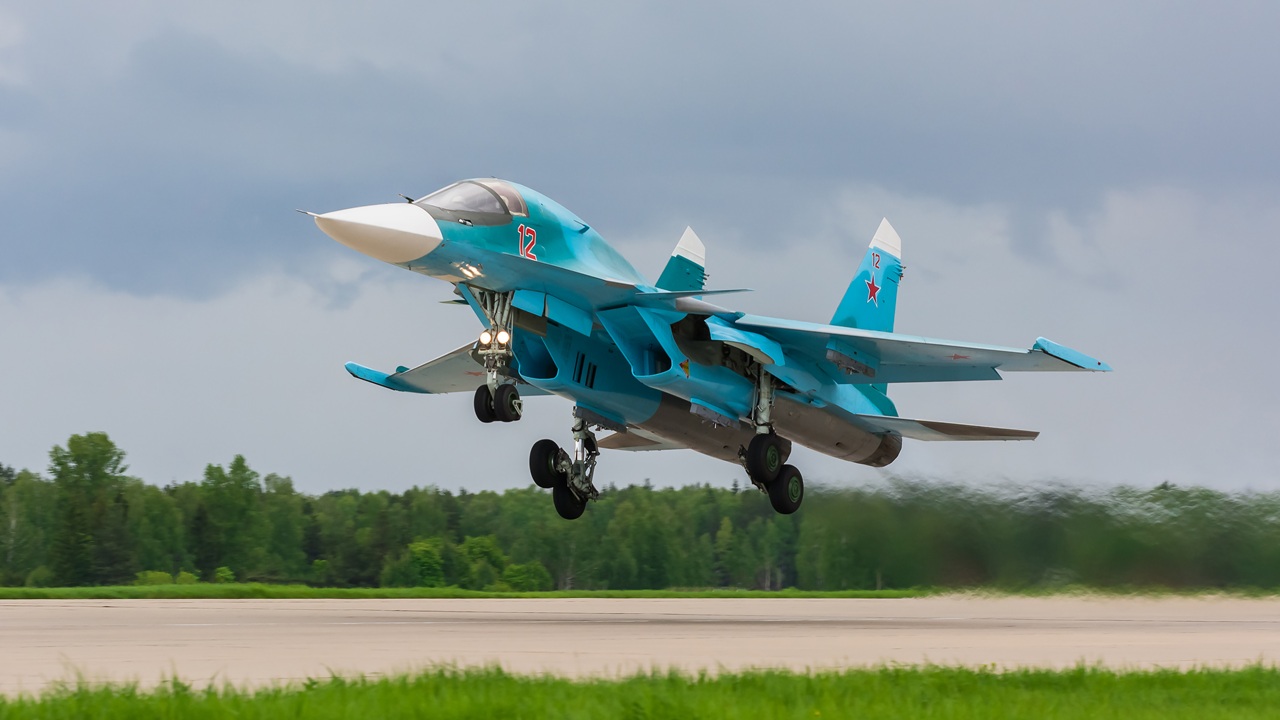
Last week, the United Aircraft Corporation (UAC), a subsidiary of Russian defense firm Rostec, delivered yet another batch of the Su-34 Fullback fighter-bombers to the Russian Aerospace Forces (VKS).
About the Su-34 Fullback
- Year Introduced: 2014
- Number Built: Fewer than 200
- Length: 23.34 m (76 ft 7 in)
- Wingspan: 14.7 m (48 ft 3 in)
- Weight (MTOW): 45,100 kg (99,430 lb)
- Engines: Two Saturn AL-31FM1afterburning turbofan engines, 132 kN (30,000 lbf) with afterburner
- Top Speed: 1,900 km/h (1,180 mph) / Mach 1.8 at altitude
- Range: 4,000 km (2,485 mi) with external fuel tanks
- Service Ceiling: 14,650 m (48,000 ft)
- Loadout: One 30 mm GSh-301 cannon with 150 rounds, 12 hardpoints for a variety of air-to-air and air-to-surface missiles, guided bombs, and unguided rockets
- Aircrew: Two (2) side-by-side seating
The Su-34 is a twin-seat, twin-engine fighter-bomber that can strike against naval and ground targets. It can be used to obliterate air defense (AD) surrounding critical infrastructure and key military command-and-control (C2) targets. It can also attack air threats at extended ranges.
That last bit is important, since the air war over Ukraine has been defined by extended range strikes—in large part because the air defenses of Ukraine have helped to create a barrier that is hard (and dangerous) to breach by the Russian Aerospace Forces.
One of the primary roles that the Su-34 has filled in the Ukraine War has been as a vehicle to drop UMPK/UMPB guided bombs from 37-56 miles behind the frontlines from inside the relative safety of Russia. This has given Moscow’s forces greater flexibility in terms of striking Ukrainian positions without having to put their warplanes at the tender mercies of NATO-provided air defenses covering Ukrainian territory.
The Su-34 Is Russia’s Most Important Warplane Today
Most analysts agree that the Su-34 has been the VKS’ most important air asset in the Ukraine War. Of course, even with the standoff tactics employed to preserve these warplanes, the Su-34 has seen significant losses at the hands of Ukrainian defenders.
Experts assess that, because the plane is not a stealth bird, because it is a larger airframe, and because it must run predictable flight patterns for bombing runs into Ukraine, NATO-provided air defenses in Ukraine have an easier time tracking these plans. Yet that only tells part of the story.
It is imperative to understand that the Russians are engaged in a full-blown war that, in their view, is not only against Ukraine, but against Ukraine’s NATO backers. In that sense, the Ukraine War is not akin to the American wars in Iraq or Afghanistan, but a near-peer conflict that has required the full commitment of Russian forces.
So, naturally, there will be higher numbers of combat losses. It is doubtful that the US or European militaries, if faced with a similar situation, would perform much better in terms of losing aircraft in combat. But the Russians continue adapting—and the Russian Armed Forces fighting in Ukraine today are fundamentally different, indeed they are better than the Russian Armed Forces that invaded Ukraine in 2022.
Hard lessons learned have been quickly applied to Russian forces. That is why the Russians are consistently fighting better—and beating—the Ukrainians.
In War, Militaries Adapt or Die—and Russia Has Adapted
The Su-34s that were recently produced by UAC in Russia are reported to have been upgraded based on those hard lessons learned in the air war over Ukraine, too. Advances like enhanced offensive and electronic warfare (EW) capabilities, along with new types of rocket-powered glide bombs that possess extended ranges continue to expand the long-distance reach of the Su-34s.
Over the last few years, there have been many critical writeups in American and European press about the Su-34 and its allegedly high losses (one source claims at least 41 of these planes have been lost in combat since the start of the war). Even if these figures are accurate, however, the Russians are engaged in what amounts to a near-peer struggle with NATO as well as Ukraine. And it would seem that the Kremlin is not having any difficulty replacing—and enhancing—those lost Su-34s.
Can American and European air forces make the same claim about their warplanes, if they were lost under similar combat conditions and in similar numbers to the Russian Su-34s?
About the Author: Brandon J. Weichert
Brandon J. Weichert is a senior national security editor at The National Interest. Recently, Weichert became the host of The National Security Hour on America Outloud News and iHeartRadio, where he discusses national security policy every Wednesday at 8pm Eastern. Weichert hosts a companion book talk series on Rumble entitled “National Security Talk.” He is also a contributor at Popular Mechanics and has consulted regularly with various government institutions and private organizations on geopolitical issues. Weichert’s writings have appeared in multiple publications, including The Washington Times, National Review, The American Spectator, MSN, and the Asia Times. His books include Winning Space: How America Remains a Superpower, Biohacked: China’s Race to Control Life, and The Shadow War: Iran’s Quest for Supremacy. His newest book, A Disaster of Our Own Making: How the West Lost Ukraine is available for purchase wherever books are sold. He can be followed via Twitter @WeTheBrandon.
Image: Shutterstock / Arseniy Shemyakin Photo.
The post Russia Just Sent Another Batch of Su-34 Fighter-Bombers into Ukraine appeared first on The National Interest.
Источник: nationalinterest.org