
«Данное сообщение (материал) создано и (или) распространено иностранным средством массовой информации, выполняющим функции иностранного агента, и (или) российским юридическим лицом, выполняющим функции иностранного агента»
 Topic: Trade Blog Brand: Silk Road Rivalries Region: Asia, and Eurasia Tags: Afghanistan, Central Asia, China, Japan, Kazakhstan, Middle Corridor, Russia, Sanae Takaichi, and United States Japan’s Development Pitch to Central Asia December 25, 2025 By: Eldar Mamedov
Share
By announcing new investments in Central Asia, Japan is entering a crowded field of competition and must prove the advantages of cooperation with it.
The first Japan-Central Asia summit reflects Tokyo’s new foreign policy activism and the latest move in Central Asia’s hedging strategy, which seeks to leverage a growing interest of major powers in the region. It does not, however, necessarily herald a new phase of geopolitical competition in Eurasia.
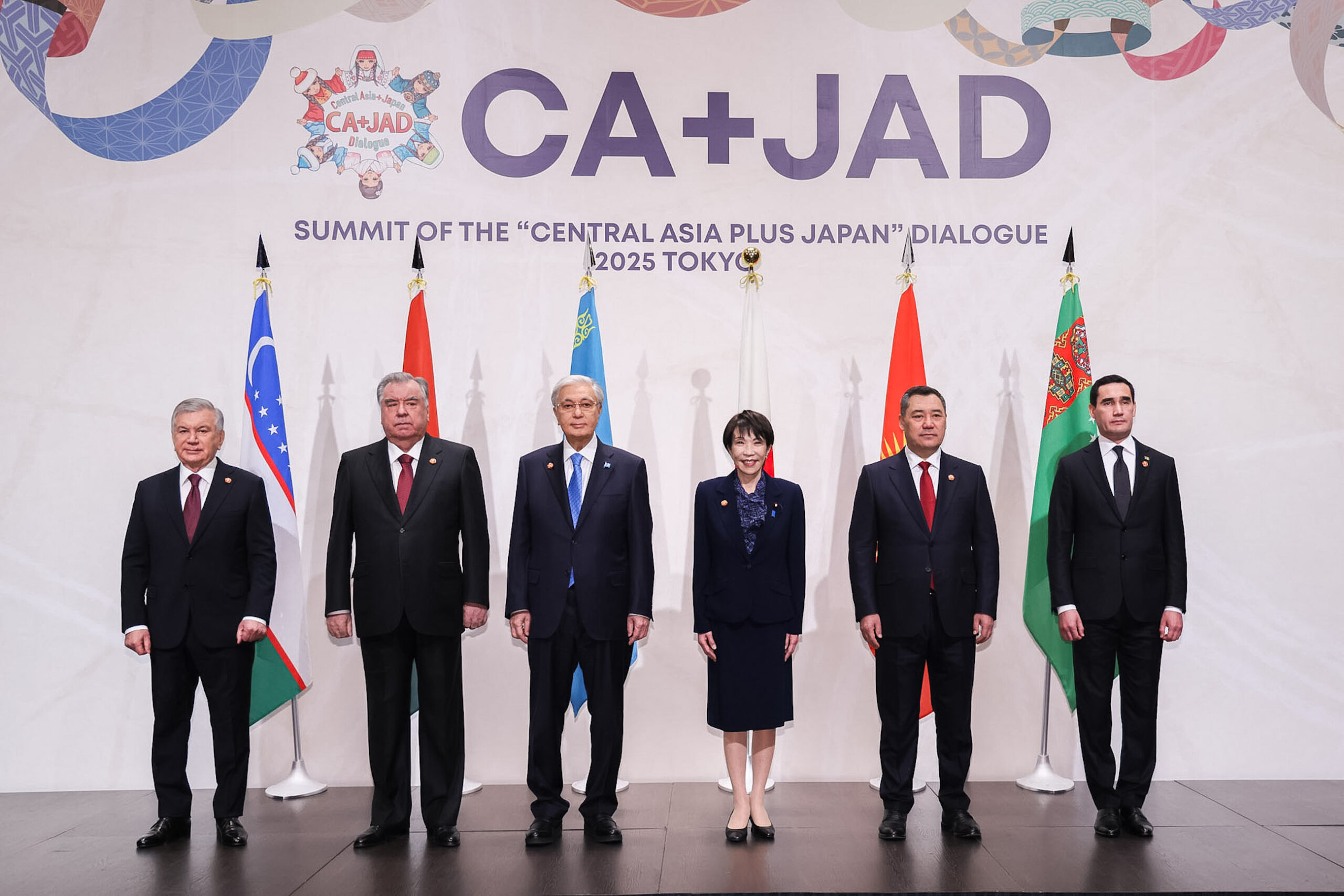
The timing, from Tokyo’s perspective, was in itself a strategic signal. Just two months into her premiership, Japanese prime minister Sanae Takaichi—known for her assertive rhetoric on China aimed at limiting Beijing’s regional influence—convened the inaugural leaders’ summit of the “Central Asia plus Japan” dialogue (CA+JAD) in Tokyo on December 20. This act, following canceled summits under her predecessors, underscored the priority.
The summit’s substantial outcome—a 53-point Tokyo Declaration and Japan’s $19 billion commitment to Central Asia—marks Japan’s turn from patient “Silk Road Diplomacy” to a more proactive geoeconomic doctrine aimed at shaping Eurasia’s future to its benefit. For Takaichi, this move serves a dual domestic and international purpose. It demonstrates a reliable, committed partnership to Central Asian nations and signals Tokyo’s readiness to contest Beijing’s primacy in a critical region.
Japan’s new “CA+JAD Tokyo Initiative” is built on three pillars: green transition, connectivity, and human resource development. While framed as a partnership, its execution would offer an alternative development model to the dominant influences in the region, particularly those of Russia and China.
In connectivity, the competition is most tangible. By pledging support for the Trans-Caspian International Transport Route (the Middle Corridor) and offering to modernize customs at Kazakhstan’s port of Aktau, a key Eurasian node, Japan is not only investing in trade but also backing a key corridor that bypasses Russia.
The focus on green transition similarly serves a dual purpose. It addresses Central Asia’s climate vulnerabilities while securing for Japan diversified supplies of critical minerals such as uranium and rare earths—resources crucial to its high-tech industry. It is about economic security as much as it is about green partnership.
Beyond economics, the summit forged a subtle but significant security alignment. In a carefully negotiated exchange, Japan backed Central Asia’s primary security concern: stabilizing Afghanistan and mitigating spillover threats of terrorism and instability. In the face of declining Western interest in Afghanistan, Japan’s engagement with Central Asian states on the challenges posed by that country could certainly prove helpful, as Tokyo continues its dialogue with Kabul after the Taliban’s return to power.
In return, the Central Asian states affirmed support for Japan’s core security objective: the complete denuclearization of the Korean Peninsula. This sends a significant diplomatic message: it asserts their independent foreign policy while subtly distancing them from Russia, the region’s traditional hegemon.
Historically, Moscow supported non-proliferation efforts and participated in international talks aimed at the denuclearization of North Korea, alongside Japan and other world powers. However, it reversed its stance since its full-scale invasion of Ukraine in 2022, which led to a deepening military and political partnership with Pyongyang.
Japan, which views a nuclear-armed North Korea as an existential threat, also considers the Ukraine War a direct concern due to its own unresolved territorial dispute with Russia over the Kuril Islands. There is still no peace agreement between the two countries. Tokyo staunchly supported Ukraine from the outset of the Russian invasion, and even concluded a security agreement with Kyiv to bolster Ukraine’s defense. Securing the Central Asians’ endorsement of their key security concern was a key objective of the summit.
In a broader sense, for Japan, it is a move to gain strategic depth and diplomatic partners in a world where its “strategic loneliness” is becoming more pronounced. Tokyo’s new activism in Central Asia is driven not only by Chinese and Russian competition but also by uncertainty over the reliability of the US security umbrella under the Trump administration.
While Trump’s recent visit to Japan was deemed a success, the longer-term implications of the renewed US focus on the Western Hemisphere, as enshrined in the new National Security Strategy (NSS), are worrying for Tokyo. The document explicitly states that the United States is “no longer an Atlas propping up the world.” It demands that its allies, among whom are “many wealthy and sophisticated nations,” including Japan, increase their defense spending. While Japan, particularly under Prime Minister Takaichi, appears to be serious about taking action in that direction, it seeks all the insurance it can against the perceived volatility of US ties.
The summit with Central Asia signals this profound shift. Japan is no longer a neutral development actor but an engaged strategic player in Eurasia. Takaichi’s assertive line on China provides the political drive, while the $19 billion commitment provides the tools. The goal, from Tokyo’s viewpoint, is clear: a resilient, Japanese-aligned source of connectivity and natural resources that reduces regional dependence on both China and Russia.
It should be noted, however, that Central Asia is a crowded field. For Central Asian nations to strengthen ties with Tokyo is another act of multi-vector hedging. This year alone, regional nations held summits with the United States, the European Union, the Gulf Cooperation Council, and China’s Belt and Road Initiative, and Russian influence was constantly present. Their strategy is to balance between powers, not choose one.
The ultimate test for Japan’s initiative, therefore, will be whether its offer of a “quality alternative” to Central Asia’s needs—on climate, trade, digital and green transition, security—can provide the regional states with enough tangible benefits to justify their balancing act, all while avoiding directly antagonizing Russia and China.
About the Author: Eldar Mamedov
Eldar Mamedov is a Brussels-based foreign policy expert. He has degrees from the University of Latvia and the Diplomatic School in Madrid, Spain. He has worked in the Ministry of Foreign Affairs of Latvia and as a diplomat in Latvian embassies in Washington and Madrid. Since 2009, Mamedov has served as a political advisor for the Social Democrats in the Foreign Affairs Committee of the European Parliament (EP) and is in charge of the EP delegations for inter-parliamentary relations with Iran, Iraq, and the Arabian Peninsula. Find him on X: @EldarMamedov4.
Image: Office of the Prime Minister of Japan.
The post Japan’s Development Pitch to Central Asia appeared first on The National Interest.
Источник: nationalinterest.org