
«Данное сообщение (материал) создано и (или) распространено иностранным средством массовой информации, выполняющим функции иностранного агента, и (или) российским юридическим лицом, выполняющим функции иностранного агента»
 Topic: Air Warfare, and Trade Blog Brand: The Buzz Region: Americas Tags: Defense Advanced Research Projects Agency (DARPA), Defense Industry, Explosives, North America, Supply Chains, and United States DARPA Wants to Create Nitric Acid from Thin Air December 11, 2025 By: Brandon J. Weichert
Share
Currently, nitric acid—a crucial chemical for weapons production—must be synthesized from ammonia, tying the United States to foreign exporters and presenting a supply chain risk in a future war.
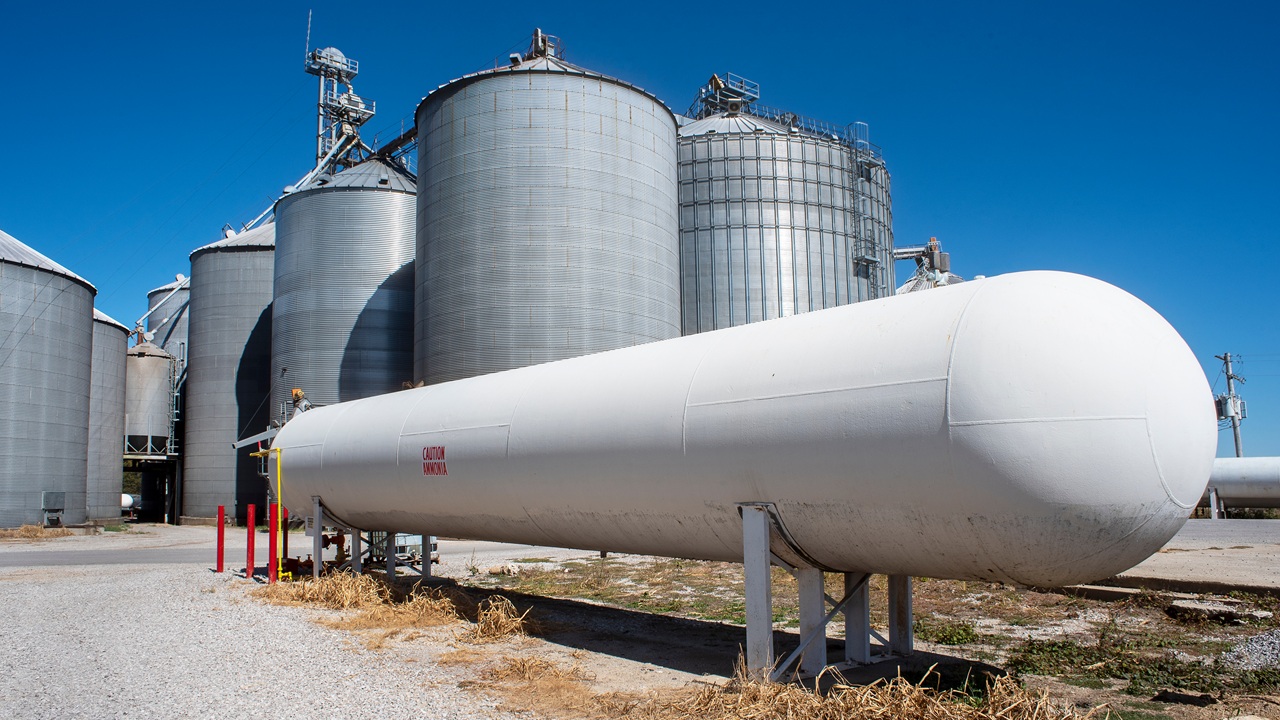
Ammonia is one of the elements that few people think about outside the industrial sectors of America. But they should be aware of it. Because it’s an important factor in America’s industrial production—notably for defense.
The United States Depends on Foreign Ammonia
And the Pentagon just made a bold move to make the United States less dependent on ammonia supplies. Today, 90 percent of America’s ammonia supply is imported. That creates a clear strategic vulnerability that US rivals could exploit in a major war. The world has already witnessed how the Chinese have exploited key bottlenecks in America’s high-tech supply chain due to Beijing’s dominance on rare earth minerals.
While the United States mostly sources its ammonia from friendly countries, most notably Canada and Trinidad and Tobago, the concern is that being dependent on any foreign power for such an important element is far too risky in today’s increasingly de-globalizing world—especially as the risk of great power war nears.
Ammonia is a primary element used in the process of creating nitric acid. Nitric acid itself is central for the production of the US military’s munitions. It is also important for industrial processes in the civilian economy, as well as for global food production.
Can DARPA Make Nitric Acid Without Ammonia?
The production of nitric acid traditionally requires an exhaustive, multi-step process wherein ammonia is initially produced via the Haber-Bosch process and then converted into nitric acid via the Ostwald process. Accordingly, ammonia is an essential chemical precursor in all large chemical factories.
The Defense Advanced Research Projects Agency (DARPA) views this as an unacceptable liability and has initiated an ambitious program meant to decentralize—and localize—the supply chain for the production of nitric acid. One proposal DARPA is fixating on falls under the imprimatur of their HNO3 program, which basically aims to produce nitric acid (HNO3) without the need for ammonia.
DARPA’s HNO3 project wants to make nitric acid directly from air and water. If successful, this new method could allow onsite nitric acid production that utterly blasted away America’s reliance on foreign sources of ammonia. Defence Blog reports that decentralizing production on this scale would be better for the US military, as it would avoid supply chain disruptions or trade restrictions—thereby ensuring that the key chemical would be available at any time.
This is likely a proof-of-concept for other key minerals and chemicals that the United States military is far too dependent on foreign sources for, especially the rare earth minerals that are important for US technology but controlled by the likes of China.
There are some various methods that DARPA might be employing to simplify the production of nitric acid—possibly even achieving production at unconventional sites, like forward operating bases if need be!
The Science of Synthesizing Nitric Acid
Chemical reactors are required to achieve DARPA’s ambitious goal of oxidizing nitric acid directly from air and water and bypassing entirely the use of ammonia as a precursor. When DARPA uses terms like “chemical reactors” in their documents, it is not being used for energy production necessarily as, say, a nuclear reactor would be employed.
In chemistry, a chemical reactor is a machine where a chemical reaction—in this case the creation of nitric acid—occurs.
One such method DARPA might employ would be the Plasma-Assisted Nitrogen Oxidation Reactor. This uses high-voltage electrical discharges to churn out nitric acid.
Plasma reactors can oxidize nitrogen directly. It works with only air and electricity and there’s no need for catalysts. Still, plasma energy is intensive, and scaling down creates massive inefficiency for the producers.
DARPA being the innovative scientific research body it is, utterly abhors energy-wasting methods. In fact, DARPA emphasizes “thermodynamic limits” and stringently opposes high energy inputs for their products, meaning that plasma reactors, while possible, are likely to be less favored.
What DARPA does tend to approve of are revolutionary processes. That’s why a hybrid electro-catalytic/plasma reactor might be the way that DARPA chooses to go instead. Essentially, plasma discharge activates nitrogen, and an electrochemical cell completes oxidation and acid formation. This would merge high activation efficiency with much lower energy costs. And DARPA has previously funded similar hybrid systems in other programs.
Basically, DARPA is trying to create a new way for creating an essential chemical—but also to create for itself a field-deployable nitric acid electrolyzer, which doesn’t yet exist at the commercial scale.
If DARPA Can Do Nitric Acid, What Else Can It Do?
Should DARPA achieve its objectives, it will revolutionize the way American munitions are produced—as well as several other civilian industrial processes that could fundamentally transform manufacturing in the United States.
You can bet that if DARPA succeeds in this decentralized, energy-efficient form of radical chemistry, it will attempt similar modular processes with other sensitive chemicals and materials. After all, nitric acid is not the only essential element upon which the United States is dangerously dependent.
About the Author: Brandon J. Weichert
Brandon J. Weichert is a senior national security editor at The National Interest. Recently, Weichert became the host of The National Security Hour on America Outloud News and iHeartRadio, where he discusses national security policy every Wednesday at 8pm Eastern. Weichert hosts a companion book talk series on Rumble entitled “National Security Talk.” He is also a contributor at Popular Mechanics and has consulted regularly with various government institutions and private organizations on geopolitical issues. Weichert’s writings have appeared in multiple publications, including The Washington Times, National Review, The American Spectator, MSN, and the Asia Times. His books include Winning Space: How America Remains a Superpower, Biohacked: China’s Race to Control Life, and The Shadow War: Iran’s Quest for Supremacy. His newest book, A Disaster of Our Own Making: How the West Lost Ukraine is available for purchase wherever books are sold. He can be followed via Twitter @WeTheBrandon.
Image: Shutterstock / Jon Rehg.
The post DARPA Wants to Create Nitric Acid from Thin Air appeared first on The National Interest.
Источник: nationalinterest.org