
«Данное сообщение (материал) создано и (или) распространено иностранным средством массовой информации, выполняющим функции иностранного агента, и (или) российским юридическим лицом, выполняющим функции иностранного агента»
 Topic: Air Warfare Blog Brand: The Buzz Region: Americas Tags: Cruise Missiles, Joint Strike Missile, Missiles, Norway, United States, and US Air Force America’s New Joint Strike Missile Is Key for Beyond-Visual-Horizon Warfare December 27, 2025 By: Brandon J. Weichert
Share
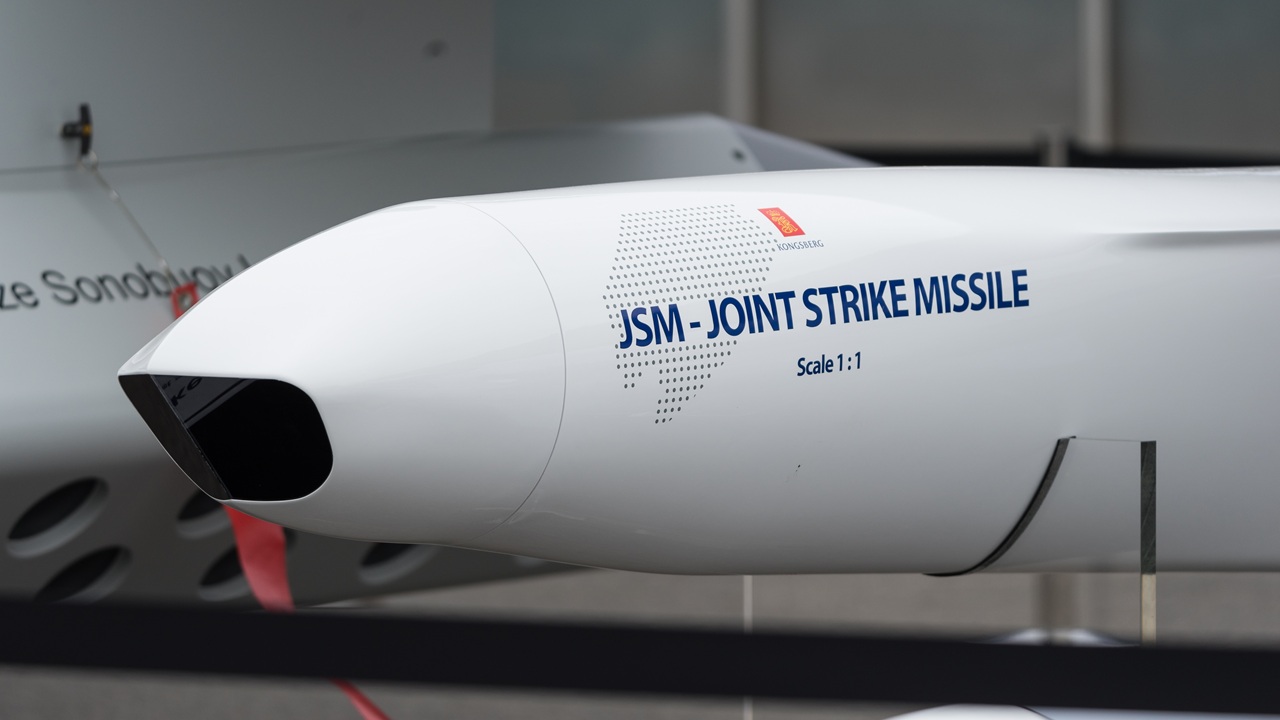
The Joint Strike Missile—under development by Norwegian defense contractor Kongsberg for the US Air Force—includes key stealth features that previous US air-to-ground missiles have lacked.
Kongsberg Defense and Aerospace has been awarded a $240.9 million firm-fixed-price contract for the United States Air Force’s Joint Strike Missile (JSM) Lot Two production. According to Army Recognition, an online trade publication, “The sole-source award covers all-up-round missiles, containers, test hardware, and support equipment, with work performed in Norway through November 30, 2028.”
The JSM is designed to be internally carried by the F-35A Lightning II fifth-generation multirole warplane.
About the JSM Missile
A stealthy, air-launched cruise missile for land and sea strikes, the JSM weighs around 917 pounds and is about 156 inches long. It can achieve high subsonic speeds and has a range of 189 nautical miles. The warhead it employs is a blast-fragmentation explosive. GPS, internal navigation system (INS), TERCOM, Imaging Infrared (IIR) seeker with Autonomous Target Recognition (ATR), ensures that the weapon will be highly accurate.
And in today’s electronically degraded environments, that is very important. GPS satellite signals can be blocked. Having those other guidance systems available allows for redundancy. A two-way Link 16 compatible data link is employed during flight.
The weapon itself is a stealthy design and is all the stealthier because it rides inside the F-35A. This weapon can also be carried by F/A-18 E/F and F-15E warplanes.
JSM’s low-altitude, sea-skimming profile allows for this weapon to evade anti-missile defenses, too. Interestingly, the JSM is actually a derivation of Kongsberg’s Naval Strike Missile that has been repurposed for air launch.
According to Defence Blog, an industry publication, “The Joint Strike Missile is expected to complement other U.S. Air Force and Navy strike weapons by providing a survivable option for penetrating defended airspace. When carried internally by the F-35, the missile allows aircraft to strike targets from extended ranges while reducing exposure to enemy air defenses.”
Why the JSM Project Matters
Therein lies the significance of this program.
The Ukraine War has shown how advanced air defenses are stymying conventional air war doctrine. No longer able to reliably project overwhelming airpower into contested domains, as the Russians have learned the hard way after three years (and counting) of warfare, the Kremlin has evolved its new air war doctrine to focus on beyond-visual-range (BVR) capabilities.
By doing this, the Russians have ensured their warplanes have an increased risk of surviving missions against Ukrainian targets while still allowing for Russian bombardment of Ukrainian targets to be successful.
The world has watched these developments closely, and everyone now understands that the way the world’s militaries have planned for air campaigns will no longer work.
Between increasingly sophisticated air defenses, as well as with drone swarms, and other jamming techniques, the fact remains that air superiority is an increasingly fleeting prospect—even for some of the most powerful air forces in the world.
Therefore, the Americans are having to retool their weapons and tactics to account for the reality that aerial bombardment will be a more complex affair over the modern battlefield—even against enemies that might appear to be weaker than the American force.
That’s why the new JSM is important for the US Air Force and Navy.
About the Author: Brandon J. Weichert
Brandon J. Weichert is a senior national security editor at The National Interest. Recently, Weichert became the host of The National Security Hour on America Outloud News and iHeartRadio, where he discusses national security policy every Wednesday at 8pm Eastern. Weichert hosts a companion book talk series on Rumble entitled “National Security Talk.” He is also a contributor at Popular Mechanics and has consulted regularly with various government institutions and private organizations on geopolitical issues. Weichert’s writings have appeared in multiple publications, including The Washington Times, National Review, The American Spectator, MSN, and the Asia Times. His books include Winning Space: How America Remains a Superpower, Biohacked: China’s Race to Control Life, and The Shadow War: Iran’s Quest for Supremacy. His newest book, A Disaster of Our Own Making: How the West Lost Ukraine is available for purchase wherever books are sold. He can be followed via Twitter @WeTheBrandon.
Image: Shutterstock / Sergey Kohl.
The post America’s New Joint Strike Missile Is Key for Beyond-Visual-Horizon Warfare appeared first on The National Interest.
Источник: nationalinterest.org