
«Данное сообщение (материал) создано и (или) распространено иностранным средством массовой информации, выполняющим функции иностранного агента, и (или) российским юридическим лицом, выполняющим функции иностранного агента»
 Topic: Diplomacy, and Naval Warfare Blog Brand: The Buzz Region: Asia Tags: China, Donald Trump, Great Power Competition, Indo-Pacific, Japan, National Security Strategy, and United States America’s Indo-Pacific Retreat Has Left Japan in a Bind December 11, 2025 By: Brandon J. Weichert
Share
After Prime Minister Sanae Takaichi initiated a confrontation with China in November, she found to her surprise that the United States had no intention of backing her up.
Japan’s new government is finding itself in a bit of a bind. After suggesting that the Japanese Self-Defense Forces (JSDF) would intervene on behalf of Taiwan if the Chinese military ever launched an attack upon Taiwan—which, the conventional thinking goes, might occur as soon as 2027—Tokyo found itself in Beijing’s crosshairs.
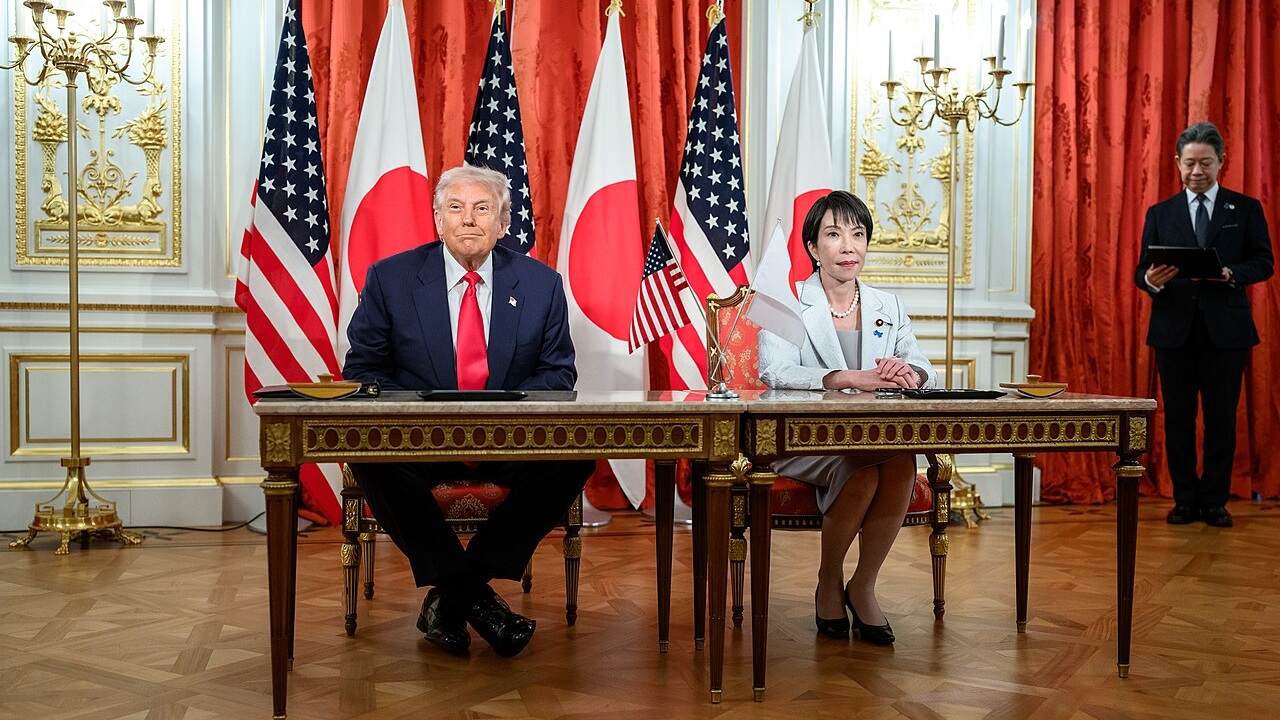
Amid the heaps of abuse poured on Japan, Prime Minister Sanae Takaichi looked to the White House for support. She got little. Instead, President Donald Trump reportedly told her to try to make amends with Beijing—prompting Tokyo to strike a more conciliatory tone in the days that followed.
Is America Still Committed to Japan’s Defense?
The Japanese have enjoyed a mutual defense treaty with the Americans that goes back to the end of World War II. Indeed, one might argue that the entire postwar Asian order is built upon the foundation of the mutual security agreement between Japan and the United States. Japan is the hub of the US military presence in Asia, and the JSDF would act as a powerful force multiplier for the United States during any future Pacific conflict.
However, if the Japanese military were to deploy against the Chinese military over a Taiwan contingency, even though their armed forces are technologically proficient, China’s sheer numbers would complicate their attempts to prevent either a Chinese naval blockade or an invasion of Taiwan. Initially, the Japanese could do some damage. But, in a protracted struggle, a serious question remains as to how long the Japanese could last in such an engagement.
Given that painful reality for Japanese strategists, the fact that the new government risked evoking the simmering historical ire of their larger Chinese neighbors indicates that Tokyo’s new government was putting a strategic trial balloon. They were testing the proverbial waters to see what Washington would do if Japan and China neared a confrontation.
The results were not encouraging for Tokyo.
On the one hand, it’s true that the US Marines are moving anti-ship ballistic missile systems—the Navy-Marine Expeditionary Ship Interdiction System (NMESIS) onto Yonaguni Island, a small Japanese island that sits just seven miles off the northern tip of Taiwan. Japan is also placing its own air defense systems on the tiny island, too. If China’s navy ever did enact a blockade and/or invasion of Taiwan, many Chinese ships would be within range of these systems.
Of course, the deployment of the NMESIS on Yonaguni is purely symbolic. There are insufficient numbers of the missiles to act as more than an annoyance to a large Chinese blockade and/or invasion force that comes within range of Yonaguni Island. And if China opts to attack Taiwan, it is a virtual certainty that they will do so with numbers that a combined American and Japanese battery of anti-ship and anti-aircraft missile systems could not significantly deter.
Yonaguni Island will be key for Japan and the United States to counter Chinese military aggression not only near Taiwan itself, but within the essential Miyako Strait—a key waterway in Japanese territory that Chinese warships would transit through on their way to Taiwan.
Beyond that, though, the Chinese have taken the diplomatic equivalent of a battering ram to Japan in the wake of their pronouncements.
It’s gotten so bad, and Washington’s response has been so muted, that the new Japanese government is scrambling for an off-ramp—likely because Tokyo is realizing that the Trump administration’s commitment to buttressing Japan against China, especially over a third country like Taiwan, is lukewarm at best.
The Real Impact of the New National Security Strategy
The recent release of the 33-page National Security Strategy (NSS) memo from the Pentagon reinforces the concern that Tokyo now likely feels over the reliability of US security guarantees.
In that document, the Trump administration reportedly watered down much of the more hawkish overtones of the original draft of the NSS and replaced that verbiage with language that reaffirms the standard Washington commitment to the “one country, two systems” model that has defined Sino-American relations since the 1970s.
In fact, Trump’s new NSS memo goes much farther in diminishing the military threat posed by China to the United States and its allies. Instead, Trump’s team wrote language openly calling for a more stable, harmonious relationship that focused less on military matters and more on trade issues with China going forward.
So Japan’s recent poking of the dragon might eventuate in the breakdown of the once ironclad US-Japanese security alliance. Trump very obviously wants nothing to do with military adventurism beyond the Western Hemisphere. Meanwhile, neither Japan nor Taiwan can fully resist Chinese attack without the Americans. But the Americans are making it clear they will not be coming anytime soon, which puts Tokyo and Taipei in a bind.
China and Russia both understand this. Deterrence is dead. That’s why the Trump administration is changing the narrative and focusing like a laser on Venezuela and the Western Hemisphere. There will be no serious defense of the First Island Chain. The United States, after having been defeated in the first round of the trade war against China is taking a different, more conciliatory path with Beijing.
Trump Chooses Cooperation over Conflict with China
Rather than provoking Beijing, Washington is seeking to minimize military disagreements and emphasize mutually beneficial trade and economic deals with Beijing. That is, at least until the Americans can develop a reliable workaround to China’s dominance in rare earth minerals and until Washington can diversify its agricultural trading profile (notably in soybeans) away from an overreliance on trade with China to something else.
Japan has poked the dragon. The dragon poked back. And the Americans failed the all-important ally test by not more vociferously and publicly backing Japan’s play against China. Now Beijing believes it will have a free hand to antagonize the Japanese and absorb Taiwan at its leisure with minimal interference from the United States. This is a once-in-a-generation geopolitical change underway in the Indo-Pacific that favors China and disempowers the United States. That seismic geopolitical shift will now only be stopped by a war or a collapse of the Chinese regime—neither of which appears likely at this point.
About the Author: Brandon J. Weichert
Brandon J. Weichert is a senior national security editor at The National Interest. Recently, Weichert became the host of The National Security Hour on America Outloud News and iHeartRadio, where he discusses national security policy every Wednesday at 8pm Eastern. Weichert hosts a companion book talk series on Rumble entitled “National Security Talk.” He is also a contributor at Popular Mechanics and has consulted regularly with various government institutions and private organizations on geopolitical issues. Weichert’s writings have appeared in multiple publications, including The Washington Times, National Review, The American Spectator, MSN, and the Asia Times. His books include Winning Space: How America Remains a Superpower, Biohacked: China’s Race to Control Life, and The Shadow War: Iran’s Quest for Supremacy. His newest book, A Disaster of Our Own Making: How the West Lost Ukraine is available for purchase wherever books are sold. He can be followed via Twitter @WeTheBrandon.
Image: Wikimedia Commons.
The post America’s Indo-Pacific Retreat Has Left Japan in a Bind appeared first on The National Interest.
Источник: nationalinterest.org