
«Данное сообщение (материал) создано и (или) распространено иностранным средством массовой информации, выполняющим функции иностранного агента, и (или) российским юридическим лицом, выполняющим функции иностранного агента»
 Topic: Artificial Intelligence (AI), Cybersecurity, and Nuclear Energy Blog Brand: Energy World Region: Americas Tags: Department Of Energy, North America, Nuclear Reactors, SMRs, and United States AI Is About to Transform Nuclear Energy, and the United States Isn’t Ready December 9, 2025 By: Daniel Joyner
Share
The convergence of nuclear technology and artificial intelligence is no longer a far-off possibility.
A recent announcement from Aalo Atomics and Microsoft—an unlikely pairing even a few years ago—has quietly signaled a historic turning point for the nuclear sector. Their partnership, centered on using advanced software and artificial intelligence to accelerate reactor permitting and deployment, marks more than a technical collaboration. It marks a strategic inflection point: nuclear energy, long considered a uniquely analog and mechanical domain, is becoming a digitally driven industry. The technologies that will define the next generation of reactors will not be limited to advanced fuels or modular manufacturing. They will include AI-enabled engineering tools, cloud-based licensing workflows, digital twins that update in real time, and predictive systems that continually shape reactor operations.
This convergence of nuclear and digital technology is accelerating at a speed that few policymakers have fully appreciated. It is happening across all phases of the nuclear lifecycle, from early site selection to reactor decommissioning, and it is reshaping how companies design reactors, how they interact with regulators, how national security agencies plan for microreactor deployment, and how investors evaluate nuclear projects. The United States is poised at the beginning of a transformation as consequential as the shift from slide rules to supercomputing. And yet the policy frameworks governing nuclear safety, cybersecurity, export controls, defense procurement, and regulatory oversight are all rooted in assumptions from an analog era.
I work at the intersection of nuclear regulation, international trade controls, and the emerging advanced-reactor industry. And in that space I can attest that the convergence of nuclear and AI is no longer theoretical —it is the daily reality of developers, government partners, and defense planners. The most sophisticated advanced reactor companies already treat software and data as core components of their safety and engineering philosophy. Cloud-native modeling environments, AI-assisted design optimization tools, automated supply chain verification systems, and data-rich remote operations platforms are now embedded in the DNA of the new generation of reactors and the companies that are developing them. And it has implications for all levels of regulation of the nuclear energy industry.
The United States needs to confront the implications of this transformation now, before the technology outpaces the regulatory infrastructure designed to keep nuclear energy safe, secure, and competitive.
From the Analog Era to Digital Reactors
To understand how much the industry has changed, it is instructive to recall just how non-digital the current US nuclear fleet is. The reactors supplying roughly one-fifth of US electricity were conceived in the 1960s and licensed largely in the 1970s and early 1980s. They are marvels of engineering, but their control systems were designed in a world before microprocessors, let alone machine learning. Their operational logic relies on arrays of pressure gauges, analog readouts, and mechanical switchboards. Many components have been digitally retrofitted, but the underlying architecture remains rooted in mechanical redundancy and human-centered control.
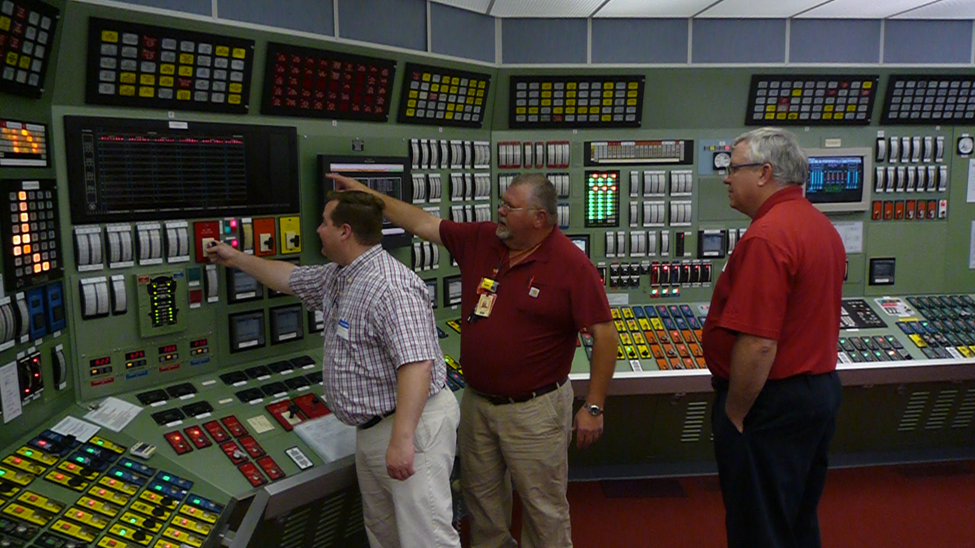
The author at the Farley Nuclear Power Plant in Dothan, Alabama. Credit is to the author.
Contrast this with the reactors now under development. Whether one examines the microreactors intended for remote military bases, small modular reactors designed for facility commitment or grid flexibility, or high-temperature reactors optimized for industrial heat production, the common denominator is digital design. These reactors are conceptualized from the ground up around software ecosystems, model-based engineering, cloud-enabled simulation environments, and extensive sensor networks. Predictive maintenance is not an add-on; it is a driving engineering assumption. Digital twins, i.e., virtual models that reflect the real-time operational state of the reactor, are not experimental — they are becoming increasingly standard in leading programs. And human operators are increasingly envisioned as supervisors of automated systems, not as direct manipulators of mechanical components as they were in previous models.
This shift brings extraordinary benefits. Digital reactors can be built faster, operated with greater efficiency, and maintained with reduced downtime. The ability to monitor systems continuously creates operational resilience that was not achievable in the analog era. But the shift also introduces a new category of risk. Nuclear reactors that operate in part through cloud-connected, software-driven systems create a vastly expanded cyber-physical surface. And while the safety logic of analog reactors tended to be insulated from digital manipulation, advanced reactors integrate digital processes deeply into safety-critical functions.
This means that the future of nuclear safety is inseparable from the future of cybersecurity and digital integrity.
AI Across the Nuclear Lifecycle
AI is already reshaping every phase of nuclear development. In site selection, reactor developers are using AI-driven geospatial analysis to evaluate seismic data, hydrological conditions, environmental impacts, and regulatory constraints. Machine-learning tools are assisting in identifying optimal reactor locations in a fraction of the time that has been historically required.
In the engineering phase, AI systems are helping developers optimize fluid dynamics, heat transfer, fuel performance, and structural load profiles. Digital twins allow developers to test an almost infinite range of scenarios without fabricating physical components, significantly reducing both cost and risk. These tools are not experimental add-ons. They are becoming indispensable.
During construction, AI-enhanced scheduling tools are reducing delays by predicting bottlenecks in supply chains, flagging potential component compatibility issues, and monitoring progress through autonomous sensing technologies. Software validation tools aid in detecting anomalies in weld uniformity, material quality, and component tolerances.
The licensing phase, perhaps the most bureaucratically complex segment of the nuclear lifecycle, is now an emerging frontier for AI integration. The NRC’s licensing frameworks under Part 50 and Part 52 were built around static documents, detailed safety analysis reports, and engineering artifacts that do not change once submitted. But digital-native developers are increasingly relying on models that update as new data comes in. AI can generate licensing documentation, translate engineering models into compliance-ready formats, and assist in safety case development. The orphaned question for regulators is whether, and how, to regulate documentation that changes while an application is pending, and what it means to validate a safety case that is partly AI-generated.
The operational phase is even more transformative. Many advanced reactor plans envision extremely small operations crews, some having fewer than a dozen personnel, supported by advanced monitoring systems and AI-driven decision support. AI anomaly detection systems can identify subtle anomalies in coolant flow, temperature gradients, neutron flux, and vibration patterns long before they become safety issues. Digital systems can predict equipment failures months in advance, allowing maintenance to occur in a far more efficient manner.
This transformation is especially significant for defense-related nuclear projects. The Department of Defense’s microreactor ambitions depend on remote monitoring architectures, AI-supported operations, and distributed oversight. A microreactor deployed at a remote base is not envisioned as a standalone analog system — it is envisioned as a networked asset in a larger digital defense ecosystem. The security challenges of such an architecture are almost entirely different from those of a traditional power-plant-based reactor.
The through-line in all these developments is the fact that AI and digitalization are not peripheral. They are becoming the backbone of the new nuclear economy.
The Coming Cybersecurity Reckoning
The integration of AI and cloud-based systems into nuclear power builds creates a challenge far more complex than any the US nuclear sector has previously confronted. The NRC’s cybersecurity regulations were crafted in a world where digital instrumentation existed, but AI-powered systems did not. Those regulations assume that digital safety systems are static and that digital data does not flow continuously to cloud environments or inform dynamic, learning-based models. That world is gone.
Advanced reactor developers now rely on cloud-hosted modeling environments, continuous integration pipelines, remote-sensing data streams, and globalized development teams. These systems introduce new risks, including data poisoning, adversarial model manipulation, supply-chain infiltration in software components, and access vulnerabilities in remote monitoring platforms.
These issues create an entirely new category of safety concern: digital integrity. The nuclear sector cannot afford the luxury of treating cybersecurity as an IT compliance function. In a digital reactor, cybersecurity is nuclear safety. A compromised model, an altered data stream, or a tampered digital twin can undermine the core safety case of a reactor in ways regulators have not yet fully contemplated.
The defense community understands these risks. For a microreactor that is intended for military bases, a cyber compromise does not merely threaten commercial viability; it threatens mission readiness. The fact that many microreactor developers are software-native companies raises questions about software development practices, access-control policies, cloud governance, and internal cyber hygiene. A reactor built on a digital foundation must be secured like a nuclear asset, not like a software company.
The US has not yet built a regulatory regime that reflects this new reality.
When Software Becomes the Most Sensitive Nuclear Export
The shift toward digitalization also has implications for export controls. Traditional nuclear export restrictions focus on hardware — reactor vessels, fuel assemblies, control rods, isotopic materials, and physical components. But in digital-native reactors, some of the most sensitive elements are not made of steel. They exist as code.
If a developer’s digital twin accurately reflects the full physics environment of the reactor, that twin is an exportable model of nuclear technology in a way that export law has never contemplated. If AI tools optimize reactor safety systems, the training data and algorithms underlying those tools become sensitive nuclear technology. A cloud-based engineering environment used collaboratively between US and foreign teams becomes an export-controlled space.
These data-related export control questions are among the most common I see coming from early-stage nuclear companies, and the answers based on existing regulations are complex and not always clear-cut.
The US regulatory architecture is only beginning to recognize what a fully digital nuclear sector means for export controls, technology-transfer governance, and safeguards. The NRC’s Part 810 rules, which were written for the transfer of tangible nuclear know-how, do not clearly address the exportability of AI training data, digital twins, cloud-based modeling environments, or continuously updating software that now constitute the intellectual core of advanced reactor designs. DOE has begun exploring the modernization of its technology transfer and Section 988 guidance for advanced reactors, and the NRC’s Part 53 rulemaking has tentatively acknowledged the need to bring digital instrumentation, software assurance, and automated systems into the safety review process. Yet none of these efforts to date approach a unified digital-first regulatory framework. Emerging Commerce Department controls on foundational AI models add another layer of complexity, but without an integrated interagency strategy, these rules risk becoming contradictory or incomplete.
The stakes of getting this wrong run in both directions. Under-regulation could allow foreign actors to obtain sensitive reactor models — not by diverting hardware but by breaching a cloud platform, manipulating a digital engineering environment, or accessing AI-assisted safety-analysis tools. In a digital-native industry, this kind of software compromise is equivalent to gaining access to design-basis information. But over-regulation poses its own strategic danger. If the rules are written so broadly that every aspect of a developer’s software ecosystem becomes an export-controlled artifact, US firms may be forced to operate behind regulatory walls that foreign competitors do not face. Excessively restrictive controls could strangle international collaboration, erode commercial viability, and ultimately push advanced reactor innovation offshore. The challenge for Washington is to modernize its regulatory system in a way that protects national security without inadvertently surrendering global leadership.
Nuclear energy is no longer simply an industrial or energy policy issue — it is a domain of strategic competition. China and Russia have already embraced digital integration in their reactor design processes. China’s Hualong One includes advanced digital systems; Russia’s Rosatom is investing heavily in digital twins and software-based optimization environments. Both states have recognized that digital reactors can be built faster and deployed more widely than previously expected, including through attractive financing packages in foreign markets.
If the United States lags in digital governance, cybersecurity, and AI regulation regarding nuclear systems, it risks ceding global leadership at precisely the moment when the world is returning to nuclear energy as a decarbonization pathway.
The risk is not just competitive erosion — it is normative erosion. If Chinese or Russian standards become de facto international norms for AI-integrated reactor deployment, the U.S. will find itself reacting to a global nuclear ecosystem shaped by rival powers.
Thus, the stakes are no longer just technological — they are geopolitical.
Workforce Transformation and the Human Factor
AI will also transform the nuclear workforce. It will not eliminate the need for reactor operators, safety engineers, or regulatory experts (hopefully!), but it will fundamentally change what they do. The operator of the future will spend less time adjusting mechanical controls and more time supervising automated systems that will be informed by continuous data flows. Maintenance technicians will rely on predictive analytics rather than manual benchmarks. Licensing experts will need fluency in both nuclear safety and software assurance. And cybersecurity specialists will be integral to nuclear project teams, not peripheral.
This creates an urgent need for training and workforce development across the entire nuclear sector. NRC regulators will need expertise in AI validation and software assurance. DOE contractors will need to build software supply chain integrity into their procurement pipelines. Reactor vendors will need cybersecurity architectures that reflect nuclear-grade security principles, rather than commercial tech-sector assumptions.
The United States has not yet built this workforce. But it will need to, and soon, if it hopes to maintain leadership in next-generation nuclear energy.
The AI Integration Policy Vacuum
The overarching concern is that AI integration is progressing far faster than the development of regulatory or security frameworks. The United States risks entering an era in which reactor developers rely on AI-driven systems, but federal regulators do not have either the tools or the frameworks needed to evaluate those systems. This mismatch creates risk from both directions. Overly rigid regulation could stifle innovation and delay deployment. Underdeveloped regulation could allow reactors to be built with insufficient attention to digital system integrity.
The United States thus urgently needs a national strategy for AI-integrated nuclear energy. This strategy should include:
- A unified framework for validating the AI systems used in safety analyses
- Cybersecurity architectures designed specifically for digital reactors
- Export-control adjustments that reflect the reality of software-based nuclear technology
- Updated NRC frameworks under Part 53 that explicitly address digital systems
- Workforce development pipelines to train regulators and developers in digital nuclear stewardship
- A national security strategy for protecting digital reactor models and supply chains
Without these things, the United States risks stumbling into a digital nuclear future defined more by guesswork than governance.
The US Must Lead the Digital Nuclear Future
The convergence of nuclear technology and artificial intelligence is no longer a far-off possibility. It is the emerging reality of the reactor designs that are now entering pre-licensing discussions, the microreactors that are moving toward defense deployment, and the partnerships that are forming between advanced reactor companies and digital-native firms like Microsoft.
This convergence will reshape the nuclear sector more profoundly than any technological change since the dawn of commercial nuclear power. But it also introduces risks that the current licensing, cybersecurity, export control, and national security frameworks were not built to manage.
If the United States embraces this challenge, it can position itself at the forefront of a new nuclear era that will be defined not just by reactors but by the data, algorithms, and digital systems that will drive them. If it does not, the future of nuclear energy regulation will be written elsewhere.
About the Author: Daniel Joyner
Daniel Joyner is the Elton B. Stephens Professor of Law at the University of Alabama School of Law and the founder and principal at Prometheus Nuclear LLC. Prior to joining the Alabama Law faculty in 2007, Dr. Joyner taught for four years on the faculty of the University of Warwick School of Law. He is the author of ‘International Law and the Proliferation of Weapons of Mass Destruction (Oxford University Press, 2009); Interpreting the Nuclear Nonproliferation Treaty (Oxford University Press, 2011); and Iran’s Nuclear Program and International Law (Oxford University Press, 2016).
Image: Shutterstock/metamorworks
The post AI Is About to Transform Nuclear Energy, and the United States Isn’t Ready appeared first on The National Interest.
Источник: nationalinterest.org