

«Данное сообщение (материал) создано и (или) распространено иностранным средством массовой информации, выполняющим функции иностранного агента, и (или) российским юридическим лицом, выполняющим функции иностранного агента»

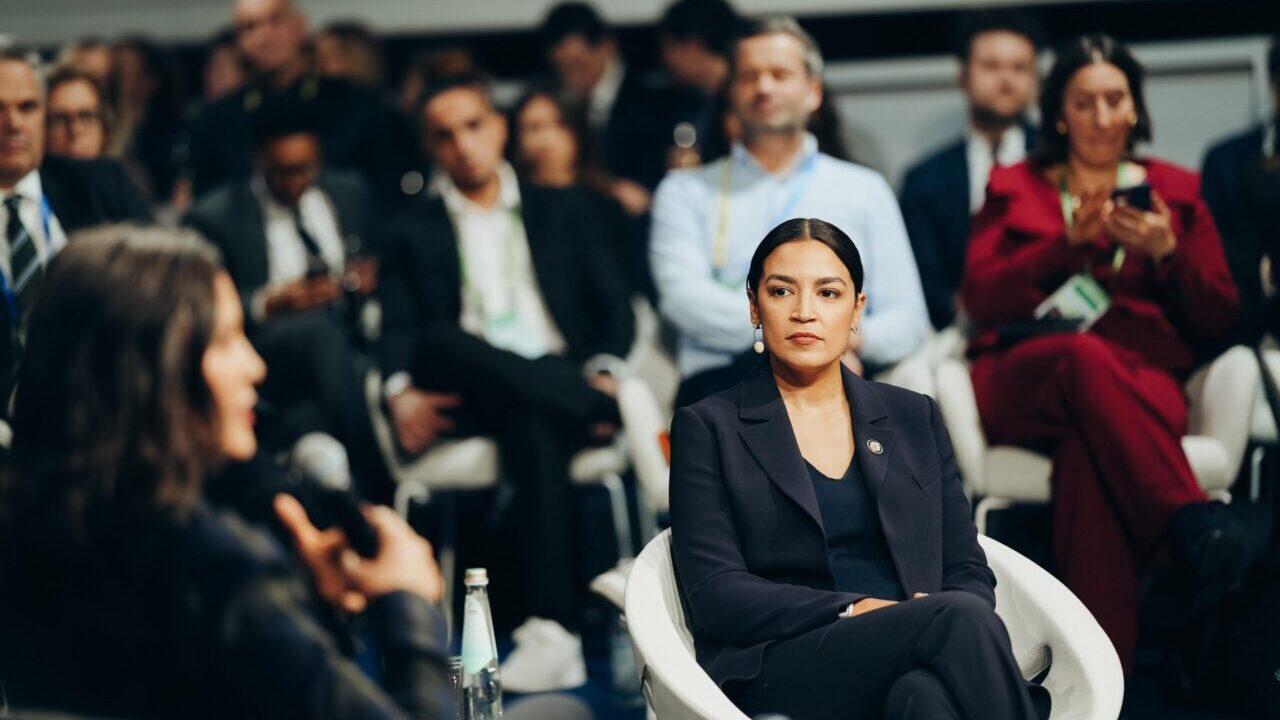
Congresswoman Alexandria Ocasio-Cortez (D-NY) speaks during a panel discussion called “Breaking (with) the Past: Seismic Shifts in US Foreign Policy” at the Munich Security Conference on Feb. 12, 2026. (MSC/Geigle)
Topic: Congress, and Trade Blog Brand: US Politics Region: Americas Tags: Alexandria Ocasio-Cortez (AOC), Democrats, Munich Security Conference, North America, United States, and World Trade Organization (WTO) Can AOC Help Democrats Craft a Positive Trade Agenda? February 23, 2026 By: Simon Lester
Share
Alexandria Ocasio-Cortez’ recent remarks at the Munich Security Conference could help show a way forward for Democrats.
In a move widely seen as an effort to build credibility on foreign policy in anticipation of a presidential run, Alexandria Ocasio-Cortez (AOC) offered some detailed remarks recently at the Munich Security Conference and at a German university. While her focus was foreign policy, she also made a few comments on trade policy, and some of her big picture points about foreign policy can be applied to trade policy, as well. In recent years, Democrats have struggled to come up with policies and a message on trade that resonates with voters, but AOC’s remarks could help show the way forward.
Three key principles she invoked in her remarks were: The rule of law, working with allies, and focusing on ordinary Americans rather than catering to corporate interests. These principles could help guide Democrats on US trade policy going forward.
Starting with the rule of law, one of the biggest problems in the trade policy world in recent years has been the blocking of appointments to the World Trade Organization’s appeals court (the Appellate Body). The first Trump administration started this blocking (the Obama administration objected to specific appeals judges but allowed replacements), and the Biden administration continued it. The practical result has been that a large number of trade disputes are in limbo, with appeals being made “into the void” (as it has been termed), and the rule of law in the trading system undermined. Without a neutral adjudication mechanism that can hear allegations of violations of WTO obligations and make rulings, the trading system shifts from being rules-based to being more power-based. (The Trump administration’s recent trade deals do not even have an adjudication mechanism, leaving it unclear how enforcement can be done effectively.)
In contrast to this recent US approach to the WTO appeals process, in her remarks AOC emphasized the importance of the “rules-based order” in international affairs — and even seemed to want the rules to apply more strongly to the US than they have, criticizing international rules that favored the US and other wealthy countries over the Global South. Thus, a lifting of the block on appointments to the WTO’s Appellate Body seems consistent with her views and is something a future Democratic administration should consider. (And if there are objections to restoring the original Appellate Body, an alternative mechanism for appeals has been developed by the EU and other governments, and the US could consider signing up for that.)
Second, AOC talked about the importance of working with allies, saying to her European audience that “I know that the Democratic Party is here for our allies.” During the Biden administration, this issue became a heated one in trade policy as part of the legislative debate over the Inflation Reduction Act. Some of the conditions for the clean energy subsidies provided under that legislation explicitly discriminated against products from other countries, including European and other allies. As part of the implementing regulations, the Biden administration was able to scale some of the discrimination back, but nevertheless this approach soured relations with many trading partners.
The Trump administration is moving away from efforts to address climate change, but a future Democratic administration that takes up the fight again should embrace an approach that considers the issue to be a global one, in which governments work together, rather than using climate goals as an excuse to limit competition in the clean energy sector through protectionist measures. For example, an approach to promoting clean energy that involves consumer or producer subsidies should provide these subsidies in a way that does not discriminate against the products of U.S. allies.
Finally, returning to a theme she has invoked consistently throughout her career, in her remarks AOC put a premium on having trade policy help working class people, stating that the benefits of trade should not “accru[e] overwhelmingly … to the wealthiest.” Her sentiment is an important one for trade: Like all policy areas, over the years trade has seen interest groups lobby successfully to get their preferred policies incorporated into international agreements. As a result, as AOC put it, “there are hundreds of pages of non-tariff related policies that are included in these trade agreements that amount to corporate protectionism.”
In this context, AOC gave the example of how WTO intellectual property rules required the US to extend patent term protection from 17 years, as had been the law previously, to 20 years. She noted that this meant “pharmaceutical companies held onto their patents longer,” drugs “could not go generic,” and health care costs increased. AOC may have a point here, as some economists and other experts have questioned the wisdom of long, uniform patent terms.
Along the same lines, AOC referred to “tech companies seek[ing] to erode all protections on privacy and user data so that they can commodify our personal information,” noting that she “would not be surprised if they use trade agreements in order to advance that as well.” On the point about tech regulation, it is worth noting a statement from Biden’s US Trade Representative Katherine Tai, who cautioned against going too far in attacking foreign regulations that impact big tech companies, saying we should consider the intent of the foreign actions: “we have to really be cognizant that measures that may look like they have a discriminatory effect may or may not be advanced with a discriminatory intent.” An emphasis on this principle when formulating trade rules could help address AOC’s concern.
Putting AOC’s principles into action in the area of non-tariff policies, a future Democratic administration should focus on promoting trade policies that have an overall benefit to Americans, rather than those that help well-connected corporations who lobby the government to intervene on their behalf.
As speculation about a possible presidential run heats up, AOC’s remarks in Germany are sure to be just the first exchange in a long conversation about her foreign and trade policy views, but she has already articulated a set of principles that provide a good framework on trade. One of her most memorable lines from the conference was “hypocrisies are vulnerabilities.” She offered this phrase in the context of foreign policy, but it applies to trade policy as well. In this regard, a helpful guide for the Democrats would be to adopt a US approach to the world trading system that is based on the rule of law, good faith partnerships with allies, and an emphasis on ordinary citizens rather than special interests.
About the Author: Simon Lester
Simon Lester is a nonresident fellow at the Baker Institute. He runs the websites WorldTradeLaw.net and China Trade Monitor. He has taught trade law at the University of Melbourne School of Law.
The post Can AOC Help Democrats Craft a Positive Trade Agenda? appeared first on The National Interest.
Источник: nationalinterest.org