

«Данное сообщение (материал) создано и (или) распространено иностранным средством массовой информации, выполняющим функции иностранного агента, и (или) российским юридическим лицом, выполняющим функции иностранного агента»

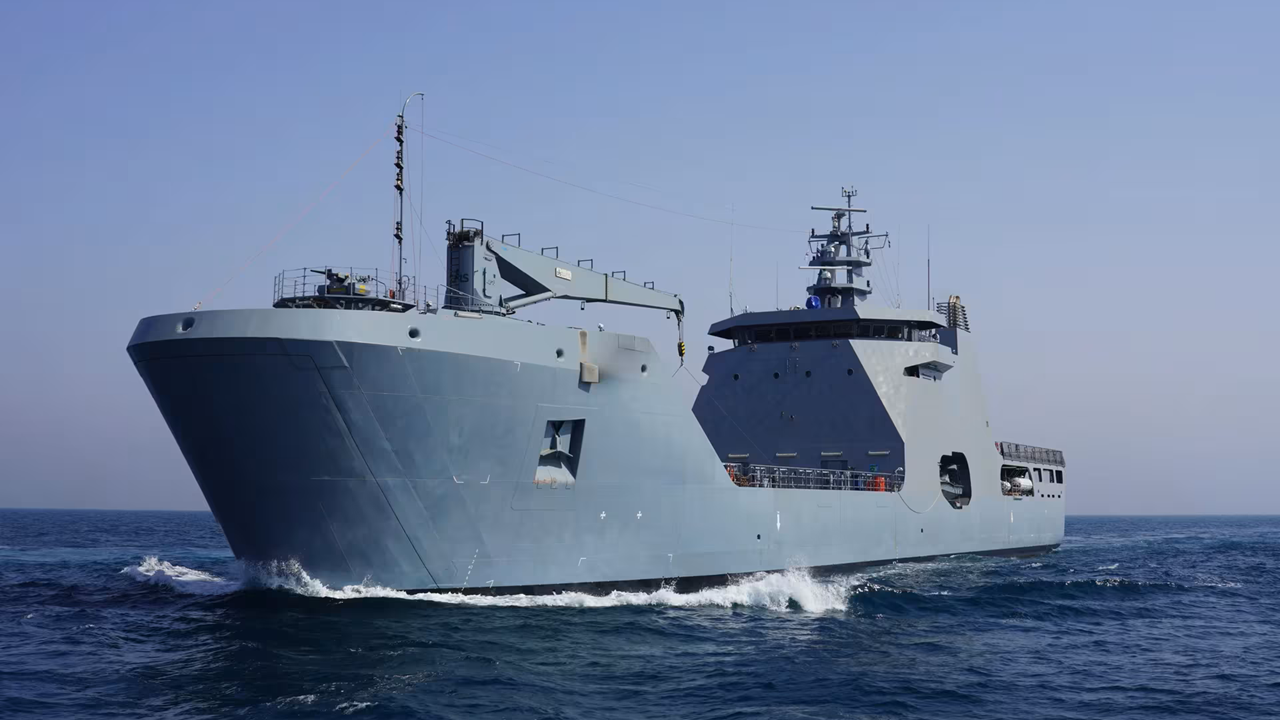
A concept illustration of a Damen Landing Ship Transport (LST) 100. The US Navy’s Medium Landing Ship is expected to be based on the LST. (Damen Shipyards Group)
Topic: Naval Warfare Blog Brand: The Buzz Region: Americas Tags: Defense Industry, Medium Landing Ship, North America, Shipbuilding, United States, and US Navy US Navy Seeks Contractor to Manage New Landing Ships Program February 21, 2026 By: Peter Suciu
Share
The US Navy urgently wants to build the Medium Landing Ship on time and on budget—and avoid the issues that forced the early cancellation of the Constellation class.
As the United States prepares for a potential conflict with China in the Indo-Pacific, the US Navy faces several challenges. Multiple shipbuilding programs are running late and/or over budget. The service has also made some costly mistakes in selecting programs ill-suited to the geopolitical climate. It recently cancelled the Constellation-class frigate after that program experienced cost inflation and construction delays—an ironic twist, given that the Constellation-class program had been created to avoid those problems.
Another concern has been the issue of moving personnel and materiel should the US engage in a far-flung conflict. The US Navy is seeking an urgent course correction.
The Navy Wants to Get the LSM Landing Ship Program Right
This week, the US Navy issued a Request for Proposal (RFP) that called for a Vessel Construction Manager (VCM), which would aid in the service’s acquisition of its new Medium Landing Ship (LSM). LSMs are seen as vital for addressing the capability gap that exists between the service’s smaller “short-range” landing craft and large amphibious warfare vessels.
In December, the US Navy and USMC jointly announced that the Dutch-designed Daman Naval LST 100 would serve as the “baseline to help rapidly field” the LSM.
“This strategy is designed to maximize commercial practices to accelerate delivery, improve cost discipline, and expand the US shipbuilding industrial base, with a contract award anticipated for mid-2026,” the US Navy explained.
Even as the US Navy seeks new proposals, two shipyards have already been awarded contracts to build the LSMs. Fincantieri Marinette Marine in Wisconsin, which had been constructing the Constellation-class frigates for the US Navy, and Bollinger Shipyards in Mississippi.
Bollinger will support the program’s “long lead time procurement” and will further direct the “ship engineering design activities” that began last September. Fincantieri has been contracted to produce four of the planned LCMs.
“The VCM will then have the ability to decide the best strategy for awarding the remaining three ships authorized under the base contract,” the Navy added.
A VCM Could Keep America’s Shipyards on Track
The VCM will serve as the prime contractor on the LCM program, issuing and managing subcontracts with the shipyards. Moreover, the VCM will have direct contractual control of the respective performance, which the US Navy suggested would reduce cost and schedule risks.
“The VCM approach not only accelerates construction timelines but also strengthens our industrial base by engaging multiple shipyards,” explained Rear Adm. Brian Metcalf, program executive officer for ships. “By providing a mature, ‘build-to-print’ design and empowering a VCM to manage production, we are streamlining oversight for this acquisition. This approach accelerates the timeline and strengthens our industrial base, ensuring we have the capacity and expertise needed for sustained maritime advantage.”
What We Know About the McClung-Class Medium Landing Ships
At the end of the Biden administration, in January 2025, then-Secretary of the Navy Carlos Del Toro announced that the lead vessel of the program would be named to honor United States Marine Corps Major Megan M.L. McClung, the first female USMC officer killed in combat during the Iraq War. McClung, who served as a public affairs officer, was also the first female graduate of the United States Naval Academy to be killed in the line of duty.
Previously known as the Light Amphibious Warship (LAW) program, the LSM calls for the US Navy to receive between 18 and 35 to support the Marine Corps and its Expeditionary Advanced Base Operations (EABO).
According to a report to Congress last year, “LSMs would be much smaller and individually much less expensive to procure and operate than the Navy’s current amphibious ships.”
As the LSM program is still in its infancy, little is known about the prospective ships. Still, the LST 100, on which the LSM will be based, was designed to beach itself on unimproved shorelines and to provide cargo capacity for 500 tonnes of military hardware, including armored vehicles. The LSM could be employed to carry Marine Littoral Regiments to islands and shorelines in the Indo-Pacific. A stern flight deck is also capable of supporting up to medium-sized helicopters or unmanned aerial systems (UAS).
About the Author: Peter Suciu
Peter Suciu has contributed over 3,200 published pieces to more than four dozen magazines and websites over a 30-year career in journalism. He regularly writes about military hardware, firearms history, cybersecurity, politics, and international affairs. Peter is also a contributing writer for Forbes and Clearance Jobs. He is based in Michigan. You can follow him on Twitter: @PeterSuciu. You can email the author: Editor@nationalinterest.org.
The post US Navy Seeks Contractor to Manage New Landing Ships Program appeared first on The National Interest.
Источник: nationalinterest.org