

«Данное сообщение (материал) создано и (или) распространено иностранным средством массовой информации, выполняющим функции иностранного агента, и (или) российским юридическим лицом, выполняющим функции иностранного агента»

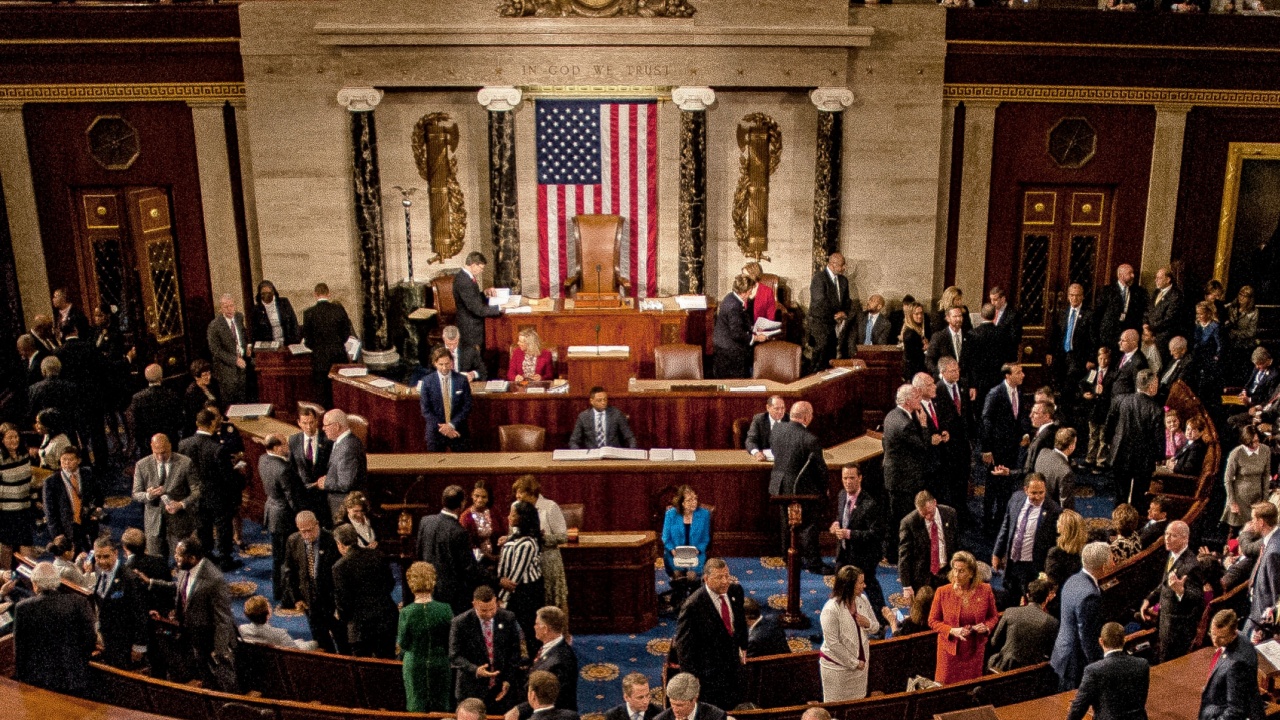
The House of Representatives is in session. Congress ultimately holds the key to a significant improvement in US-Central Asia relations. (Shutterstock/Mark Reinstein)
Topic: Congress, Critical Minerals, and Trade Blog Brand: Silk Road Rivalries Region: Eurasia Tags: Central Asia, China, Jackson-Vanik, Magnitsky Act, Russia, Soviet Union, and United States Why Congress Hasn’t Repealed the Jackson-Vanik Amendment for Central Asia February 15, 2026 By: Eric Rudenshiold
Share
Repealing Jackson-Vanik is not merely a question of foreign policy; it is a question of legislative arithmetic.
For well over a decade, US administrations of both parties have acknowledged a simple truth about their efforts in Central Asia: the United States is shooting itself in the foot. A policy relic from a bygone era remains in the US law books and impedes engagement in this dynamic region.
Designed over half a century ago as a moral and economic lever in response to Soviet restrictions on Jewish emigration, the Jackson-Vanik Amendment to the 1974 Trade Act today is an arcane vestige of Cold War policy that no longer reflects geopolitical reality, contemporary human rights practice, or America’s strategic interests in Eurasia.
Yet despite broad consensus among analysts, diplomats, and business leaders, Jackson-Vanik remains law. That persistence is not a failure of strategy or a measure of Central Asia’s political significance. It is a consequence of constitutional design; Jackson-Vanik can only be repealed by Congress. No executive order, waiver, or diplomatic reassurance can substitute for legislative action.
Understanding the distinction between policy intent and statutory authority is essential to fully understanding or appreciating current United States efforts in the region. Observers of US governance point to the repeal of Jackson-Vanik as a key impediment to improving relations between the Central Asian region and Washington. They see it as a bellwether measure of US goodwill. It isn’t.
What Jackson-Vanik Was and Why It No Longer Works
The Jackson-Vanik Amendment, Section 402 of the Trade Act of 1974, denied normal trade relations (NTR) to non-market economies, restricting freedom of emigration. The amendment’s specific target was the Soviet Union, whose policies limited the ability of Jewish citizens and others to leave the country. At the time, the amendment was a creative synthesis of human rights advocacy with US trade policy that proved highly successful. Once adopted, emigration increased, international pressure mounted, and the provision’s moral clarity was widely praised. Then history moved on.
The Soviet Union collapsed more than three decades ago. Most post-Soviet states transitioned to market economies, and Jewish emigration from across the former USSR occurred on a massive scale from the 1990s through the early 2000s. Today, freedom of emigration is not a defining human rights issue in Central Asia, nor is it the principal gauge by which the region’s governments are assessed.
Yet Kazakhstan, Uzbekistan, Tajikistan, Turkmenistan, and Azerbaijan remain technical hostages to the Jackson-Vanik Amendment. US presidents have routinely issued annual waivers granting conditional NTR. The amendment’s continued presence on the statute books makes it a symbolic irritant in bilateral relations. In essence, Jackson-Vanik no longer advances human rights; it obscures them behind an inappropriately applied and outdated legal framework.
Analysts have long warned that the unintended consequence of Jackson-Vanik has been to make the United States a “least-favored trading partner” in Central Asian trade relationships, by undermining American commercial competitiveness without delivering meaningful leverage on human rights. While still law, Jackson-Vanik impedes the granting of permanent normal trade relations to countries in the region, which, in turn, sends an inappropriate and cautionary signal to US business investors.
United States relations with the post-Soviet world in the 1990s to the 2010s were often filtered by concerns over human rights violations and rampant corruption. So, when Russia sought to accede to the World Trade Organization (WTO), Washington balanced human rights concerns with the desire to see Moscow join a rules-based trade organization, to adhere to international property and other rights, and to secure a chance to lift its flagging economy.
Granting Moscow Permanent Normal Trade Relations (PNTR) status required a compromise in the US Congress. The general trade restrictions under Jackson-Vanik were replaced by more targeted sanctions under the 2012 Sergei Magnitsky Rule of Law and Accountability Act.
Unlike Jackson-Vanik, Magnitsky could target culpable individuals explicitly identified as involved in human rights abuses and corrupt acts. Rather than blanket-sanctioning an entire country, Magnitsky mandated freezing assets and visa travel bans for Russian-specific officials. The success of the act’s application by US government offices led Congress to broaden the legislation in 2016 to the Global Magnitsky Human Rights Accountability Act, which enabled Washington to sanction human rights violators and corrupt officials worldwide.
While Magnitsky became the “intellectual successor” to Jackson-Vanik, some US officials and offices in the government and Congress continued to view Jackson-Vanik as a more generic human rights accountability mechanism—going far beyond its migration focus. As a result, the 1974 provision remains in effect.
Central Asia’s Rising Strategic Importance
The case for repeal is not merely historical; it is also strategic. Central Asia sits at the intersection of global energy markets and emerging supply chains for critical minerals, uranium, and rare earth elements. The region’s emerging Middle Corridor trade route is at the center of a geo-economic transformation stretching from Central Asia across the Caspian and through the South Caucasus to Turkey and Europe. The developing trade and economic connectivity along this route is now central to the entire region’s growth and a target of US policy interest.
As a result, the Middle Corridor has become a strategic passageway and opportunity, particularly given Washington’s strong interest in securing alternate suppliers for strategic minerals and rare earths. The 2025 Summit between the United States and five Central Asian presidents set the stage for ambitious economic partnerships, identifying cooperation on strategic minerals as a key priority. For the United States, the timing is urgent, as Washington needs reliable critical mineral supply chains that are not dependent on China.
Kazakhstan alone possesses the world’s largest uranium reserves and is a major supplier to the United States. Rare earth deposits abound in Central Asia. American firms are seeking to invest billions of dollars across the region in strategic mineral mining and refining, energy, and infrastructure. Despite Washington’s recent flurry of efforts, its level of economic engagement lags behind that of its competitors. China is already deeply embedded in Central Asian economies. Russia retains structural influence through legacy infrastructure, labor migration, and security ties.
Given these realities, maintaining the Cold War-era Jackson-Vanik trade restriction weakens US credibility and constrains long-term economic cooperation. It is hard for Washington to compete for influence in Central Asia while treating its economies as relics of the Soviet past. However, repealing Jackson-Vanik would not necessarily resolve all challenges in US-Central Asia relations. Still, it would remove an unnecessary obstacle and signal to the region’s capitals that Washington sees the region as a partner of consequence, not an afterthought.
Repealing Jackson-Vanik Is Not an Executive Decision
Despite frequent references to Jackson-Vanik repeal as a “policy choice,” it is not one the executive branch can make. The Jackson-Vanik Amendment is a law and, as such, can only be amended or repealed through legislation passed by a majority in both chambers of Congress and signed by the president. The various waivers, certifications, and diplomatic assurances used by successive administrations over the past 30 years were workarounds and not solutions.
This distinction matters because it explains why repeal has proven so elusive. Jackson-Vanik is an esoteric provision that few Members of Congress know of, let alone have ever voted on. Even fewer can readily explain its origins, purpose, or contemporary relevance. Building a majority of 218 votes in the House and 51 in the Senate requires sustained education, coalition-building, and political will. That hard reality has frustrated administrations of both parties and Central Asians seeking a deeper US partnership. It has also allowed the amendment to persist long after its rationale expired.
There are reasons to believe now may be different. During his January 2025 confirmation hearing, Secretary of State Marco Rubio described Jackson-Vanik as a “relic” and acknowledged that permanent normalization of trade with Central Asia requires congressional action. His comments were closely watched in the region and interpreted as a sign of growing awareness at the highest levels of US policymaking.
At the same time, bipartisan coalitions in both chambers have reintroduced legislation (HR5917 and S3031) aimed squarely at repealing Jackson-Vanik’s application to Central Asian states and granting permanent normal trade relations. These repeated efforts reflect a slow but steady recognition that the status quo is untenable.
Repealing Jackson-Vanik would not constitute a blanket endorsement of Central Asian governance. Still, it would signal a long-term US strategic interest in Central Asia and enable permanent normal trade relations, thereby encouraging US investment. Removing Jackson-Vanik’s outdated trade restrictions will improve US competitiveness vis-à-vis China and Russia in the region, especially as rivalry over the region’s strategic minerals intensifies.
Legitimate US concerns about the rule of law, labor rights, and political reform may persist after repeal, and are likely better addressed through modern tools such as diplomacy, multilateral engagement, and targeted sanctions. In short, repealing the 50-year-old Trade Law amendment will modernize US trade policy in Central Asia without abandoning values.
Why This May Be the Best Chance to Repeal in Years
Several factors converge to make repeal more achievable now than at any point since the Soviet collapse. The Republican Party currently holds a majority in both Houses of Congress and pays close attention to White House priorities. This administration appears better positioned to translate policy intent into legislative success if it chooses to invest political capital and work closely with congressional leadership. Certainly, the White House is continuing to demonstrate historic levels of interest and “unprecedented levels” of engagement with Central Asia.
Another cause for optimism is that there appears to be bipartisan alignment on the strategic importance of Central Asia and the geopolitical urgency driven by competition with China and Russia over strategic minerals and energy. US businesses are also engaged at an unprecedented level and appear to be pressuring Congress to expand trade into Central Asia.
The case for repealing the Jackson-Vanik amendment remains overwhelming. The Cold War vestige no longer protects the rights it was designed to defend, nor does it reflect economic reality. In the eyes of Central Asia and US business, Jackson-Vanik actively undermines US strategic engagement in a region that matters more with each passing year.
But recognizing that fact is not enough. For more than a decade, US administrations across departments and agencies have favored the repeal of Jackson-Vanik. Unable to lobby directly, US leaders waited and hoped for Congressional action, cheering the introduction of bills in each new session of Congress, only for them to die for lack of broad interest. Repeated executive orders, waivers, and diplomatic reassurances have been the US government’s only substitute for legislative action.
Bystanders often point to Jackson-Vanik’s longevity as intentional, when in actuality, it is largely an outdated relic awaiting replacement. For US policymakers, Jackson-Vanik has for years been a thorn in the side of progress in Central Asian relations.
Repeal requires Congress to act deliberately and explicitly, and to understand that modernizing US trade policy is itself a strategic act. If lawmakers seize this opportunity, they will do more than remove an outdated statute. They will affirm that American foreign policy can evolve without abandoning its principles and that the United States is prepared to engage Central Asia as it is, not as it once was.
About the Author: Eric Rudenshiold
Dr. Eric Rudenshiold was the National Security Council director for Central Asia under presidents Donald Trump and Joe Biden. He led efforts in the US government to seek the repeal of the Jackson-Vanik Amendment. He is currently a senior fellow at the Caspian Policy Center in Washington.
https://www.shutterstock.com/image-photo/washington-dc-usa-january-3-2017-1186368265?trackingId=35225513-a88e-498a-8634-266675ac9cf3&listId=searchResults
Caption:
The House of Representatives is in session. Congress ultimately holds the key to a significant improvement in US-Central Asia relations. (Shutterstock/Mark Reinstein)
The post Why Congress Hasn’t Repealed the Jackson-Vanik Amendment for Central Asia appeared first on The National Interest.
Источник: nationalinterest.org