

«Данное сообщение (материал) создано и (или) распространено иностранным средством массовой информации, выполняющим функции иностранного агента, и (или) российским юридическим лицом, выполняющим функции иностранного агента»

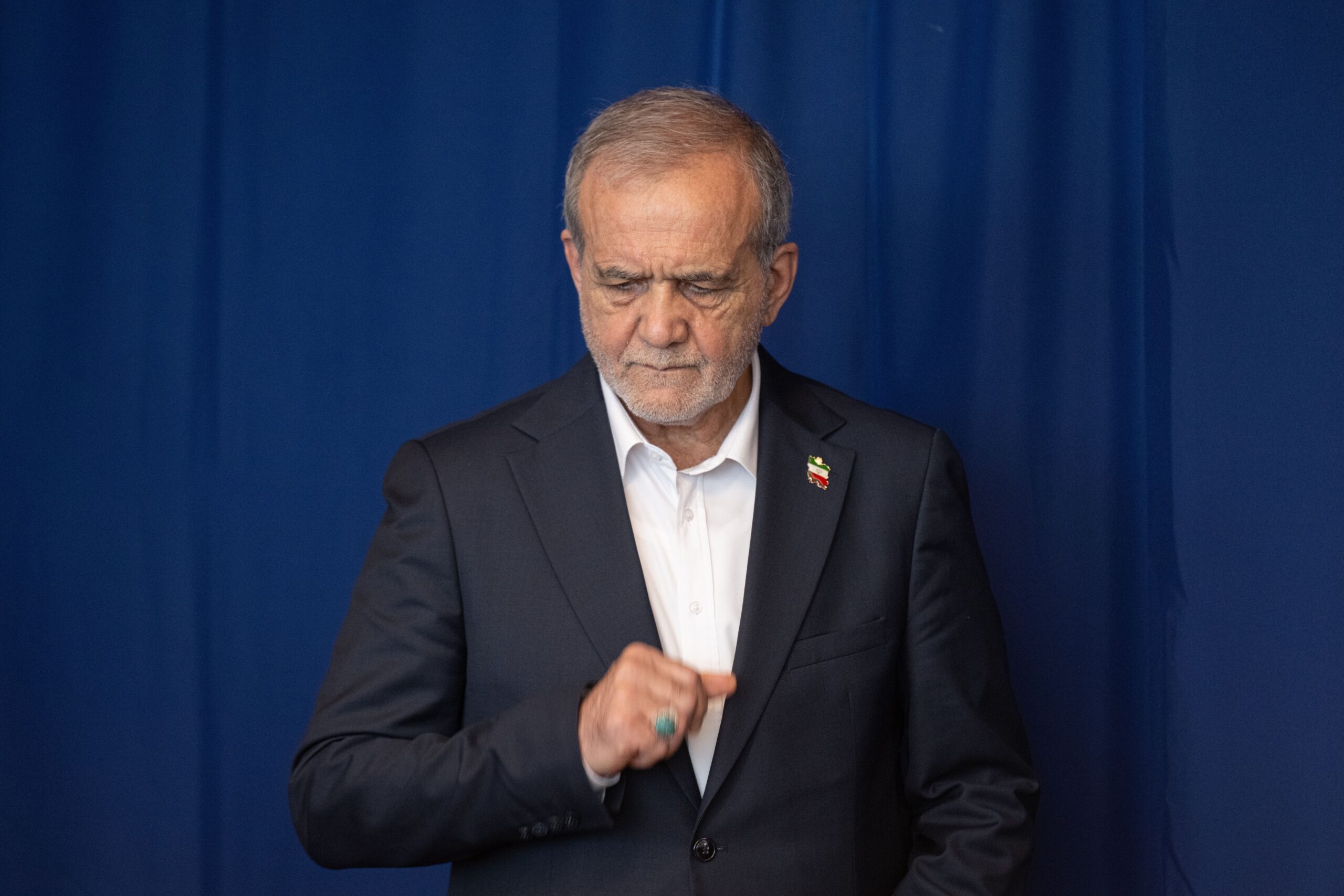
Iran’s president Masoud Pezeshkian meets with Secretary-General of the United Nations Antonio Guterres at the United Nations on September 25, 2025. Iran could be supporting ISIS-K in the Caucasus to target Azerbaijan’s energy infrastructure (Shutterstock/Noam Galai).
Topic: Terrorism Blog Brand: Silk Road Rivalries Region: Eurasia, and Middle East Tags: Azerbaijan, Caucasus, Central Asia, Iran, ISIS-K, Israel, Middle Corridor, Tajikistan, and United States Is Iran Weaponizing ISIS-K Against Azerbaijan? February 11, 2026 By: Joseph Epstein
Share
The resurgence of ISIS-K attacks in the Caucasus could harm US-backed trade and energy connectivity projects across Eurasia.
Iran may have a new weapon in its shadow war against the West—and it’s one that Tehran spent decades fighting: Sunni jihadists.
Last week, Azerbaijani security forces arrested three men planning to attack the Israeli embassy in Baku. The suspects claimed allegiance to ISIS-K, the Afghan branch of the Islamic State responsible for the devastating Crocus City Hall massacre in Moscow that killed 145 people in 2024. On its face, this looks like another data point in ISIS-K’s expanding campaign of global terror.
But look closer, and a more troubling picture emerges—one that should concern policymakers in Washington. The South Caucasus is becoming a new front in the shadow war between Iran and its enemies, and the Islamic Republic may be using Sunni extremists as a cover for its own malign activities.
For years, Iran has tried to destabilize Azerbaijan through the Husseiniyyun, an ethnic Azerbaijani proxy founded by the late IRGC Quds Force commander Qassem Soleimani. Since its establishment around 2015, this group—sometimes called the “Hezbollah of the Caucasus”—has been linked to assassination attempts against Azerbaijani officials and threats against Israeli and Jewish targets. In 2018, a Husseiniyyun member shot and seriously injured the mayor of Ganja, Azerbaijan’s second-largest city.
Yet over the past year, the Husseiniyyun’s profile has conspicuously lowered while Sunni extremists have dominated headlines in Azerbaijan. In May 2025, Azerbaijani authorities extradited four nationals who had attended training camps on the Pakistan-Afghanistan border—an area strongly associated with ISIS-K activity. Last October, an ISIS-K affiliate was convicted of plotting an attack on a Baku synagogue.
This shift coincides with Iran’s strategic collapse. Israel has systematically dismantled Tehran’s “Axis of Resistance”—Hamas devastated, Hezbollah decapitated, the Assad regime in Syria toppled. The June 2025 war brought Israeli strikes directly onto Iranian soil. Meanwhile, mass protests have convulsed Iranian cities since late December, with security forces reportedly killing more than 30,000.
A weakened, desperate Iran is a more dangerous Iran. And Tehran has growing reasons to lash out at Azerbaijan specifically.
The Trump Route for International Peace and Prosperity—the US-brokered corridor linking Azerbaijan to its Nakhchevan exclave through Armenian territory—represents a direct threat to Iranian influence. Tehran views this 99-year American development lease as a strategic encirclement.
Last month, IRGC-affiliated Fars News warned it would “spread the flames of war” to Baku over its cooperation with Israel, describing Azerbaijan’s oil exports to Jerusalem as placing the country in “Tehran’s crosshairs.” Following the August peace summit, a senior adviser to Supreme Leader Khamenei threatened to make TRIPP a “graveyard for the mercenaries of Donald Trump.”
Working through ISIS-K would provide Iran with plausible deniability that Shia proxies cannot offer. This isn’t unprecedented. Tehran has long backed Sunni groups when convenient—Hamas, Palestinian Islamic Jihad, and increasingly, elements of the Taliban. Moreover, the Islamic Republic has provided a safe haven to Al Qaeda leaders and secretly funded some of the group’s operations.
But the closest template to Tehran’s playbook may be Tajikistan. Tajik authorities have accused Iran of using both the banned Islamic Renaissance Party and ISIS networks to recruit locals for terrorist activities. In 2018, a group of Tajiks operating under the Islamic State banner killed four foreign cyclists. The ringleader later testified he had undergone ideological and military training in Qom, Iran’s religious center. The Iranian proxy Kataib Hezbollah is reportedly responsible for such coordination with Central Asian jihadists like ISIS-K and the Taliban. The proxy has used Tajik nationals to conduct operations, including multiple attacks on Jewish targets in Kazakhstan and Uzbekistan.
If Iran is indeed pivoting to use ISIS-K as a vector against Azerbaijan, the implications extend far beyond Baku. ISIS-K is the most dangerous terrorist organization in Central Asia, and it has already demonstrated the capability and intent to strike at major powers’ interests.
The January 19 suicide bombing of a Chinese restaurant in Kabul—for which ISIS-K claimed responsibility, resulting in at least seven casualties—underscores the operational seriousness of this threat. The attack was followed by a coordinated media campaign across ISIS-K-aligned channels, disseminated in eight languages, explicitly threatening further strikes against Chinese interests. The message was clear: ISIS-K was punishing Beijing for its treatment of Uighur Muslims in Xinjiang. But the attack served another purpose—burnishing the group’s credentials as defenders of the global Muslim community, a propaganda play designed to attract new recruits and establish credibility among extremists worldwide.
The same logic could easily be directed at American targets. TRIPP and US infrastructure investments across Central Asia offer ISIS-K opportunities to position itself as a vanguard against Western encroachment in the Muslim world. An attack on American interests—or on American-backed projects like the Middle Corridor—would generate the kind of global attention and jihadist credibility that ISIS-K craves. Tehran, meanwhile, would achieve its strategic objectives while maintaining plausible deniability.
The United States has vital interests at stake. TRIPP and the broader Middle Corridor represent Washington’s most significant infrastructure play in the region in decades—a trade route connecting Central Asia to Europe while bypassing both Russia and Iran. Attacks on this corridor would damage not just regional stability but American strategic investments. Central Asian states have signaled their willingness to deepen security cooperation precisely to counter domestic extremism; Uzbekistan explicitly cited this rationale in joining the Board of Peace.
Washington should act now, before the threat metastasizes. Three steps would strengthen American security while bolstering a crucial ally.
First, the United States should pursue trilateral security cooperation among Azerbaijan, Israel, and Israel, as Prime Minister Benjamin Netanyahu proposed last year. Enhanced intelligence sharing and coordinated responses to extremist threats would leverage existing partnerships—Azerbaijan and Israel already maintain deep defense ties—while adding American capabilities and diplomatic weight.
Second, Congress should finally repeal Section 907 of the 1992 Freedom Support Act. This Cold War relic—which restricts US assistance to Azerbaijan—has required annual presidential waivers since 2001 and serves no purpose now that Baku and Yerevan have signed a peace agreement. President Trump extended the waiver in August; legislation introduced in December would eliminate it entirely. Full repeal would signal a sustained American commitment and remove bureaucratic obstacles to deeper cooperation.
Third, the United States should expand border security cooperation with Azerbaijan. If the Iranian regime falls—an outcome that seems increasingly possible—the resulting instability could send refugees streaming across borders. Azerbaijan sits at a critical juncture: any spillover could threaten the Middle Corridor, the lynchpin of trans-Caspian trade. Proper screening and border management will be essential to prevent extremists from exploiting chaos.
The arrests in Baku last week were a wake-up call. A weakened Iran, facing existential pressure, may be weaponizing the very terrorist groups it once fought. Azerbaijan is on the front line of this evolving threat—and it’s asking for American partnership. Washington should answer the call.
About the Author: Joseph Epstein
Joseph Epstein is the director of the Turan Research Center, a senior fellow at the Yorktown Institute, an expert at the N7 Foundation, and a research fellow at the Begin Sadat Center for Strategic Studies at Bar Ilan University. He also sits on the advisory board of the Alekain Foundation, a nonprofit dedicated to providing education to women and girls in Taliban-controlled Afghanistan. He specializes in Eurasia and the Middle East, and his work has been featured in various outlets such as Newsweek, The Wall Street Journal, The Hill, the Atlantic Council, Novaya Gazeta, RFE/RL, Foreign Policy, and others.
The post Is Iran Weaponizing ISIS-K Against Azerbaijan? appeared first on The National Interest.
Источник: nationalinterest.org