

«Данное сообщение (материал) создано и (или) распространено иностранным средством массовой информации, выполняющим функции иностранного агента, и (или) российским юридическим лицом, выполняющим функции иностранного агента»
 Topic: Naval Warfare Blog Brand: The Buzz Region: Asia Tags: Aircraft Carriers, China, Fujian, Indo-Pacific, Liaoning, People’s Liberation Army Navy, and Shandong China Might Have Nine Aircraft Carriers by 2035, Pentagon Says February 3, 2026 By: Stavros Atlamazoglou
Share
A recent Department of Defense report indicated that China would seek to build an additional six aircraft carriers for the People’s Liberation Army Navy over the next decade.
The People’s Liberation Army Navy (PLAN) seeks to add six new aircraft carriers to its fleet by 2035, according to the US Department of Defense—bringing its total up to nine, and setting Beijing on a collision course with the United States.
America Is Guessing at China’s Naval Plans
A few weeks ago, the Department of Defense released its annual report assessing the capabilities of the Chinese military.
According to the Pentagon’s unclassified report on the capabilities of the Chinese armed forces, Beijing seeks to add six new aircraft carriers by the middle of the next decade. These six carriers would be added to the Liaoning, the Shandong, and the Fujian, its current contingent, for a total of nine flattops.
The Chinese military is currently undergoing one of the most significant military modernization and rearmament processes in modern history. The PLAN is one of the largest beneficiaries of Beijing’s military modernization process. In the past decade, it has added scores of warships to its roster, including missile-guided destroyers, submarines, amphibious landing ships, and aircraft carriers—giving it a larger fleet size than the US Navy in terms of total number of ships, although the US Navy still exceeds it in tonnage.
In May, the PLAN completed the inaugural sea trials of its third aircraft carrier, Fujian, also known as CV-18 or 003. The Fujian is China’s first fully homegrown aircraft carrier, designed and built within Chinese shipyards. It is also the PLAN’s first Catapult-Assisted Take-off, Barrier-Arrested Recovery (CATOBAR).
Αccording to the Department of Defense, the PLAN “likely intends for Fujian’s future airwing to include the J-35 stealth fighter, J-15T fighter jet, J-15D electronic warfare aircraft, Z-20 helicopter, KJ-600 early warning aircraft, and various UAVs [unmanned aerial systems].”
China’s Existing Fleet Is Nothing to Scoff At
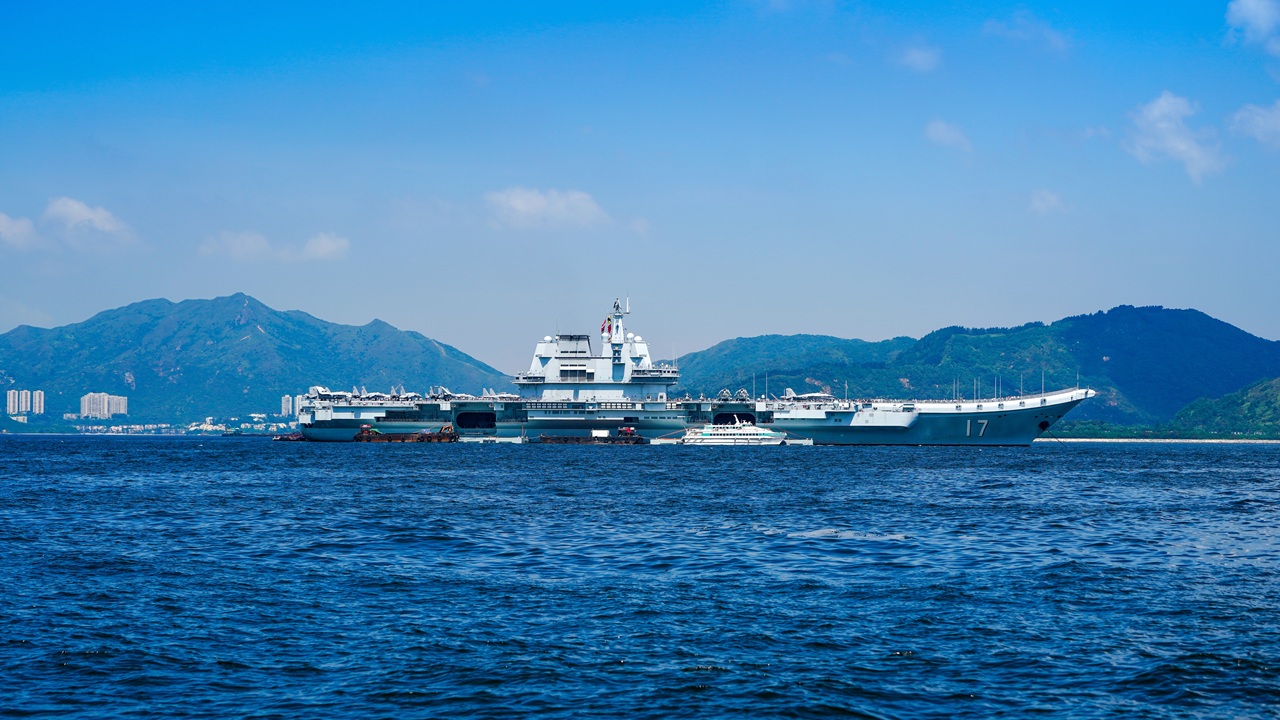
The PLAN currently operates three carriers. The Liaoning (Type 001) and Shandong (002) are Short Take-off, Barrier-Arrested Recovery (STOBAR) carriers, relying on a ramp to propel aircraft to the sky. Because they lack catapults, aircraft must take off from STOBAR carriers fully under their own power, meaning they must be smaller and lighter than aircraft operating from catapult-assisted carriers.
The Liaoning is actually a refurbished version of Russia’s Admiral Kuznetsov aircraft carrier. The Liaoning shares the same basic design, but is a brand new warship—and appears to have few of the troubles that have consigned the Admiral Kuznetsov to irrelevance.
The Type 003 Fujian, the PLAN’s most recent carrier, has a flat top and an electromagnetic catapult—leapfrogging the Nimitz-class carrier’s steam catapults. Unlike the Nimitz class, however, the Fujian is conventionally powered, limiting its range. Future Chinese aircraft carriers are expected to have nuclear propulsion.
All US aircraft carriers—both the Nimitz class and its replacement Ford class—are nuclear-powered CATOBAR flattops.
| Carrier Type | Type 003 Fujian (China) | Nimitz Class (US Navy) |
| Year Introduced | 2025 | 1975 |
| Number Built | 1 | 10 (1 likely to be decommissioned soon) |
| Length | 316 m (1,036 ft) | 333 m (1,092 ft) |
| Beam (Width) | 76 m (249 ft) | 76.8 m (252 ft) |
| Displacement | ~80,000–85,000 t | 100,000+ t |
| Propulsion | Conventionally-powered steam turbines | 2 Westinghouse nuclear reactors, 4 steam turbines |
| Range | ~6,000 nmi (6,900 mi, 11,112 km) | Unlimited |
| Top Speed | ~30 knots (34.5 mph, 55.5 km/h) | ~30 knots (34.5 mph, 55.5 km/h) |
| Armaments | Gun- and missile-based CIWS 50+ aircraft |
Sophisticated countermeasures suite 2–3 Mk 29 Guided Missile Launching Systems, 8 RIM-162 ESSM or RIM-7 Sea Sparrow missiles each 3–4 Phalanx CIWS 2 Mk 49 Guided Missile Launching Systems 25mm machine guns 85–90 aircraft |
| Crew | ~3,000 | 5,000+ |
America Will Still Have More—and Better—Carriers than China
It is important to note that having nine flattops by 2035 does not mean that China will have the same capabilities as the US Navy. For one thing, the US Navy will have 11 carriers in 2035—a mix of the Nimitz and the Ford class, all of which are nuclear-powered and catapult-equipped.
The PLAN also lacks the combat and operational experience that the US Navy has accrued throughout decades of practice. Indeed, its two operational aircraft carriers, the Liaoning and Shandong, conducted dual-carrier drills for the first time only in 2024. The joint training took place in the Yellow Sea, East China Sea, and South China Sea, and aircraft from one carrier operated on the other.
The US Navy has been conducting such complex naval drills for decades. In addition, it has conducted wartime carrier operations during the majority of the past 26 years. Lessons learned through combat cannot be learned in peace. Drills go a long way in providing important training to ships and crews, but the experience gained through the demands of warfare is unparalleled.
Beijing is expanding its naval forces and seeks to add six new aircraft carriers by 2035. More flattops, however, do not ensure parity.
About the Author: Stavros Atlamazoglou
Stavros Atlamazoglou is a seasoned defense journalist specializing in special operations and a Hellenic Army veteran (national service with the 575th Marine Battalion and Army HQ). He holds a BA from the Johns Hopkins University and an MA from the Johns Hopkins’ School of Advanced International Studies (SAIS). His work has been featured in Business Insider, Sandboxx, and SOFREP.
Image: Shutterstock / Chintung Lee.
The post China Might Have Nine Aircraft Carriers by 2035, Pentagon Says appeared first on The National Interest.
Источник: nationalinterest.org