

«Данное сообщение (материал) создано и (или) распространено иностранным средством массовой информации, выполняющим функции иностранного агента, и (или) российским юридическим лицом, выполняющим функции иностранного агента»
 Topic: History Blog Brand: The Buzz Region: Americas Tags: 51st State, Canada, Donald Trump, North America, Revolutionary War, and United States From Quebec 1775 to Trump 2025: America’s Long Obsession with Owning Canada December 31, 2025 By: Brandon J. Weichert
Share
The United States has long sought to possess its northern neighbor—but each attempt has ended in failure. Today, President Donald Trump is trying again.
With the 250th anniversary of the founding of the United States set to occur on July 4, 2026, it is important to remember that there is another interesting 250th anniversary upon us today. This is the anniversary of the Battle of Quebec—fought on New Year’s Eve 1775, as the American colonists struggled to throw off the yoke of their imperial masters in Britain.
The First American Dream of Canada Died in the Snow
The Battle of Quebec was part of a larger—albeit ill-conceived—campaign by the Americans to wrest Canada from the clutches of the British Empire.
The problem facing the American revolutionaries was that, unlike their brethren in the 13 Colonies, the Canadians did not want to leave the bosom of the British Empire. Indeed, after the Revolutionary War, Canada became a refuge for American loyalists fleeing their former neighbors.
In 1775, the Americans figured that, should the British lose access to their Canadian holdings, the entirety of North America could be denied to His Majesty’s Armed Forces—further ensuring that the colonists’ cause of liberty was successful.
But the American foray into Canada, with the capture of Quebec being their primary objective, was doomed almost from the start. Although led by the brilliant (though dangerously egotistical) General Benedict Arnold, as well as Daniel Morgan and Richard Montgomery, the rag-tag American force that ventured into the cold depths of Canada was woefully ill-equipped, undermanned, and painfully disorganized.
Quebec itself was an older city among the European settlements in North America, having first been settled by the French and then claimed by Britain following France’s disastrous showing in the Seven Years War. Because of its age and large population, the city was well fortified. A blizzard had covered the city and stymied the efforts of the American militias to capture the city.
The Americans under the command of Benedict Arnold quickly laid siege to Quebec. But the large, populated, and well-defended city was able to withstand that haphazard siege by Arnold and his troops long enough to allow for British forces to relieve the city and effectively end the American mission. Arnold’s forces retreated back into America, and Canada remained unmolested through the remainder of the war.
December 31, 1775, was the day that the delusions of grandeur for the Americans when it came to conquering Canada ended.
Or did they?
In 1812, America Tried Again—and Failed Again
American forces would again attempt to conquer Canada from Britain in the War of 1812. After a string of defeats in 1812, the United States briefly captured the city of York (now Toronto) the following year, but was defeated outside Montreal and retreated. By 1814, Napoleon’s defeat in Europe freed up thousands of British troops for service in the Americas, and the United States remained on the defensive for the rest of the war.
The Treaty of Ghent formally ended the war in December 1814, though battles continued into 1815 before local forces learned of the agreement. After that, for more than a century, the Americans and Canadians eyed each other suspiciously across their shared border.
It has since been revealed that Canada had prepared themselves for a potential US invasion of their lands at the dawn of the 20th century—and the Americans had, too, plotted for an overwhelming attack on Canada around that time.
All that came to a close by the time the Cold War began. The Americans needed to defend the Arctic passes from the Soviets. To do that, Washington found it easier to simply partner with the Canadian government and military rather than plan an invasion. After all, the very fate of the Free World depended on the total security of North America. Such an important goal could never be achieved if the Americans and Canadians were warring.
At the end of the Cold War, it appeared as though the United States and Canada had finally turned away from their generations’ worth of distrust, suspicion, and loathing.
Trump Has Thrown US-Canada Relations into Chaos
Then came Donald Trump’s re-election in 2024. Declaring Canada to be the “51st State,” Trump triggered a truly seismic shift in Canada’s domestic politics—unintentionally bolstering the wildly unpopular leadership of Liberal Prime Minister Justin Trudeau and destroying the fortunes of the rising Conservative Party.
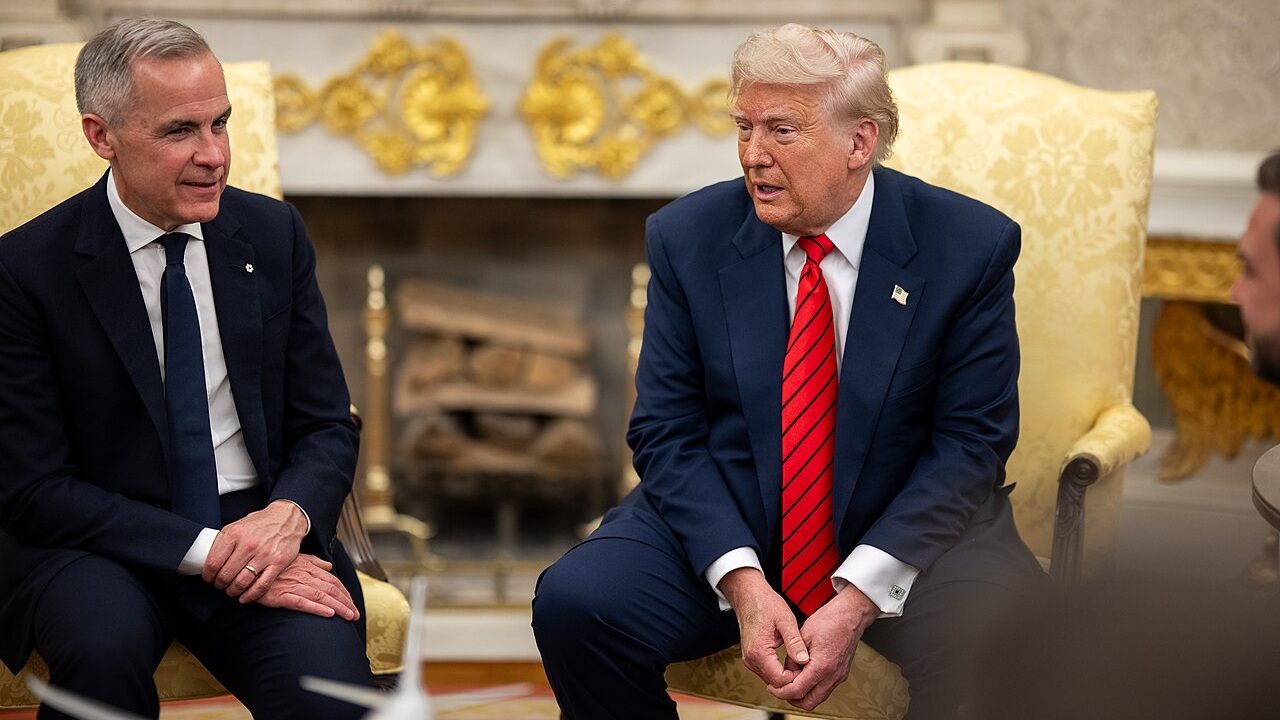
Trudeau resigned from office shortly after Trump’s inauguration. His successor, Mark Carney, was seen by many Canadians as a quintessentially anti-Trump figure. Trump is an economic populist who has raged against the “elites” and the “establishment”; Carney, who clearly belongs to both, was selected based on his expertise as a central banker. The contrast could not be more stark.
With the specter of Trump looming over Canadian politics, Carney easily survived an electoral challenge from the Conservatives in April, and his approval ratings in most of Canada have remained positive. Yet the prime minister has largely continued the Trudeau-era policies that have hurt Canada’s economy and divided its society. To make matters worse, Carney has periodically engaged in equally antagonistic behavior with Trump as Trump had engaged with Trudeau. In only 12 months, US-Canada relations have regressed to where they were at the turn of the 20th century.
Of course, Washington is not drawing up war plans to invade Canada (that we know of). What it is doing, though, is angling to surround and dismember Canada. This is where Trump’s Greenland ploy is so helpful. Acquiring Greenland will ensure the United States has more direct access to the Arctic—and completely surrounds Canadian territory. At the same time, the Trudeau-Carney policies have so thoroughly divided Canada that its western Alberta province is set to hold a referendum on leaving Canada’s confederation soon.
There is significant support from the White House for Alberta’s separation from Canada—though, given Trump’s unpopularity there, the president has wisely kept his distance from the issue. As the most prosperous, energy-rich province of Canada, if Alberta were to declare independence, the entire Canadian national project would implode. This is obviously what the Trump administration desires.
A New US Strategy for Canada: Surround, Don’t Invade
Here’s the kicker, though—and it cuts back to that frosty day of failure outside of Quebec on December 31, 1775. The United States has long lusted after Canada but has repeatedly failed to fulfill that geopolitical lust. At Quebec in 1775, the Americans had a measly 1,000 disparate troops to take the entirety of what is now eastern Canada. In 1812, the Americans couldn’t accomplish the mission either. For a century thereafter, the Canadians and Americans eyed each other warily.
Now, the Americans under Trump are back to finish what their forefathers started. But just as with those past occasions, the American reach might far extend their grasp. That’s because, for all his rhetoric, Trump has done little to either secure Greenland as an American protectorate—and there remains a very big question mark over the prospect of Alberta’s separation from Ottawa’s control.
Absorbing Canada is a task that requires the full attention of the United States and the commitment of its political elites. Neither are there at the moment.
So, Canada’s existence as an independent entity will continue, if only because Canada is an afterthought for most Americans. In the meanwhile, Trump has alienated Canada with his loose talk, while doing little to provide the resources and leadership for succeeding in his stated mission of making Canada the “51st state.”
It’s the worst of both worlds. Let us hope that Trump either drops this half-hearted course of action, or fully commits to convincing the Canadians that their future would really be brighter as a part of the United States.
About the Author: Brandon J. Weichert
Brandon J. Weichert is a senior national security editor at The National Interest. Recently, Weichert became the host of The National Security Hour on America Outloud News and iHeartRadio, where he discusses national security policy every Wednesday at 8pm Eastern. Weichert hosts a companion book talk series on Rumble entitled “National Security Talk.” He is also a contributor at Popular Mechanics and has consulted regularly with various government institutions and private organizations on geopolitical issues. Weichert’s writings have appeared in multiple publications, including The Washington Times, National Review, The American Spectator, MSN, and the Asia Times. His books include Winning Space: How America Remains a Superpower, Biohacked: China’s Race to Control Life, and The Shadow War: Iran’s Quest for Supremacy. His newest book, A Disaster of Our Own Making: How the West Lost Ukraine is available for purchase wherever books are sold. He can be followed via Twitter @WeTheBrandon.
Image: Wikimedia Commons.
The post From Quebec 1775 to Trump 2025: America’s Long Obsession with Owning Canada appeared first on The National Interest.
Источник: nationalinterest.org