

«Данное сообщение (материал) создано и (или) распространено иностранным средством массовой информации, выполняющим функции иностранного агента, и (или) российским юридическим лицом, выполняющим функции иностранного агента»
 Topic: Military Administration Blog Brand: The Buzz Region: Asia Tags: ISR, and MQ-9 Reaper Kadena: This Is the ISR Network China Fears Most December 23, 2025 By: Stavros Atlamazoglou
Share
In a potential conflict with China, the US military and its partners will rely on ISR assets to provide important information domination capabilities.
When one thinks of major military clashes, fighter jets, large warships, missiles, main battle tanks, and other weapon systems that can dish out punishment to the enemy come to mind.
However, intelligence-gathering assets can be equally important on the battlefield, allowing commanders to better understand the operational and tactical situation.
Kadena Is a Key ISR Hub
The US military’s Kadena Air Base in Japan is a key intelligence, surveillance, and reconnaissance (ISR) hub in the Indo-Pacific theater of operations.
In a potential conflict with China, the US military and its partners will rely on ISR assets to provide important information domination capabilities in a battlefield that spans thousands of miles.
Kadena is a true multi-service and multination ISR hub with units from the US Navy, Air Force, and Marine Corps, as well as Australia and New Zealand.
One of the units operating from Kadena is the 82nd Expeditionary Reconnaissance Squadron.
“The 82nd Expeditionary Reconnaissance Squadron delivers multi-domain situational awareness that is critical to all operational decisions in the Indo-Pacific,” Air Force Lt. Col. Michael Ellsworth, the commanding officer of the 82nd ERS, said about his unit in a command press release.
“Our RC-135 Rivet Joint aircrew partners with Kadena-based ISR platforms to provide clarity that allows commanders to anticipate, not react,” he added.
US forces in the Indo-Pacific theater have several ISR options, including E-3 Sentry airborne early warning and control aircraft, RC-135 Rivet Joint signals intelligence aircraft, P-8 Poseidon maritime surveillance aircraft, MQ-4C Triton high-altitude, long-endurance unmanned aerial systems, and MQ-9 Reaper drones.
ISR platforms offer commanders a better picture of the battlefield and can help dismiss much of the fog of war that comes in combat. In vast maritime operational theaters like the Indo-Pacific, ISR platforms are that much more important because they can help commanders keep an eye on larger distances without committing frontline resources.
“Kadena Air Base remains the eyes of the Pacific, projecting vigilance, coordination, and strength across the region,” INDOPACOM stated.
The MQ-9 Reaper Is the King of ISR
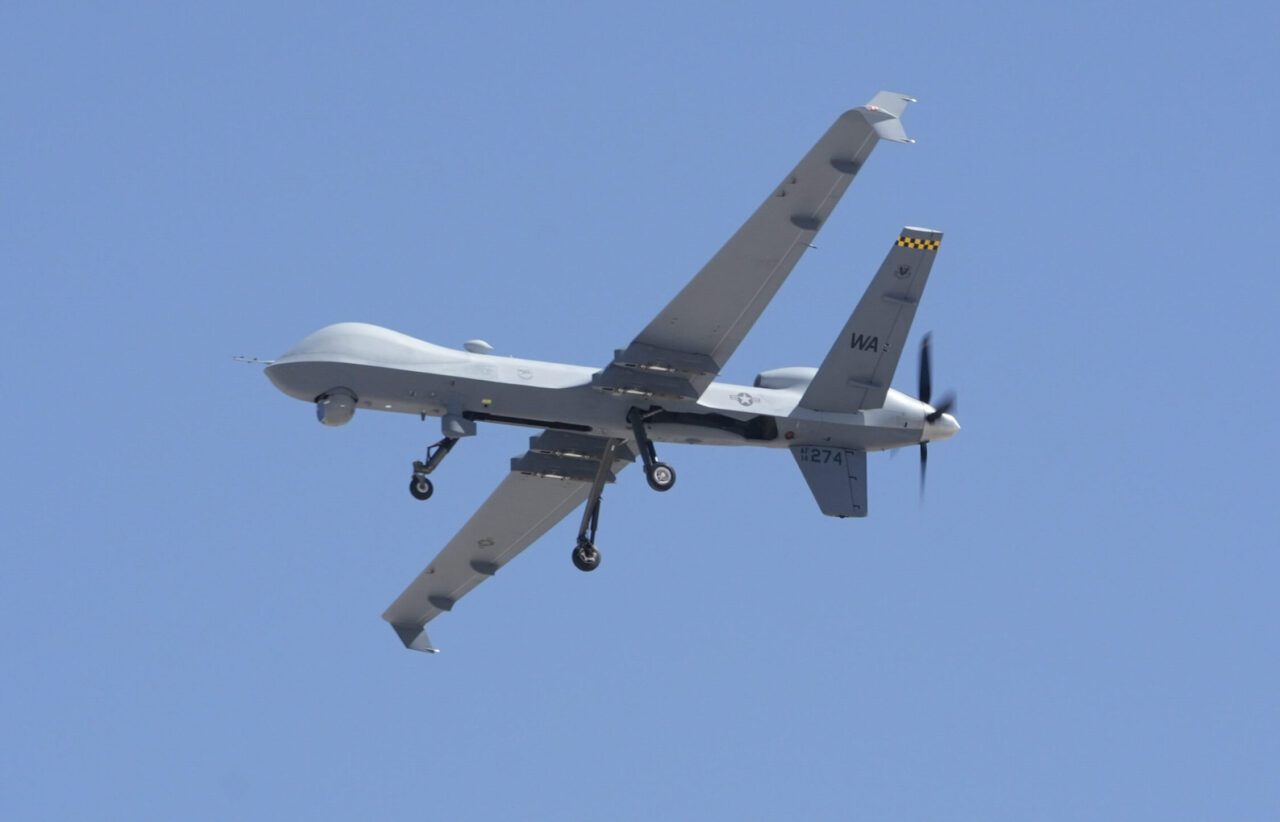
The MQ-9 Reaper unmanned aerial system is one of Kadena’s most powerful ISR assets. There are Air Force and Marine Corps units operating MQ-9 Reapers from Kadena on a daily basis. Specifically, the 319th Expeditionary Reconnaissance Squadron and Marine Unmanned Aerial Vehicle Squadron 3 work together with other US military units and the Japanese military, providing important ISR capabilities across key approaches to Japan and the First Island Chain.
The MQ-9 Reaper is a particularly valuable tool for policymakers, military commanders, and tactical units for several reasons.
First, it can operate for long periods of time. The fact that it is an unmanned aerial system means that it can operate longer than manned aircraft because it can change operators mid-flight. Moreover, the drone offers great loitering capabilities and can stay on target for hours if necessary. Finally, the MQ-9 Reaper can carry munitions and, if necessary, switch from an intelligence-gathering posture to a kinetic one, taking out high-value targets or providing close air strike capabilities to units on the ground. These attributes made the MQ-9 Reaper particularly well-liked by US and NATO troops during the wars in Iraq and Afghanistan.
About the Author: Stavros Atlamazoglou
Stavros Atlamazoglou is a seasoned defense journalist specializing in special operations and a Hellenic Army veteran (national service with the 575th Marine Battalion and Army HQ). He holds a BA from the Johns Hopkins University and an MA from the Johns Hopkins’ School of Advanced International Studies (SAIS). His work has been featured in Business Insider, Sandboxx, and SOFREP.
Image: DVIDS.
The post Kadena: This Is the ISR Network China Fears Most appeared first on The National Interest.
Источник: nationalinterest.org