

«Данное сообщение (материал) создано и (или) распространено иностранным средством массовой информации, выполняющим функции иностранного агента, и (или) российским юридическим лицом, выполняющим функции иностранного агента»
 Topic: Naval Warfare Blog Brand: The Buzz Region: Americas Tags: Amphibious Landing, Drones, North America, United States, and US Marine Corps The Marines Just Tested a New Landing Zone-Clearing Amphibious Drone December 23, 2025 By: Brandon J. Weichert
Share
Amphibious landings in contested areas are the most difficult operations in warfare—and effective drones are likely to be vital to their future success.
The United States Marine Corps (USMC) strives to be at the forefront of America’s ongoing revolution in military affairs. Toward that end, they are constantly developing and testing new combat systems to ensure that their mission of being the tip of America’s spear into conflict is dynamic and deadly.
As modern warfare becomes increasingly defined by unmanned systems, the Marines are wrapping their arms around unmanned technology to keep them competitive on the new battlefield.
The “Technical Concept Experiment,” Explained
During a two-week Technical Concept Experiment (TCE) at Camp Pendleton, California, the Marines conducted trials on a new unmanned amphibious craft. They were testing to see how the unmanned amphibious drone would deal with mines and IEDs in surf and beach zones. It is clear that this was aimed at any contingency involving the People’s Republic of China (PRC), considering that any conflict with China would likely be waged in the First Island Chain of the Indo-Pacific. The craft in question is designed to operate autonomously or under remote control—including beyond line-of-sight, thanks to satellites.
According to Army Recognition, an industry publication, multiple vehicles can network and scan larger areas to relay data to the rest of any attacking Marine force. In other words, if one of these systems goes down, the others can continue fighting while utilizing the data that the downed system collected before its disabling.
This tracked unmanned vehicle utilizes flotation aids, ensuring that it can move from open water into the surf and, inevitably, onto the beach. Traditionally, this has always been a difficult task for unmanned systems.
The configuration of the unmanned system at Camp Pendleton indicates that there are sensor payloads and comms equipment in the place of weapons. A flat deck that appears to hold modular equipment cuts across the body of this platform, indicating that these unmanned amphibs can carry light loads that might assist with logistics operations or the like during combat.
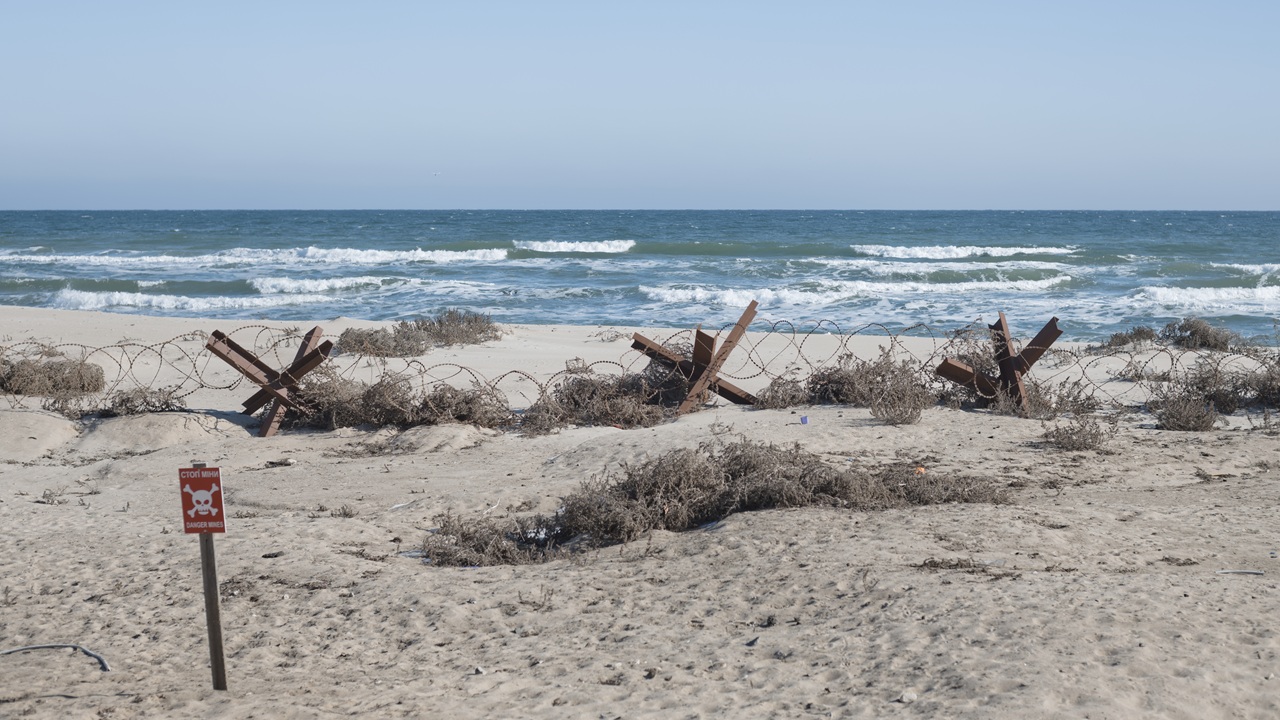
Interestingly, the system in question is not an armored combat vehicle for carrying Marines ashore. Instead, it is to be deployed ahead of any landing force to probe for hazards on the beaches. This platform will identify and clear mines before the Marines ever hit the beach.
Amphibious Landings Are Really Hard for Drones
This is where the importance of this system comes into play. For years, the surf zone of a landing area has been the bane of unmanned systems due to waves and saltwater degradation.
These initial tests at Camp Pendleton were successful. But they were rudimentary. Before the Marines ever deploy this system into real combat, they will put the system through a bevy of far more complex minefield drills—under tougher ocean conditions—with longer endurance tests and a tighter integration with other Marine Corps systems.
None of this works unless the system itself is scalable. Another round of more intensive testing will determine its viability.
By using unmanned amphibious craft that are heavily networked and operate in swarms, the Marines are ensuring that traditional ship-to-shore operations are safer and much more effective in combat. It is a small but necessary step toward a more automated combat experience. And it is a step toward ensuring that the Marines pave the way once more for true innovation in amphibious combat—before the Chinese go to war with Taiwan and/or Japan, likely prompting Washington to become involved as well.
About the Author: Brandon J. Weichert
Brandon J. Weichert is a senior national security editor at The National Interest. Recently, Weichert became the host of The National Security Hour on America Outloud News and iHeartRadio, where he discusses national security policy every Wednesday at 8pm Eastern. Weichert hosts a companion book talk series on Rumble entitled “National Security Talk.” He is also a contributor at Popular Mechanics and has consulted regularly with various government institutions and private organizations on geopolitical issues. Weichert’s writings have appeared in multiple publications, including The Washington Times, National Review, The American Spectator, MSN, and the Asia Times. His books include Winning Space: How America Remains a Superpower, Biohacked: China’s Race to Control Life, and The Shadow War: Iran’s Quest for Supremacy. His newest book, A Disaster of Our Own Making: How the West Lost Ukraine is available for purchase wherever books are sold. He can be followed via Twitter @WeTheBrandon.
Image: Shutterstock / Valerii Gomeniuk.
The post The Marines Just Tested a New Landing Zone-Clearing Amphibious Drone appeared first on The National Interest.
Источник: nationalinterest.org