

«Данное сообщение (материал) создано и (или) распространено иностранным средством массовой информации, выполняющим функции иностранного агента, и (или) российским юридическим лицом, выполняющим функции иностранного агента»
 Topic: Space Blog Brand: The Buzz Region: Americas Tags: Ballistic Missiles, Golden Dome, Missile Defense, United States, and US Space Force Inside the Space Force’s Push for Orbital Missile Killers December 11, 2025 By: Stavros Atlamazoglou
Share
The development of these weapon systems has a clear goal: deter and, if necessary, defeat US adversaries in space, particularly China.
The US Space Force is looking for space-based interceptors that will be able to shoot down Russian and Chinese ballistic missiles.
Space is becoming increasingly militarized as near-peer competitors are advancing their capabilities.
A Space-Based Interceptor for America
A potential near-peer conflict with China or Russia will almost certainly involve the launching of ballistic missiles against US military targets. Now, the US military wants weapon systems that will be able to shoot down advanced ballistic missiles before they reach friendly military targets or the homeland.
The Space Force’s Space Combat Power Program Executive Office issued a request for a prototype proposal for a space-based interceptor. The solicitation clarifies that the Space Force is only looking for “kinetic midcourse solutions only.” This capability request is meant for interceptors that will be able to shoot down enemy ballistic missiles during the midcourse phase of flight.
The solicitation for munitions that can be based in space and intercept ballistic missiles midcourse is only one part of the Space Force’s strategy to protect the homeland from enemy ballistic missiles.
The Space Force is also developing interceptors that can take down an enemy ballistic missile in its initial boost phase. In November, General Michael Guetlein, the Golden Dome director, said at the Reagan National Defense Forum that the Space Force has awarded 18 contracts for boost-phase interceptor prototypes.
Both weapon systems under development are part of the wider Golden Dome air defense program.
The development of these weapon systems has a clear goal: deter and, if necessary, defeat US adversaries in space, particularly China.
The main threat to the United States in space comes from China. Beijing has the second-largest operational satellite fleet behind the United States, with over 1,200 satellites in active service.
In April, Space Force General B. Chance Saltzman, the Space Force’s chief of space operations, stated that “from a military perspective, Beijing understands that the space domain is a key enabler of long-range precision strike as well as of information gathering and dissemination, which makes it foundational to the projection of national power.”
The Three Phases of a Ballistic Missile
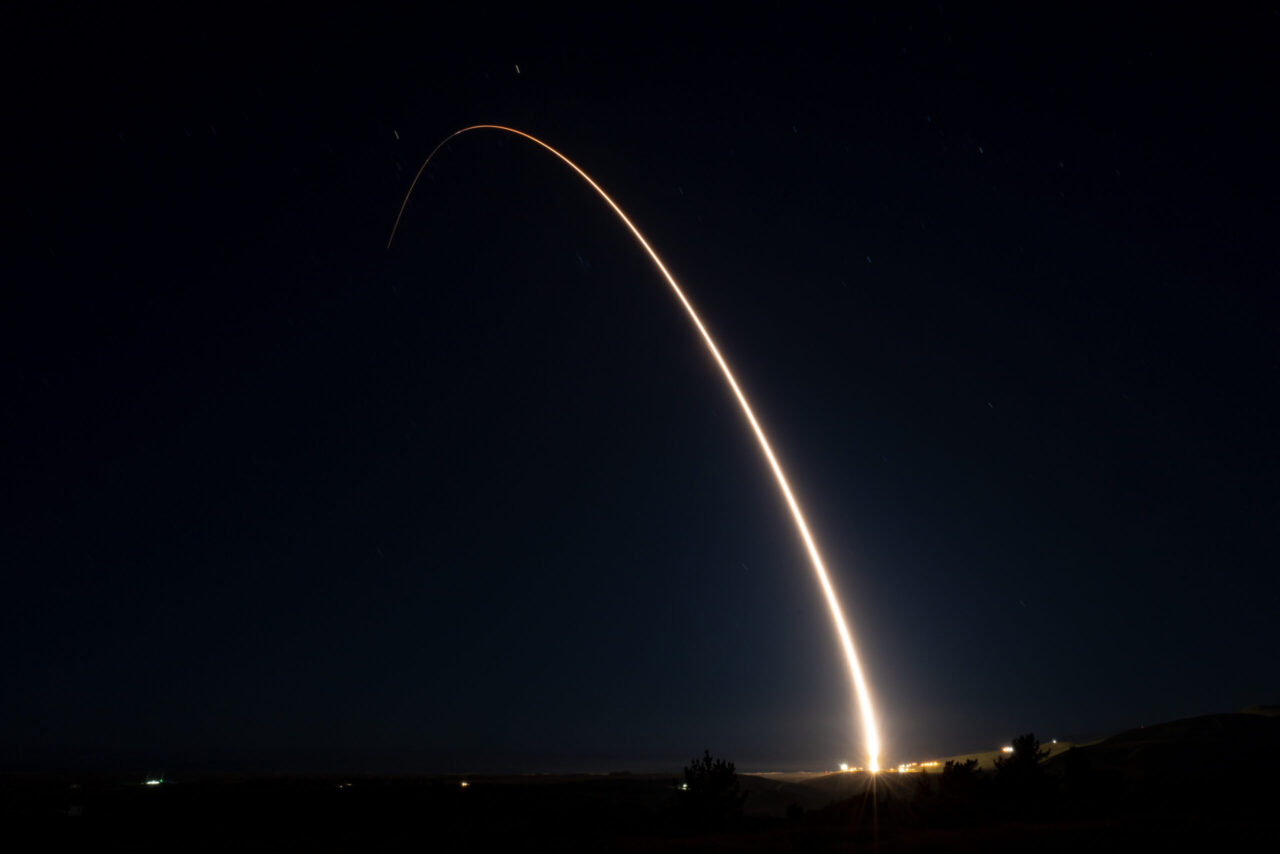
All ballistic missiles have three flight phases: boost, midcourse, and terminal.
During the boost phase, a ballistic missile is using maximum thrust, often with the use of rockets, to gather the necessary velocity to reach its intended target. The boost phase can last anywhere from one to five minutes, depending on the munition and the range of the target. During the boost phase, a long-range ballistic missile (the sort that can carry a nuclear warhead) will exit the Earth’s atmosphere into outer space, while a short-range ballistic missile will reach an area between the fringes of the atmosphere and the beginning of outer space.
During the midcourse flight phase, a ballistic missile does not have any power and follows a predictable path to the target. This flight phase offers the largest interceptor window. However, during this phase, a ballistic missile can launch countermeasures to evade interception.
Finally, during the terminal flight phase, which usually lasts less than one minute, a ballistic missile storms toward the target.
About the Author: Stavros Atlamazoglou
Stavros Atlamazoglou is a seasoned defense journalist specializing in special operations and a Hellenic Army veteran (national service with the 575th Marine Battalion and Army HQ). He holds a BA from the Johns Hopkins University and an MA from the Johns Hopkins’ School of Advanced International Studies (SAIS). His work has been featured in Business Insider, Sandboxx, and SOFREP.
Image: DVIDS.
The post Inside the Space Force’s Push for Orbital Missile Killers appeared first on The National Interest.
Источник: nationalinterest.org