

«Данное сообщение (материал) создано и (или) распространено иностранным средством массовой информации, выполняющим функции иностранного агента, и (или) российским юридическим лицом, выполняющим функции иностранного агента»
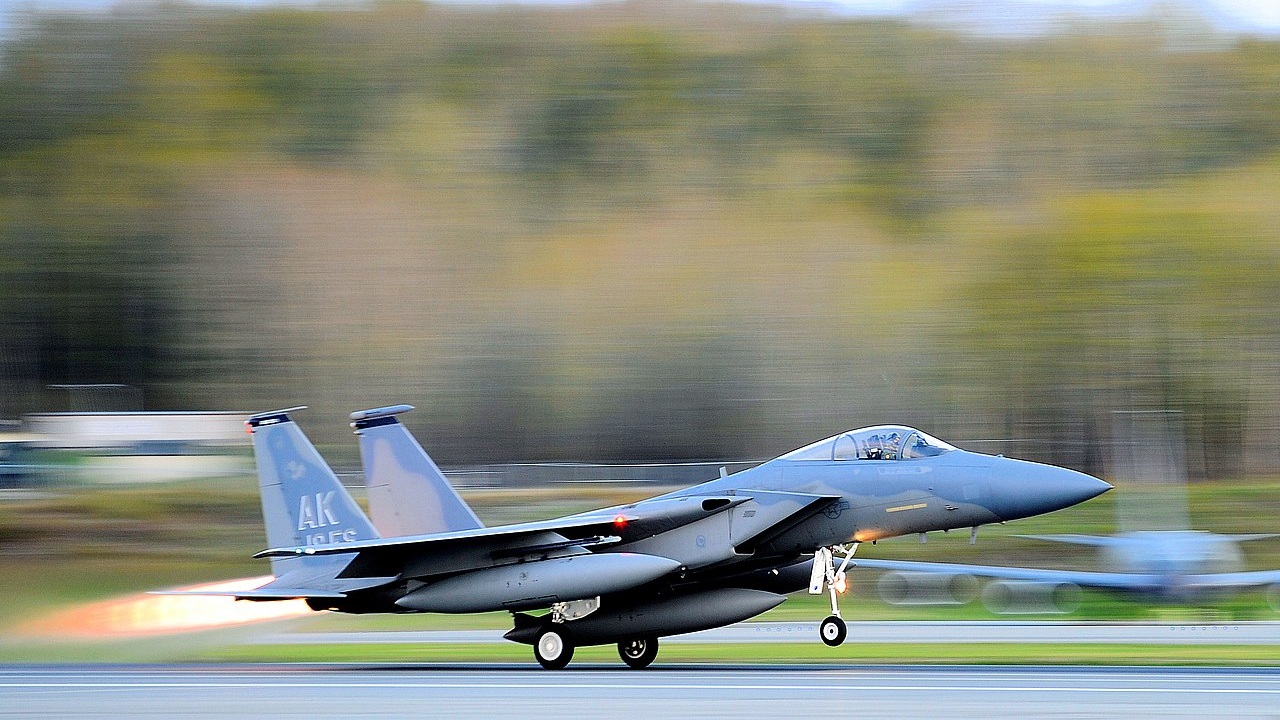 Topic: Air Warfare Blog Brand: The Buzz Region: Americas Tags: Air Defense, Dogfighting, Fighter Aircraft, Supersonic Aircraft, and US Air Force Does Speed Still Matter for Fighter Jets? December 7, 2025 By: Harrison Kass
Share
The days of fighter jets outrunning ground defenses are long since past, and new aerial innovations are focused on stealth and sensor technology. But raw speed still has a place.
Supersonic flight, that is—flight in excess of Mach 1—was first achieved in October 1947, when Chuck Yeager broke the sound barrier in his Bell X-1 experimental plane. The newfound ability to transcend Mach 1 in flight was applied immediately to military aircraft, quickly rendering propeller planes nearly obsolete and becoming the operational standard in early Cold War jets. At the time, the inclusion of supersonic speed was viewed as a revolution in air combat—enabling interceptors, fast strike aircraft, and missile carriers to perform missions that had previously been impossible for slower aircraft. Even today, despite the emergence of stealth technology, long-range missiles, and networked warfare, there is still strategic value in raw, kinetic, blistering speed.
Speed Still Matters—but Not as Much as It Used To
Supersonic speed facilitates rapid intercept capability. When a jet has supersonic speed, it can reach intruding aircraft, or cruise missile carriers, rapidly. This is a critical capability, particularly for nations with large airspaces—including the United States, Canada, Russia, Australia, and China—and nations in broad contested air zones such as the Indo-Pacific. Speed shrinks response time, pulling the corners of the map closer and expanding the defender’s engagement window.
Time-sensitive offensive strike is another benefit of supersonic speed. Supersonic aircraft can reach fleeting targets before they can escape. This is especially useful for striking missile launchers, command vehicles, or high-value individuals, compressing timelines during complicated joint operations.
Speed enhances survivability, too, in reducing exposure to air defenses. The faster an aircraft crosses a threat envelope, the less time enemy radars and SAMs have to detect, track, and engage the aircraft. Accordingly, supersonic dash profiles are standard in strike packages—even for stealth fighters. As one might imagine, less time in engagement zones equals higher survivability.
Supersonic speed enhances missile performance, thereby enhancing beyond-visual-range (BVR) combat performance. Indeed, launching missiles at high speeds dramatically increases missile range; energy in the terminal phase; probability of kill; and intercept geometry flexibility. A fighter launching a missile at supersonic speed outranges a missile fired from a subsonic fighter by a significant margin.
Lastly, at closer-ranges—particularly during within-visual-range (WVR) combat—supersonic speed offers positional advantages. Supersonic speed can be used to create separation with an adversary; force a merge on more favorable terms; or deny the opponent positional control.
Supersonic Fighter Jets Are the Bread and Butter of Modern Air Forces
For maintaining territorial integrity—one of the core strategic values of all nation-states—supersonic fighters are especially effective. Nations and organizations, like the US, Japan, NATO, and NORAD, routinely use supersonic fighters for combat air patrol and air policing. In this function, speed translates simply into an ability to react to civil emergencies, or to confront unidentified aircraft, more quickly.
In short, supersonic flight still matters today. Stealth and sensors have risen to dominate modern warfare; it has long been impossible for an aircraft to simply outrun the missiles that enemies fire at it. But speed still increases flexibility, provides energy for weapons, counters enemy denial systems, and supports dispersed operations. Supersonic dashes remain integral to Western, Russian, and Chinese fighter doctrine for a reason. And while supersonic flight no longer defines air combat the way it once did, it remains a critical enabler of reaction time, survivability, and lethality.
About the Author: Harrison Kass
Harrison Kass is a senior defense and national security writer at The National Interest. Kass is an attorney and former political candidate who joined the US Air Force as a pilot trainee before being medically discharged. He focuses on military strategy, aerospace, and global security affairs. He holds a JD from the University of Oregon and a master’s in Global Journalism and International Relations from NYU.
Image: Wikimedia Commons.
The post Does Speed Still Matter for Fighter Jets? appeared first on The National Interest.
Источник: nationalinterest.org