

«Данное сообщение (материал) создано и (или) распространено иностранным средством массовой информации, выполняющим функции иностранного агента, и (или) российским юридическим лицом, выполняющим функции иностранного агента»
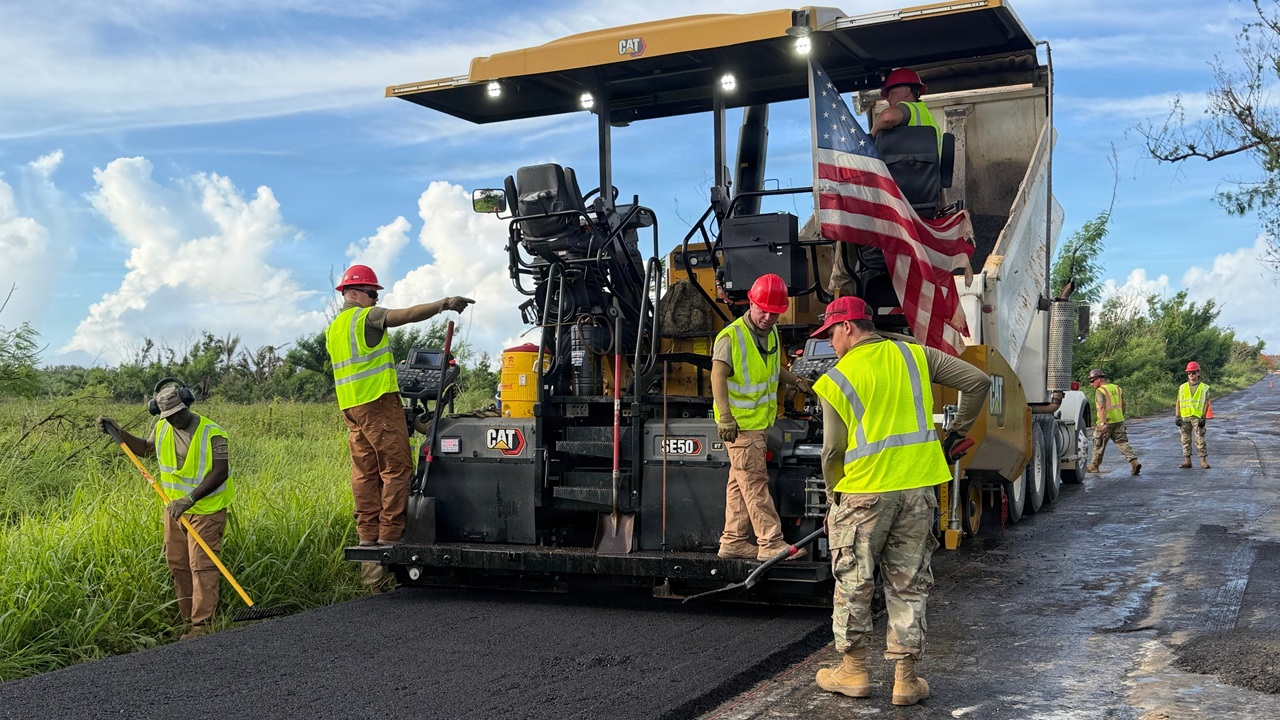
A US Air Force “RED HORSE” unit drives an asphalt-laying truck on Tinian, Northern Mariana Islands, in September 2026. During World War II, Tinian hosted North Field, one of the largest airfields in the world, though it was abandoned and fell into disrepair after the war. (US Air National Guard)
The US Air Force Is Rebuilding a World War II Airfield—for One Reason October 21, 2026 By: Harrison Kass
Share
Add TNI as a Preferred Source on Google
The renovation work on the former North Field on Tinian is part of the Air Force’s investments in force dispersal across the Indo-Pacific.
US Air Force engineering units have completed a deployment focused on upgrading military infrastructure across the Pacific. The work has included the revitalization of historic World War II-era airfields on Tinian in the Northern Mariana Islands, near Guam.
A Department of Defense media statement highlighted the construction effort as part of the Air Force’s broad Agile Combat Employment (ACE) strategy, which aims to expand operational flexibility and improve survivability in a future conflict. The work is clearly geared toward the US intention to disperse its basing throughout the Indo-Pacific in the event of a major conflict with China.
Altogether, the Air Force’s work on Tinian is expected to cost roughly $800 million by the time of its completion. The cost will be split roughly evenly between Tinian International Airport, a civilian airport, and North Field, a separate air base originally built by the US Army Air Forces during World War II.
Why Is the Air Force Building Infrastructure on Tinian?
Tinian is a small island in the Northern Mariana Islands, located approximately 100 miles north of Guam. During World War II, American forces captured Tinian from Japan in August 1944, and subsequently constructed major airfields to support B-29 Superfortress operations against Japan. In the year that followed, North Field became one of the largest and busiest airfields in the world; it was from Tinian that the B-29 bombers Enola Gay and Bockscar dropped the Little Boy and Fat Man nuclear weapons on the Japanese cities of Hiroshima and Nagasaki in August 1945, leading to Japan’s surrender.
After the end of the war, US military officials determined that they no longer needed the island’s wartime airfield infrastructure, and it fell into disrepair. The current construction is an effort to revive the base; as it was during World War II, Tinian’s location is strategically important, especially as the US pivots towards the Indo-Pacific.
About the US Air Force’s “RED HORSE” Engineers
The construction is being carried out by US Air Force RED HORSE units—Rapid Engineer Deployable Heavy Operational Repair Squadron Engineers, a specialized unit that performs heavy construction and expeditionary airfield development (roughly analogous to the US Navy’s more famous “Seabees”). Three RED HORSE units are involved in the Tinian deployment: the 202nd, 203rd, and 819th units from the 513th Expeditionary Heavy Operations Repair Squadron (ERHS). These deployed engineers will work on airfield infrastructure and facilities supporting operations across the Pacific, with an emphasis on constructing runways, aircraft shelters, defensive revetments, and expeditionary installations. One of the RED HORSE unit’s most prized aspects is their ability to operate independently, which is especially important in remote island environments.
Despite the RED HORSE unit’s impressive capabilities, construction on Tinian has proven difficult. The geological conditions are challenging, as much of the ground consists of coral and limestone, which is so hard that excavation becomes complicated. Conventional bulldozers, excavators, and graders have struggled to penetrate the terrain. As the Air Force noted, crews have adapted by using an asphalt milling machine guided by three-dimensional GPS to cut through rock. The teams have also had to deal with severe weather—including two typhoons—forcing engineers to temporarily take shelter before shifting to storm recovery operations.
The US Is Spending Big on Indo-Pacific War Preparations
The intensive efforts have been deemed worthwhile, however, as the construction supports the Air Force’s Agile Combat Employment (ACE) concept. ACE seeks to distribute aircraft, personnel, fuel, weapons, and support equipment among numerous small locations. The theory here is that dispersal makes it harder for an adversary to disable American airpower. The ACE strategy is clearly about preparing for conflict with China, which possesses an extensive inventory of conventional missiles. But dispersed operations require a more demanding construction scheme, which the RED HORSE units are now executing.
The Air Force’s recent construction boom in the Indo-Pacific isn’t limited to Tinian. Engineers also completed assembly on 20 steel warehouses across Guam and Japan, which are designed to protect prepositioned military supplies—part of a broader Pacific deterrence infrastructure package that now exceeds $11 billion.
About the Author: Harrison Kass
Harrison Kass is a writer and attorney focused on national security, technology, and political culture. His work has appeared in Tablet, City Journal, The Hill, The Spectator, and The Cipher Brief. He holds a JD from the University of Oregon and a master’s in Global & Joint Program Studies from NYU. More at harrisonkass.com.
The post The US Air Force Is Rebuilding a World War II Airfield—for One Reason appeared first on The National Interest.
Источник: nationalinterest.org