
«Данное сообщение (материал) создано и (или) распространено иностранным средством массовой информации, выполняющим функции иностранного агента, и (или) российским юридическим лицом, выполняющим функции иностранного агента»
 Topic: Foreign Leaders Blog Brand: Silk Road Rivalries Region: Eurasia Tags: Authoritarianism, Central Asia, Democracy, Kassym-Jomart Tokayev, Kazakhstan, Kyrgyzstan, Middle Corridor, Tajikistan, and Uzbekistan From Reform to Control: Kassym-Jomart Tokayev’s New Kazakhstan April 2, 2026 By: Aigerim Turgunbaeva
Share
The latest round of Kazakhstan’s constitutional reforms consolidates power in the presidency, bringing an end to a period of relative openness to pluralism.
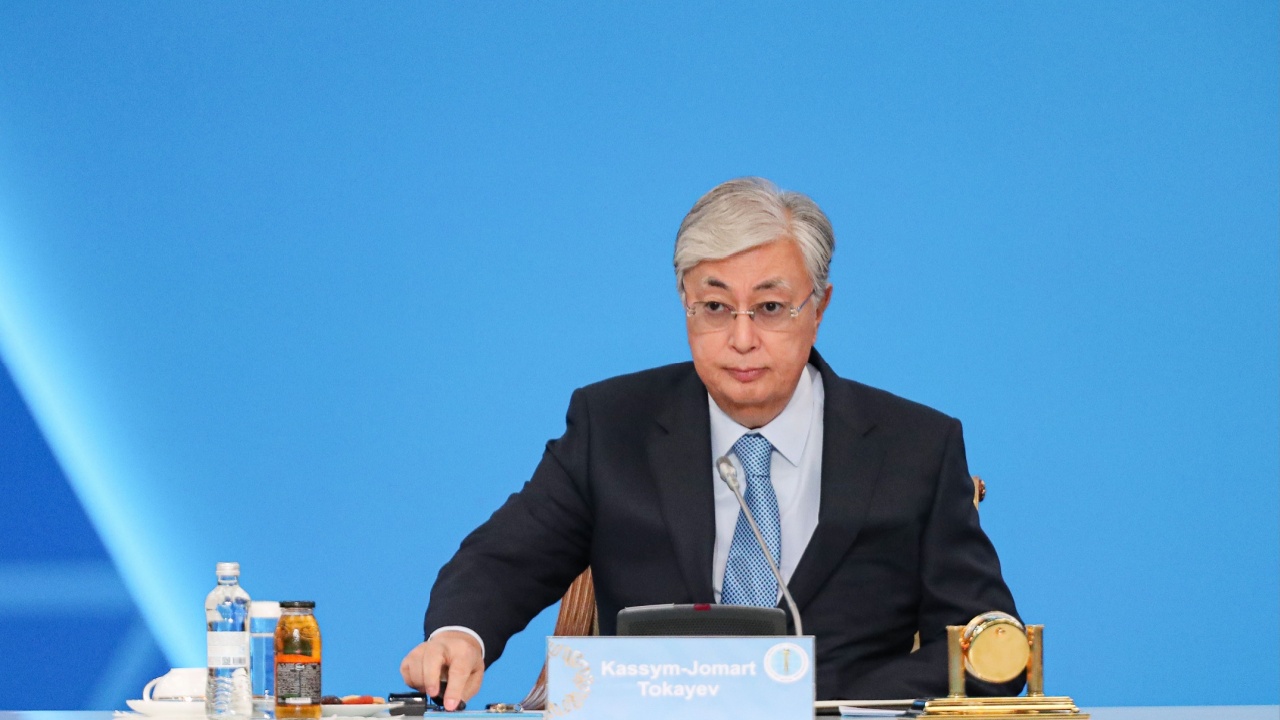
On March 15, 2026, Kazakhs turned out in record numbers—73.12 percent, the highest for any national vote since 2019—to approve a sweeping new constitution with overwhelming support. Preliminary figures showed 87.15 percent in favor, with final tallies confirming nearly 90 percent. President Kassym-Jomart Tokayev signed the document into law on March 17, with its entry into force set for July 1, 2026.
Officially framed as the culmination of the “New Kazakhstan” project launched after the government suppressed the January 2022 pro-democracy protests, the reform rewrites roughly 84–95 percent of the basic law. According to Tokayev (who recently penned a defense of the reforms in this publication) and his administration, these changes streamline governance, move away from a “super-presidential” model, and strengthen citizens’ rights amid global volatility.
Yet the underlying logic is familiar to observers of post-Soviet Eurasia. Tokayev, who assumed the presidency in 2019, has followed a well-trodden regional trajectory. Initially positioned as a contrast to Nursultan Nazarbayev’s long rule, he introduced symbolic reforms after the 2022 protests: term limits, modest parliamentary strengthening, and the rollback of the former president’s privileges. But the violent lessons of “Bloody January” (Qandy Qantar)—when unrest threatened regime survival—triggered a rapid recalibration toward centralized control.
The 2026 Constitution consolidates this shift. The reintroduction of the vice presidency creates a clear mechanism for managed succession, allowing Tokayev (now 72) either to step aside early while retaining influence or to reset the tenure rules under the new framework ahead of the 2029 presidential elections. In doing so, Kazakhstan aligns more closely with regional patterns: Shavkat Mirziyoyev’s controlled reforms in Uzbekistan, Sadyr Japarov’s consolidation of presidential authority in Kyrgyzstan, and Emomali Rahmon’s dynastic model in Tajikistan—systems where stability consistently outweighs pluralism and executive dominance remains the norm.
For US interests, this evolution presents a mixed picture. Kazakhstan remains Central Asia’s indispensable state: the world’s largest uranium producer, a critical minerals hub, and a central node in the Middle Corridor that bypasses Russia and Iran. A more centralized and predictable system may offer short-term advantages in energy, transit, and resource security amid great-power competition. At the same time, entrenched executive control narrows Western leverage, weakens democracy-focused tools, and risks deepening Astana’s balancing between Beijing and Moscow.
Kassym-Jomart Tokayev’s Evolution: From Reformist Promise to Regional Norm
When Tokayev assumed the presidency in June 2019 after Nazarbayev’s surprise resignation, many viewed him as a potential break from the super-presidential model. A career diplomat, he promised a “listening state” (slyshashchee gosudarstvo), gradual liberalization, and greater public participation in governance, emphasizing dialogue with civil society, anti-corruption reforms, and reduced oligarchic influence.
The Qandy Qantar protests of January 2022 put this vision to the test. Triggered by fuel prices but quickly turning into broader unrest against inequality and elite privilege, the crisis left 238 dead and prompted Tokayev to request troops from the Russian-led Collective Security Treaty Organization (CSTO). In its aftermath, he dismantled Nazarbayev’s residual influence—stripping him of the honorary title of Elbasy (“leader of the nation”) and curbing his family’s privileges—and advanced 2022 constitutional amendments that introduced a single seven-year term and modestly strengthened parliament. These steps were widely seen in the West as genuine reform and the foundation of a“New Kazakhstan.”
Yet developments since 2022 reveal a recalibration toward the classic Central Asian governance model, where centralized executive authority and managed succession ensure political stability. The March 2026 referendum marks the culmination of this shift. The new Constitution—rewriting 84–95 percent of the existing framework—replaces the bicameral parliament with the unicameral Kurultai (with its 145 deputies elected proportionally), restores the vice presidency (appointed by the president with Kurultai approval and a formal succession role), and establishes the People’s Council (Halyk Kenesi)—a presidentially appointed body with legislative initiative.
Critics, including Chatham House analysts, describe the 2026 Constitution as a façade democracy due to limited public debate, a compressed drafting timeline, and constrained competition. From a realist perspective, however, this is a strategic adaptation in a volatile environment bordering Russia, China, and Afghanistan. Tokayev has prioritized predictability over political experimentation.
For Washington, the central question remains: does a more centralized yet stable Kazakhstan better serve US interests than the uncertain reform trajectory of 2019–2022?
Kazakhstan’s Presidential Succession Scenarios
The reinstatement of the vice presidency is the most consequential innovation in the new Constitution. Abolished in 1996, the post returns with the vice president appointed by the president (and confirmed by the Kurultai) and serving as designated successor in cases of resignation, dismissal, death, or incapacity. Powers are defined by the president, making the office a flexible tool for delegation without ceding ultimate authority.
Tokayev faces the end of his term in 2029. The new framework offers three pathways for continuity:
- Early exit with retained influence: Tokayev steps down before 2029, appoints a loyal vice president, and retains informal influence.
- Constitutional reset of term limits: Tokayev authorizes another substantial constitutional rewrite, allowing him to remain in office beyond 2029.
- Managed succession: Tokayev appoints a trusted figure as vice president after July 2026 and gradually transfers power before leaving office in 2029.
The names circulating—including Maulen Ashimbayev, Aida Balayeva, Imangali Tasmagambetov, and Erlan Karin—reflect a preference for loyalty and administrative experience over independent bases.
This mechanism seeks to prevent the instability seen in Kyrgyzstan’s repeated upheavals and avoid power vacuums that could invite external pressure. Risks persist: Tokayev’s age creates timing uncertainty, while a weak successor could spark elite competition. Socioeconomic pressures and latent discontent, as in 2022, could complicate the process if it appears overly engineered.
Kazakhstan’s Constitutional Reset and US Interests
Kazakhstan’s constitutional reset occurs amid intensifying great-power competition in Eurasia. A more consolidated executive enhances predictability without altering Astana’s multi-vector foreign policy, which balances Moscow, Beijing, Washington, Brussels, and Ankara.
The new institutional setup with fewer veto points, stronger presidential control over appointments, and a formalized succession mechanism reduces risks of abrupt reversals or elite fragmentation. This benefits partners seeking long-term commitments in uranium, critical minerals, and Middle Corridor infrastructure.
At the same time, consolidation narrows the space for Western soft-power tools such as support for democracy and civil society. The trajectory aligns with regional trends prioritizing stability and control.
Economically, Kazakhstan remains highly attractive. It accounts for roughly 40 percent of global uranium production, holds significant reserves of copper, lithium, and tungsten, and serves as a key node in the Middle Corridor—an alternative to Russian and Iranian land routes out of Central Asia. Centralized decision-making can accelerate investment approvals, though this predictability also favors Chinese engagement based on non-interference.
For US policymakers, the calculus is pragmatic. A centralized Kazakhstan delivers stable access to critical resources and diversified transit routes. The trade-off is reduced normative influence. Direct efforts to counter the authoritarian shift would likely prove counterproductive and accelerate the draw closer to Beijing and Moscow.
A more effective approach is targeted engagement: deepening cooperation on critical minerals and energy supply chains, investing in Middle Corridor bottlenecks, and sustaining security dialogue on counterterrorism and borders—while treating multi-vector balancing as a structural constant driven by economic and security incentives.
Kazakhstan’s Reversion to the Central Asian Mean
Kassym-Jomart Tokayev began his presidency in 2019, promising a break from autocratic rule. The January 2022 unrest forced a strategic recalibration, and early reforms briefly suggested gradual liberalization. Yet the March 15, 2026, referendum marks a decisive pivot for his administration.
The new constitution allows President Tokayev to build a framework that allows him to shape the leadership transition on his own terms: an early resignation with retained influence, a potential term reset, or the elevation of a loyal successor. Kazakhstan now fits the broader Central Asian pattern, where leaders prioritize regime stability, executive dominance, and managed continuity over pluralism.
For the United States, this is a classic realist trade-off. Short-term advantages include policy predictability on uranium, strategic minerals, and the Middle Corridor, plus a stable—if cautious—neutrality in great-power competition. Longer-term costs include narrower channels for Western influence.
A pragmatic approach requires adjustment rather than resistance. Washington stands to gain more by deepening targeted cooperation on critical minerals, transit infrastructure, and security coordination while maintaining a clear-eyed view of Kazakhstan’s trajectory. In a volatile strategic environment, reliability may prove more valuable than convergence. US diplomatic success in Central Asia will depend on recognizing the difference.
About the Author: Aigerim Turgunbaev
Aigerim Turgunbaeva is a freelance journalist based in Bishkek, Kyrgyzstan, focusing on Central Asian geopolitics, human rights, and economic trends. Her articles have appeared in outlets such as Reuters, Al Jazeera, The Diplomat, and The Guardian. She is also a contributor at the Central Asia-Caucasus Institute with the American Foreign Policy Council and a fellow at the Turan Research Center. With more than 10 years in the field, she offers real, firsthand perspectives on how authoritarianism, foreign money, and global relations intersect in the region.
The post From Reform to Control: Kassym-Jomart Tokayev’s New Kazakhstan appeared first on The National Interest.
Источник: nationalinterest.org