
«Данное сообщение (материал) создано и (или) распространено иностранным средством массовой информации, выполняющим функции иностранного агента, и (или) российским юридическим лицом, выполняющим функции иностранного агента»
 Topic: Nuclear Proliferation Blog Brand: Korea Watch Region: Asia Tags: China, Donald Trump, Iran War, Kim Jong-un, Kim Yo-jong, North Korea, North Korean Nuclear Program, Northeast Asia, Russia, South Korea, and United States Why North Korean Denuclearization Is No Longer Possible March 23, 2026 By: James Park
Share
Tacit US acceptance of North Korea’s nuclear program might be the only way to ensure future arms control negotiations.
At North Korea’s Ninth Party Congress in late February, Kim Jong-un delivered a speech, reiterating that his country’s nuclear status—which was enshrined in the North Korean Constitution in 2023—is “completely and absolutely irreversible,” and denuclearization “can never happen.” Adding to that, Kim signaled openness to conditional engagement with the United States, suggesting that “if the US respects the present position of our state specified in the Constitution…and withdraws its hostile policy toward the DPRK, there is no reason why we cannot get on well with the US.”
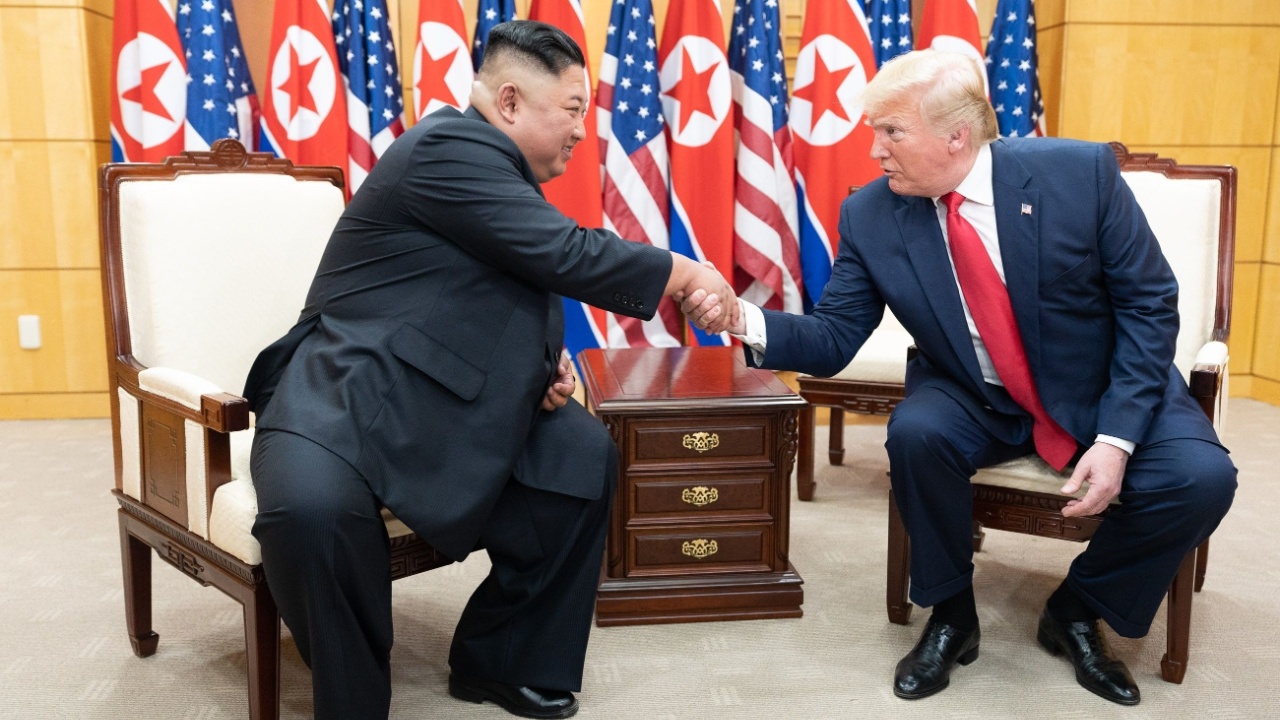
Kim’s speech is another reaffirmation of Pyongyang’s consistent signal to Washington throughout the past year: it is willing to re-engage, provided that certain preconditions are met. Among them, the most emphatically stressed North Korean demand is that the United States stop pursuing “denuclearization.” Pyongyang has made this point abundantly clear in multiple public statements, including another speech by Kim Jong-un in September 2025, in which he acknowledged his “good memor[ies]” with President Donald Trump but asserted that there will be no talks without the United States “freeing itself from its absurd pursuit of denuclearization.”
In reaction to Kim’s speech, the White House responded by saying that “US policy on North Korea has not changed. President [Donald] Trump remains open to talking with Kim Jong-un without any preconditions.” From North Korea’s perspective, the White House statement attaches unacceptable preconditions. It does not specifically mention denuclearization, but the line “US policy on North Korea has not changed” suggests that denuclearization remains the US goal.
If the Trump administration has any desire to resume diplomacy with North Korea, simply repeating that it is open to talks without preconditions is, at best, insufficient. Washington would have to make a bold decision to take denuclearization off the table.
North Korea Has Few Reasons to Trust the US
The harsh reality Washington has to grapple with is that the possibility of pursuing North Korean denuclearization, whether through diplomatic persuasion or coercive pressure, looks nonexistent.
Kim Jong-un may have had plausible reasons to agree on denuclearization talks back in 2018 and 2019. Despite notable improvements, his nuclear deterrence buildup remained rather far from completion. Geopolitical conditions were also unfavorable, with China and Russia maintaining a good distance from North Korea. North Korea’s long-term strategic outlook did not look all that promising at that time.
Now, Pyongyang is in a far better strategic position. North Korea is far more resilient in the face of international sanctions, thanks to its newly reinvigorated alliance with Russia and improved ties with China. Since the last Trump-Kim summit in 2019, North Korea has also advanced its nuclear capability significantly. It is now able to threaten a second strike against US targets in its neighborhood—American bases in South Korea and Japan—and possibly even the American mainland. Taking all these trends into account, the Kim regime looks “more secure than ever,” as the longtime North Korea expert Andrei Lankov observed recently.
What’s more, if Kim had any remaining faith in Trump’s commitment to “peace” from their intimate engagement in 2018 and 2019, Trump’s reckless military campaigns against Venezuela and Iran this year should compel Kim to reassess Trump’s intent. Watching Trump oust the Nicolas Maduro regime in Venezuela by force and launch a preventive war against Iran (in the middle of denuclearization negotiations), Kim must be only more convinced that he was absolutely right to reject Trump’s demand to immediately “hand over all nuclear weapons.”
Trump’s use of force against Venezuela and Iran does not necessarily introduce a new source of anxiety for Kim; North Korea has never been naïve about the long US track record of regime change efforts and what that implies for its own future. It will, however, inevitably reinforce Kim’s existing conviction that North Korea’s future without nuclear weapons is unthinkable.
Why US North Korea Policy Should Move Beyond Denuclearization
Ultimately, if the Trump administration has any intention of bringing North Korea back to the negotiating table, it has to move past denuclearization and start thinking seriously about the next steps. Of course, this can be more difficult than it sounds. For Washington, one big source of uncertainty is: after denuclearization is taken off the table, what does North Korea really want to discuss and achieve in negotiations?
Pyongyang’s demand that Washington stop pursuing denuclearization sounds straightforward, but the devil is in the details. Would Pyongyang settle for “tacit recognition” as a nuclear state, as long as it gets to keep its nuclear deterrent? Or does it see an eventual “formal recognition” as essential? The distinction between the two matters.
Tacit recognition would involve the United States dropping denuclearization from its declaratory policy but also continuing to avoid publicly recognizing North Korea’s nuclear status. In this scenario, while the focus of US policy would shift to arms control and stability, the scenario of resuming progress toward denuclearization in the distant future would not be entirely foreclosed. It can be argued that tacit recognition, though entailing risks, is something Washington could manage.
On the other hand, formal recognition would involve the United States and the international community explicitly recognizing North Korea as a legitimate nuclear power. This would require amending the Non-Proliferation Treaty (NPT) to include North Korea, which would not only create a formal legal barrier to denuclearization but also wreak havoc on the NPT’s credibility. This scenario would be unacceptable for Washington in many ways.
There has been growing speculation that North Korea views an explicit US recognition of its nuclear status as a prerequisite for engagement. Such speculation is reasonable considering that Pyongyang has an obvious incentive to consolidate its nuclear status and make it as irreversible as possible. In that effort, Pyongyang amended its constitution in 2023 to enshrine its nuclear status in law and now routinely underscores the constitutional illegality of denuclearization.
For instance, in her July 2025 statement, Kim Yo-jong, Kim Jong-un’s sister and North Korea’s top foreign policy spokesperson, stressed that “any attempt to deny the position of the DPRK as a nuclear weapons state…fixed by the supreme law…will be thoroughly rejected.” Kim Jong-un’s September speech also emphasized that “asking us to accept denuclearization now is as good as asking us to go against our Constitution.” Likewise, his recent speech at the Ninth Party Congress urged the United States to “respect the present position of our state specified in the Constitution of the DPRK.”
Nevertheless, such North Korean rhetoric remains ambiguous. The condition of “not denying” North Korea’s nuclear status and “respecting” the regime’s position specified in its constitution may not require formal recognition. The state of tacit recognition—taking denuclearization off the table and treating North Korea as an arms control counterpart without formal acceptance of its nuclear status—could possibly meet this bar.
One may argue that even if tacit recognition technically meets Pyongyang’s bar, Pyongyang has no reason to forgo maximalist goals in favor of compromised arms-control diplomacy. That may prove true, but also false.
Pyongyang has an interest in avoiding an inadvertent conflict on the Korean Peninsula that can escalate into a potentially existential war. So it may see incentives in building guardrails that do not require giving up deterrence (denuclearization).
Furthermore, improving its relationship with the United States, even at the expense of some concessions, may have long-term geopolitical appeal for North Korea. Pyongyang seems positioned to maintain stable ties with Moscow and Beijing for the foreseeable future. However, North Korea’s relationships with both Russia and China have historically been shaky, with many ups and downs, and can always go downhill again. Despite North Korea’s wishful rhetoric of a “New Cold War” authoritarian coalition, the reality looks far from that.
China prioritizes pragmatic partnerships and is not keen on forming an “authoritarian axis.” The Russia-North Korea strategic alliance will likely persist, but the depth of ties and cooperation may very well loosen after the war in Ukraine. A cohesive authoritarian coalition that North Korea can count on for long-term stability seems unlikely to materialize, which could lead Pyongyang to consider negotiations with Washington.
Besides the dilemma of North Korea’s nuclear status, there are other tough questions that Washington would have to ponder, such as what changes could arms-control diplomacy with North Korea bring to the US force posture in South Korea.
An easy assumption to make is that Pyongyang would seek to move US forces completely out of the Korean Peninsula. Pyongyang certainly has a broad interest in the US withdrawal from Korea. But “to what extent” could be up for debate. Pyongyang may understand that insisting on a sweeping withdrawal would make US accommodation far less likely and drive Washington away from negotiations, so it may not rule out the possibility of coexistence with some US military presence in Korea.
Relatedly, Washington and Seoul should consider whether it is essential to maintain the current level of nearly 30,000 US troops in South Korea, a level unchanged for several decades despite the growth of a far stronger South Korean military. North Korea’s military has lagged behind, and the South now far outmatches it in conventional military terms, so maintaining deterrence on the Korean Peninsula could be feasible even in the scenario of a considerable US military drawdown.
The key component of US extended deterrence for South Korea—the US nuclear umbrella, US intelligence, surveillance, and reconnaissance (ISR) capabilities, and a US military presence to serve as a tripwire—could remain effective without a large number of boots on the ground. A reduction in US forces might be appealing to the Trump administration in itself, but it would be better to secure concessions from the North in exchange.
The Korean Nuclear Status Quo Is Unsustainable
The bottom line is that, while the United States should not be naïve about North Korea’s motives and goals, it should also not assume the worst and prematurely reject the idea of moving past denuclearization to pursue new diplomacy. In the end, Washington will not find out what Pyongyang wants and is willing to compromise until they sit down at the negotiating table.
Indeed, there are many difficult and uncomfortable questions when thinking about what comes next after moving past denuclearization, which may encourage Washington to opt for the status quo. But the status quo of trying to deter an increasingly nuclear-capable North Korea while pursuing “denuclearization”—which Pyongyang finds excessively hostile and is determined to confront at all costs—is becoming more and more dangerous and unsustainable.
Now that the Trump administration is fighting an indefinite war in the Middle East, all the while conducting trade negotiations with China, peace talks with Russia, and more assertive operations in Venezuela, it is hard to imagine it can pivot attention to North Korea anytime soon. But sooner or later, Washington will have to explore an alternative approach to North Korea beyond denuclearization.
About the Author: James Park
James Park is a research associate at the Quincy Institute’s East Asia Program. His research focuses on Korean Peninsula security, South Korean foreign policy, and US grand strategy in East Asia. He has written for The Diplomat, The National Interest, Responsible Statecraft, and Geopolitical Monitor.
The post Why North Korean Denuclearization Is No Longer Possible appeared first on The National Interest.
Источник: nationalinterest.org