
«Данное сообщение (материал) создано и (или) распространено иностранным средством массовой информации, выполняющим функции иностранного агента, и (или) российским юридическим лицом, выполняющим функции иностранного агента»
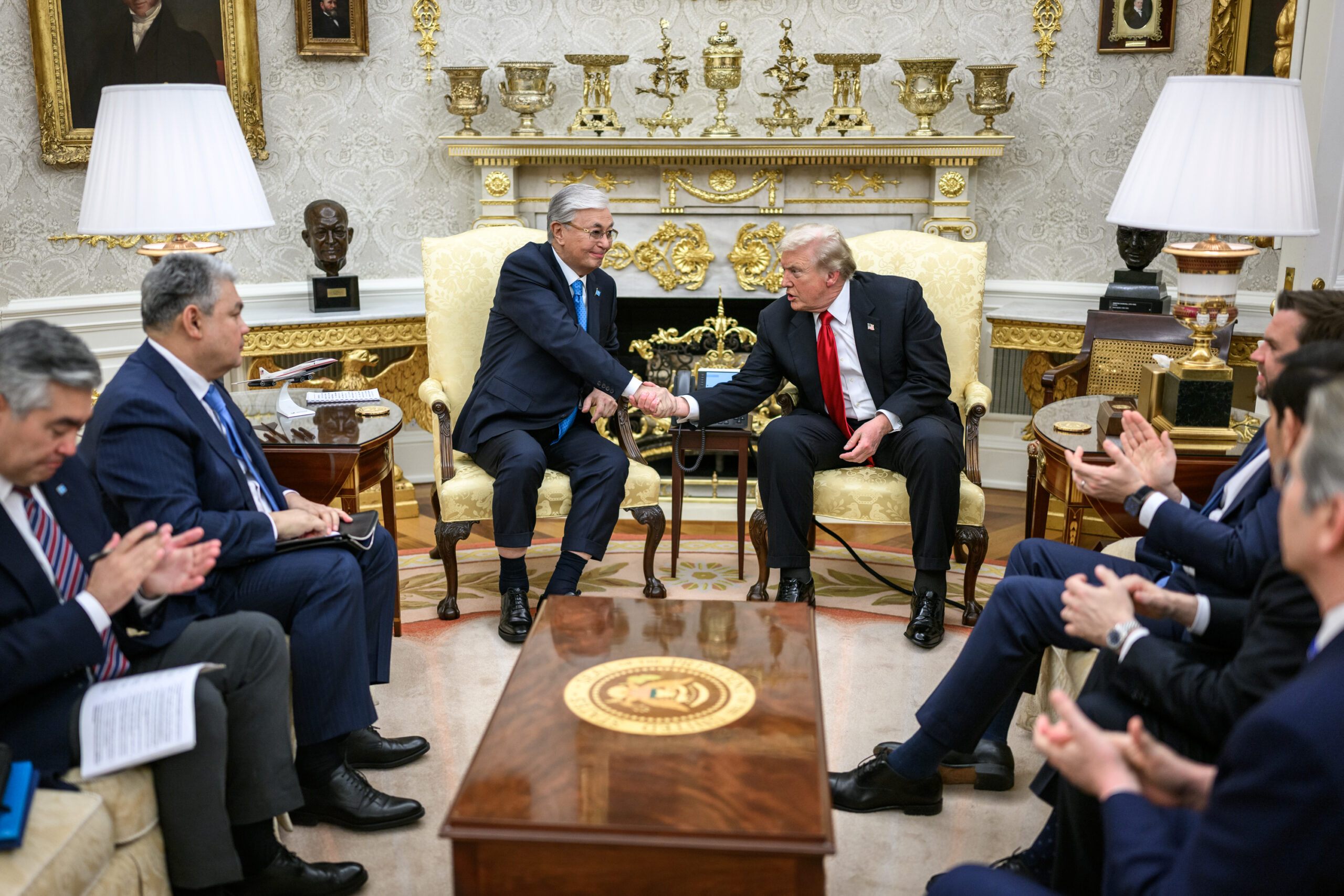
President Donald Trump meets with President of the Republic of Kazakhstan Kassym-Jomart Tokayev in the Oval Office on November 6, 2025, inaugurating a new, upward phase in US-Kazakh relations. (The White House/Daniel Torok)
Topic: Diplomacy, and Foreign Leaders Blog Brand: Silk Road Rivalries Region: Eurasia Tags: Board of Peace, Central Asia, Donald Trump, Gaza, Kassym-Jomart Tokayev, Kazakhstan, and United States US-Kazakh Relations Have Reached New Heights March 5, 2026 By: Andrew C. Kuchins, and Sayan Abaev
Share
Kazakhstan’s pragmatic engagement with the Trump administration has raised the post-Soviet republic to a new level of prestige.
Editor’s Note: The following interview with Center for the National Interest Senior Fellow Andrew Kuchins was originally published in Russian for InBusiness.kz, a Kazakh publication, under the title “Kazakhstan-USA: Relations Have Reached a Historical Maximum” on February 21, 2026. It has been republished here with the permission of that outlet and edited for style and clarity. Readers can find the original interview here.
Sayan Abaev (SA): President Donald Trump publicly thanked President Kassym-Jomart Tokayev for Kazakhstan’s participation in the [Board of Peace] and called Kazakhstan a “wonderful and rich country.” How important are such public statements in international politics, and what do they mean for US-Kazakhstan Relations?
Andrew Kuchins: President Tokayev’s participation in the inaugural meeting of the newly-founded Board of Peace in Washington is significant on at least two levels.
First, it reflects Tokayev’s very pragmatic approach to conflict resolution, peacekeeping, and critically, the role of economic development and with it stability for post-conflict zones, as well as ultimately the role of trans-border economic cooperation in promoting more peaceful relations with one’s neighbors. Kazakhstan has been a leading promoter of this approach in its own region, Central Asia, and thus brings useful experience to the persistent challenge of Israel-Palestinian relations.
Second, this provides an opportunity for Kazakhstan to solidify its ties with the Trump administration and the Washington policy community. There was a significant breakthrough between the Trump administration and the five Central Asian states in the C5+1 meeting in November, and his return to DC now is an opportunity to build on that with meetings with other significant Washington policy communities, including leading private-sector actors.
SA: The first meeting of the Peace Council focuses on Gaza’s reconstruction and humanitarian support. Why is it important for Kazakhstan to take part in these discussions, and what opportunities could this create for the country?
AK: President Tokayev is well aware that personal relations with President Trump are especially important. At the Board of Peace meeting, Trump was very direct about this, as he virtually always is, that if he likes a foreign leader personally, then his/her country is likely to benefit more from its ties with the United States. Trump’s is a far more personalistic style in diplomacy and international relations. Trump’s glowing rhetoric about Kazakhstan also usefully sends a message to Russia and China that the United States is engaged and supportive. Of course, the rhetoric needs to be backed up with concrete actions, but these seem to be in process. Tokayev’s presence this week provides a useful push for this.
SA: Kazakh troops have already taken part in international missions, including on the Golan Heights. How do you assess the possible participation of Kazakhstan in the international security forces in Gaza?
AK: Tokayev’s remarks at the meeting show how much he supports this innovative approach by the United States: “The world has never seen a move like this; it is absolutely unprecedented because, in essence, ‘Peace through Construction’ is a very innovative concept or project, and it has every chance to become a reality. By our joint efforts. Therefore, Mr. President, I acknowledge and accept your conviction that lasting peace must be built on concrete actions.”
To support this, Tokayev enumerated ways that Kazakhstan is ready to assist in the development of Gaza: building of infrastructure, food supplies—wheat, educational scholarships for Palestinian students in Kazakhstan, support for the International Stabilization Force, e-governance, etc. This indicates the seriousness of the Kazakh intention: focus on concrete actions.
SA: In his article for The National Interest, Tokayev linked Kazakhstan’s participation in the Peace Council to a broader goal, promoting dialogue between the Muslim and Jewish worlds. Do you think Kazakhstan can play a meaningful role in such a dialogue?
AK: First, I want to recommend to your readers Tokayev’s article published in The National Interest in Washington earlier this week, “Reliability is the New Power,” which is probably a better articulation of [the] goals of Trump’s Board of Peace than the US president himself has stated. The focus is on taking concrete actions in a timely manner, both to advance peace processes and to ensure that they are sustainable.
Specifically on the question of whether Kazakhstan can help advance the dialogue between Jewish and Muslim communities, I think the answer is “yes.” Kazakhstan is itself a multi-national, multi-ethnic, and multi-confessional society in which, for 35 years, relations between these different groups have been very peaceful and stable.
SA: President Tokayev said that Kazakhstan’s partnership with the United States is “stronger than ever.” Do you agree with this assessment, and what shows this in practice?
AK: I think Kazakh-US relations today are better than ever, with a very promising trend. Having travelled in and studied for more than 35 years, all Central Asian states have desired broader and deeper ties with US private companies. For the 20+ years of the war in Afghanistan, Washington was mainly focused on what Central Asian states could do to support the war and counter-terrorism. It is only now that we have an administration in Washington that wants to lead with economic and private sector cooperation in the region. I think Kazakhstan and its neighbors appreciate less pressure from Washington to cut ties with Russia.
SA: Tokayev focuses on the practical side of cooperation—investment, technology, and stronger economic ties with the United States. What does this say about his foreign policy priorities? And how important could his visit to the United States be?
AK: I see him as a pragmatic leader who understands that the most important contributions he can make to the present and future of Kazakhstan are promoting prosperity for its citizens and peace with its neighbors, as well as contributing in various ways to global peace and security. In this regard, President Tokayev views the new Board of Peace advancing goals and methods he endorses. How effective and durable this new institution will be remains to be seen, but I am impressed with President Tokayev’s genuine and enthusiastic support to advance these goals.
About the Speakers: Sayan Abaev and Andrew Kuchins
Andrew C. Kuchins is a senior fellow at the Center for the National Interest and an adjunct professor at the Johns Hopkins University School of Advanced International Studies. He has served as president of the American University of Central Asia and as director of the Carnegie Moscow Center, as well as of the Russia and Eurasia Programs at the Carnegie Endowment for International Peace and the Center for Strategic and International Studies. He is the author or editor of seven books and published columns for The Wall Street Journal, The New York Times, The Washington Post, and many other media outlets. Follow him on X: @AndyKuchins.
Sayan Abaev is a journalist for the Russian-language news website InBusiness.kz, based in Kazakhstan.
The post US-Kazakh Relations Have Reached New Heights appeared first on The National Interest.
Источник: nationalinterest.org