
«Данное сообщение (материал) создано и (или) распространено иностранным средством массовой информации, выполняющим функции иностранного агента, и (или) российским юридическим лицом, выполняющим функции иностранного агента»
 Topic: Air Warfare Blog Brand: The Buzz Region: Middle East Tags: Airborne Warning and Control System (AWACS), Aircraft, E-3 Sentry, Iran War, Operation Epic Fury, United States, and US Air Force Iran Destroyed an American E-3 Sentry AWACS Plane. Here’s Why That Matters. March 31, 2026 By: Harrison Kass
Share
The destruction of the E-3—a command node for American air and ground operations—matters far more than the shootdown of a fighter jet or aerial tanker.
An Iranian strike has destroyed a US Air Force E-3 Sentry (AWACS) at Prince Sultan Air Base in Saudi Arabia. Images show that the E-3’s tail was severed and the radar dome destroyed.
New image reportedly showing the USAF E-3 Sentry destroyed in an Iranian attack at Prince Sultan Airbase on Friday.
Matches 81-0005, an E-3C seen deployed to the base in recent weeks. pic.twitter.com/zRVzzkEPeU
— OSINTtechnical (@Osinttechnical) March 29, 2026
The loss is significant, and extends beyond the simple airframe; the E-3 is an important command-and-control node, central to how the United States fights its wars in the modern era.
The E-3 Sentry’s Specifications
- Year Introduced 1977
- Number Built 68 (17 in service)
- Length 152 ft 11 in (46.6 m)
- Wingspan 145 ft 9 in (44.4 m)
- Weight (MTOW) ~347,000 lb (157,400 kg)
- Engines Four Pratt & Whitney TF33-PW-100A turbofans (~84,000 lbf total thrust)
- Top Speed ~530 mph (853 km/h) / Mach 0.75
- Combat Radius ~4,000 nmi (4,600 mi, 7,400 km)
- Service Ceiling 30,000 ft (9,100 m)
- Loadout AN/APY-1/2 radar (360° coverage), IFF systems, electronic support measures, battle management & communications suite
- Aircrew 17–23 (4 flight crew + 13–19 mission crew)
What Does the E-3 Sentry Do?
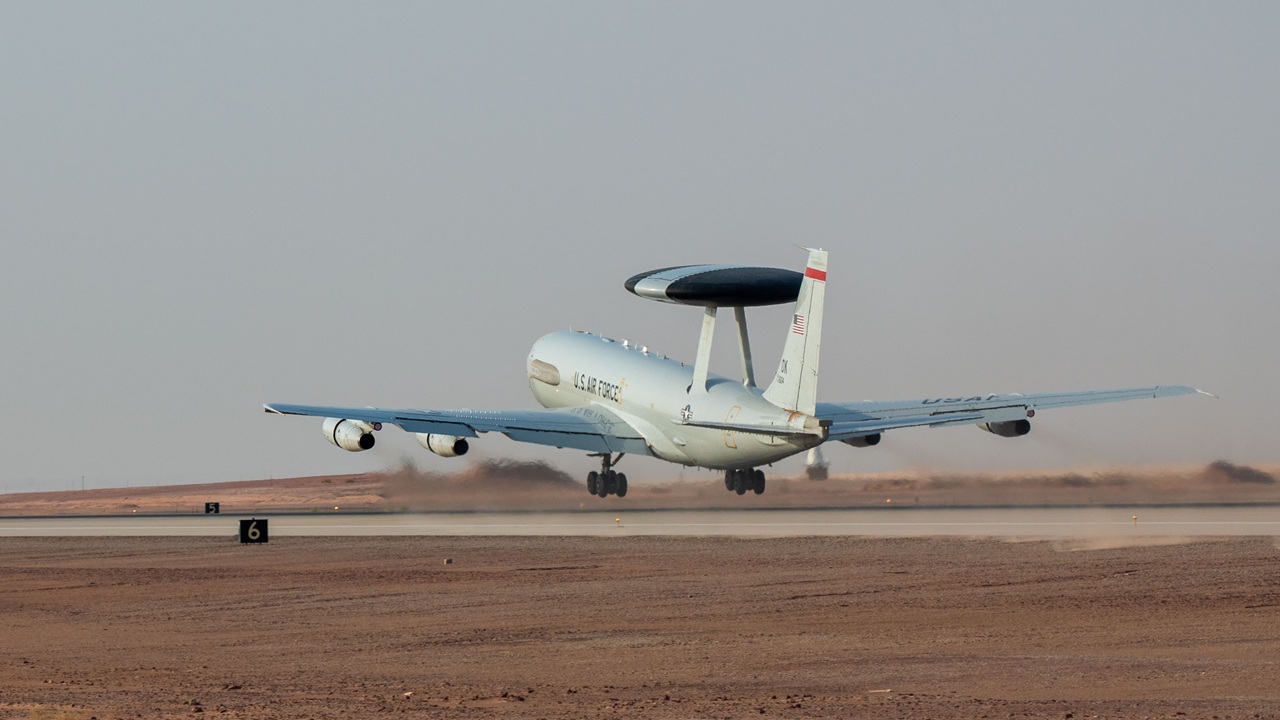
The E-3 is based on the Boeing 707 airframe and entered service in the late 1970s. With a four-person flight crew plus 13-19 mission specialists, the E-3’s defining feature is the rotating radar dome, which provides a 360-degree surveillance picture. The E-3 is capable of tracking 600 targets simultaneously while covering 120,000 square miles of battle space. In effect, the E-3 turns raw data into a real-time picture of the battlefield.
Tactically, the E-3 detects aircraft, missiles, and drones, tracking and classifying these threats. Then, mission specialists direct fighter intercepts and strike missions based on the data received, providing real-time targeting and coordination. The importance of the platform is profound, extending US detection range, spotting threats hundreds of miles earlier than ground radar. Without AWACS, air power becomes fragmented and reactive. But with AWACS, the US can coordinate multiple aircraft and multiple missions, integrating air, land, and sea operations into something coherent. So the loss of the E-3 in Saudi Arabia immediately reduces US situational awareness and reaction time, degrading the ability to vector fighters and defend against incoming threats. And because there are only 17 E-3s in the entire US inventory, the fleet is already strained operationally—meaning the loss isn’t exactly replaceable, because the E-3 is such a scarce asset.
What the Loss of the E-3 Sentry Means
If the targeting of the E-3 is any indication, Iran appears to be targeting high-value enablers, not just frontline assets. The strategy appears consistent, with strikes on radar systems, tanker aircraft, and AWACS planes—a counter-air campaign with the goal of degrading the US ability to see and coordinate their forces over Iran.
The E-3’s loss represents a failure in US force protection. The AWACS, as a scarce asset, is usually heavily protected and kept away from threat zones. In Saudi Arabia, the loss took place on the ground, hinting that Iran may have had some intelligence assistance.
The loss is all the worse for America because it does not have a direct replacement handy. The main alternative to the E-3 Sentry is the E-2D Hawkeye, a US Navy asset that can conduct carrier operations but is smaller and offers far less comprehensive coverage. And the E-3’s replacement, the E-7 Wedgetail, is stuck in limbo, with the Department of Defense proposing its cancellation in favor of space-based surveillance and Congress insisting it be kept. These debates have delayed the E-7 from entering service—meaning the E-3 is still the cutting edge of AWACS capability, despite being 50 years old.
The E-3’s destruction shows just how fragile such high-end enablers are. The lesson will need to be applied to future conflict in the Indo-Pacific—where China is expected to target enablement aircraft like tankers and AWACS, which may struggle to survive within China’s A2/AD bubble without stealth technology. China will certainly be watching this incident closely, to gauge how the US reacts to the loss of an AWACS, and what impact the loss has on America’s ability to sustain its air campaign against Iran.
About the Author: Harrison Kass
Harrison Kass is a senior defense and national security writer at The National Interest. Kass is an attorney and former political candidate who joined the US Air Force as a pilot trainee before being medically discharged. He focuses on military strategy, aerospace, and global security affairs. He holds a JD from the University of Oregon and a master’s in Global Journalism and International Relations from NYU.
The post Iran Destroyed an American E-3 Sentry AWACS Plane. Here’s Why That Matters. appeared first on The National Interest.
Источник: nationalinterest.org