
«Данное сообщение (материал) создано и (или) распространено иностранным средством массовой информации, выполняющим функции иностранного агента, и (или) российским юридическим лицом, выполняющим функции иностранного агента»
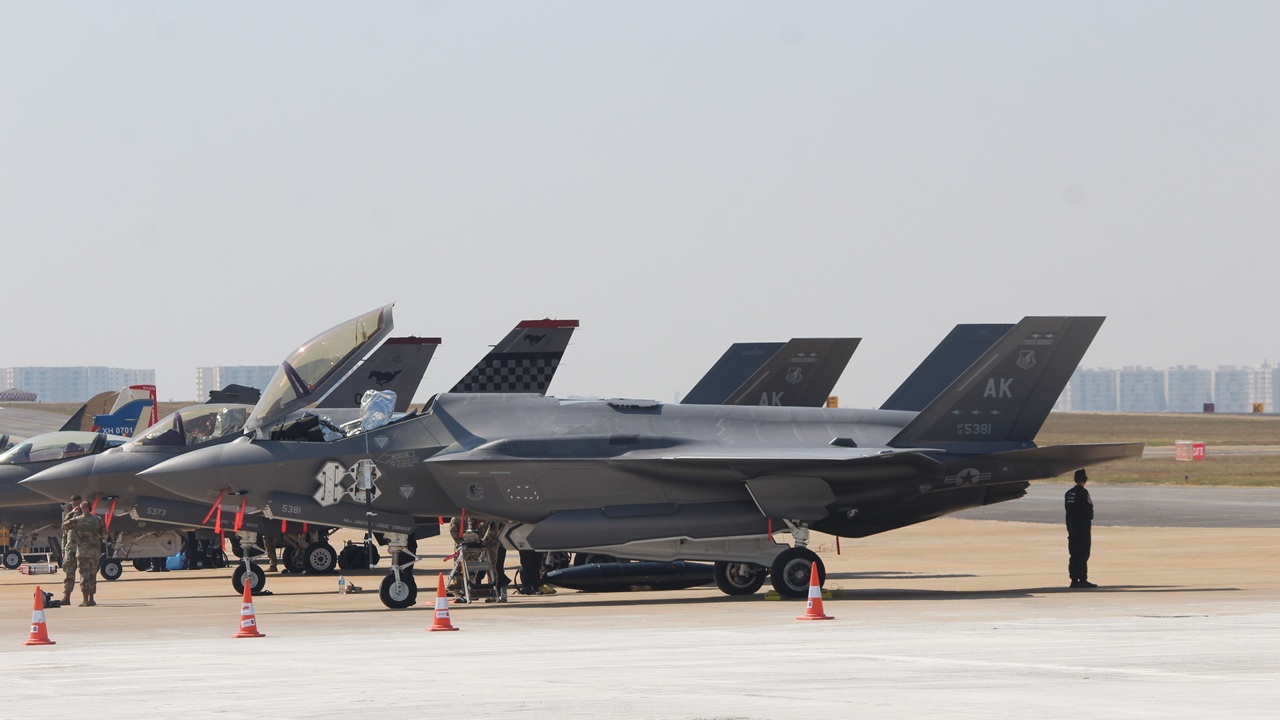
Several F-35 Lightning II fighter aircraft are on display at the AeroIndia airshow in February 2023. Lockheed Martin has recently begun integrating artificial intelligence into the F-35’s software. (Shutterstock/Aerospace Trek)
Topic: Air Warfare, and Artificial Intelligence (AI) Blog Brand: The Buzz Region: Americas Tags: F-35 Lightning II, Lockheed Martin, North America, United States, and US Air Force America’s F-35 Lightning II Fighter Jet Now Comes with AI Integration March 3, 2026 By: Harrison Kass
Share
The F-35’s AI is not equipped to operate the plane’s weapons systems, or to make other important decisions that must be left up to the pilot.
As part of “Project Overwatch,” Lockheed Martin has tested AI model integration into the F-35 mission system. This is the first instance of AI suggesting combat targeting in-flight, marking a significant milestone for human-AI collaboration in the cockpit. Of course, the AI involvement remains limited; there are no autonomous weapons, and the AI has no authority to pull the trigger. In other words, it is still used only as an advisory layer. But the test reveals part of a larger trend—in which air combat decision timelines are shrinking, and humans are increasingly outsourcing their decision-making to AI.
The F-35’s New AI Interface
The test involved the embedding of an AI model into the F-35’s information control system. The machine learning model was trained on environmental inputs, allowing for real-time data processing during flight and the generation of potential target suggestions. The pilot retained decision authority, with the AI offering recommendations.
Lockheed has emphasized that the AI can be reprogrammed on the ground, and that software updates would be available before the next sortie—and that they were still working on iterative model refinement. But the point is becoming clear that the F-35’s advanced software is quickly becoming as important as the airframe itself.
The F-35 is an ideal platform for advanced AI integration. The platform is already sensor-fusion-focused, with AESA radar, DAS, and an advanced electronic warfare suite—all of which requires massive data ingestion. The F-35 historically burdens its pilots with a high workload; accordingly, the AI is designed to filter information, prioritize, and reduce the cognitive burden of operating the airframe. The F-35, which serves as more of a data node than a kinetic dogfighter, benefits from the AI enhancing the sorting of so much information.
Tactically, AI integration will allow for faster target recognition and pattern detection beyond a human’s capacity. AI can perform multi-sensor cross-correlation in a way that humans cannot match. In theory, this will lead to a reduction in reaction time—an attractive outcome given that in high-end air combat seconds matter. Lockheed is no doubt considering AI application in the context of Indo-Pacific warfare, or in situations where electronic assets promise to be dense, or where swarm or multi-vector attacks are more likely.
Lockheed Martin’s New AI Is Far from Perfect
But AI is not impervious. AI models are dependent on training data, and are susceptible to adversary spoofing and electronic deception. Machine learning is still brittle outside of training parameters and adversaries may intentionally manipulate the sensor picture, confusing the AI. Human factors complicate the use of AI, too. Pilots will be trained to trust onboard AI, which creates an over-reliance risk. If AI suggests a target, automation bias suggests the pilot is more likely to adhere.
US AI integration with military hardware may seem accelerated, but that tempo is unlikely to slow given China’s own aggressive pursuit of AI integration. The US has strategic pressure to match or exceed China’s capabilities. The AI race is now embedded in force modernization efforts; refusal to integrate is not viewed as a viable strategic option. And while an F-35 taking targeting recommendations from an AI system is not Skynet-adjacent, it’s easy to be concerned about the direction and tempo of AI integration, which pushes forward under strategic pressure overriding caution or humility.
About the Author: Harrison Kass
Harrison Kass is a senior defense and national security writer at The National Interest. Kass is an attorney and former political candidate who joined the US Air Force as a pilot trainee before being medically discharged. He focuses on military strategy, aerospace, and global security affairs. He holds a JD from the University of Oregon and a master’s in Global Journalism and International Relations from NYU.
The post America’s F-35 Lightning II Fighter Jet Now Comes with AI Integration appeared first on The National Interest.
Источник: nationalinterest.org