
«Данное сообщение (материал) создано и (или) распространено иностранным средством массовой информации, выполняющим функции иностранного агента, и (или) российским юридическим лицом, выполняющим функции иностранного агента»
 Topic: Naval Warfare Blog Brand: The Buzz Region: Americas, Asia, and Middle East Tags: Aircraft Carriers, North America, Ships, United States, US Navy, and USS Nimitz (CVN-68) 10 Things That Make the USS Nimitz Legendary March 13, 2026 By: Peter Suciu
Share
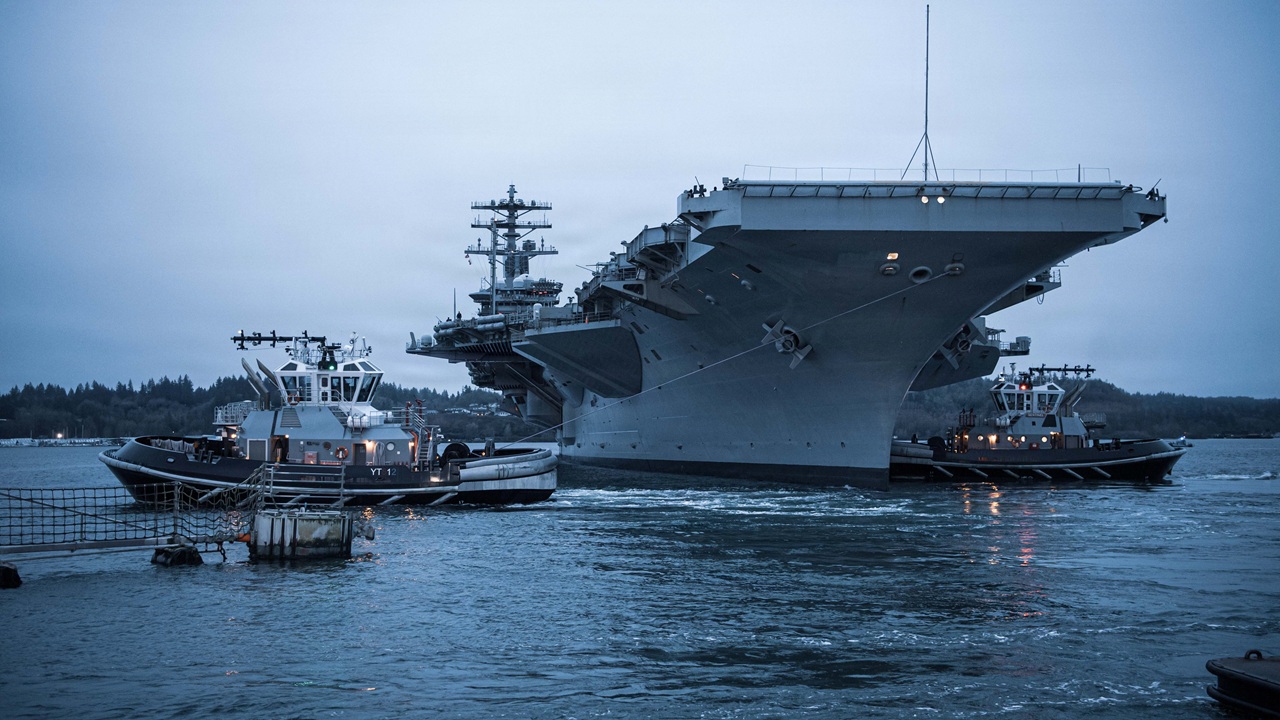
The USS Nimitz is retiring this year, at the venerable age of 51. Here are 10 memorable pieces of history from her past five decades of service.
The United States Navy’s oldest active nuclear-powered supercarrier, the USS Nimitz (CVN-68), began her final voyage earlier this month. The aircraft carrier departed from Naval Base Kitsap in Bremerton, Washington, to begin a homeport shift to Naval Station Norfolk, Virginia. In the coming weeks, CVN-68 will be decommissioned—followed by the start of an arduous recycling process that is expected to last several years.
Known as the “Pacific Northwest’s Carrier,” USS Nimitz made a port visit on Tuesday to San Diego, where she had also operated from for much of her 51 years in service. She is now headed further down the West Coast, eventually planning to pass around Cape Horn of South America and return up the eastern side of the Americas.
Here are 10 noteworthy facts about the USS Nimitz that even some who served on the famed carrier may not know.
1. The Nimitz Was Named for the Navy’s Highest Ranking Admiral
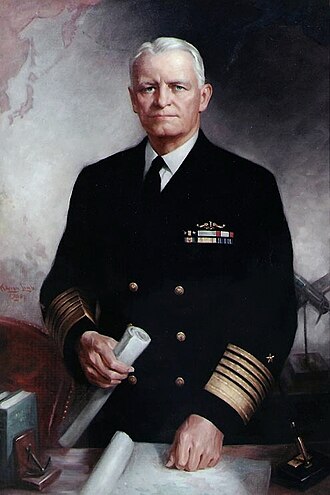 A portrait of Fleet Admiral Chester Nimitz, one of the US Navy’s four Fleet Admirals during World War II. (US Navy portrait)
Although many of the Nimitz-class supercarriers have been named for former presidents, two were named for other lawmakers. CVN-70 was named for former Congressman Carl Vinson, a staunch supporter of the US Navy, while CVN-74 was named to honor Senator John C. Stennis for what were likely political reasons.
However, CVN-68 honored neither a president nor a politician.
Instead, the warship was named after Fleet Admiral Chester W. Nimitz, the commander-in-chief of the Pacific Fleet during World War II.
Nimitz was one of only four US Navy admirals to be promoted to the five-star rank of Fleet Admiral. That rank was established in December 1944 to ensure that American commanders would hold equal rank to their British counterparts. It came with a handful of perks for Nimitz—including active-duty pay for life, meaning he never technically retired!
2. The Nimitz Was Only America’s Second Nuclear-Powered Carrier
USS Nimitz was the second nuclear-powered supercarrier to enter service with the United States Navy after USS Enterprise (CVN-65), a one-of-its-kind class that served in the Navy from 1961 until 2012—coincidentally giving it the same 51-year service life as the Nimitz, which was commissioned in 1975.
However, USS Nimitz was designed to be far more efficient than her predecessor. Whereas CVN-65 required eight nuclear reactors, CVN-68 is powered by two Westinghouse A4W nuclear reactors, which provide steam to four turbines, allowing the vessel to reach speeds of 30 knots (34.5 mph).
The two Pressurized Water Reactors had a range of more than 12,000 nautical miles without refueling—so not quite the “unlimited range” that proponents of the nuclear navy have suggested, but still an impressive distance.
3. The Nimitz Has Served Under 10 Presidencies (but Only 9 Presidents)
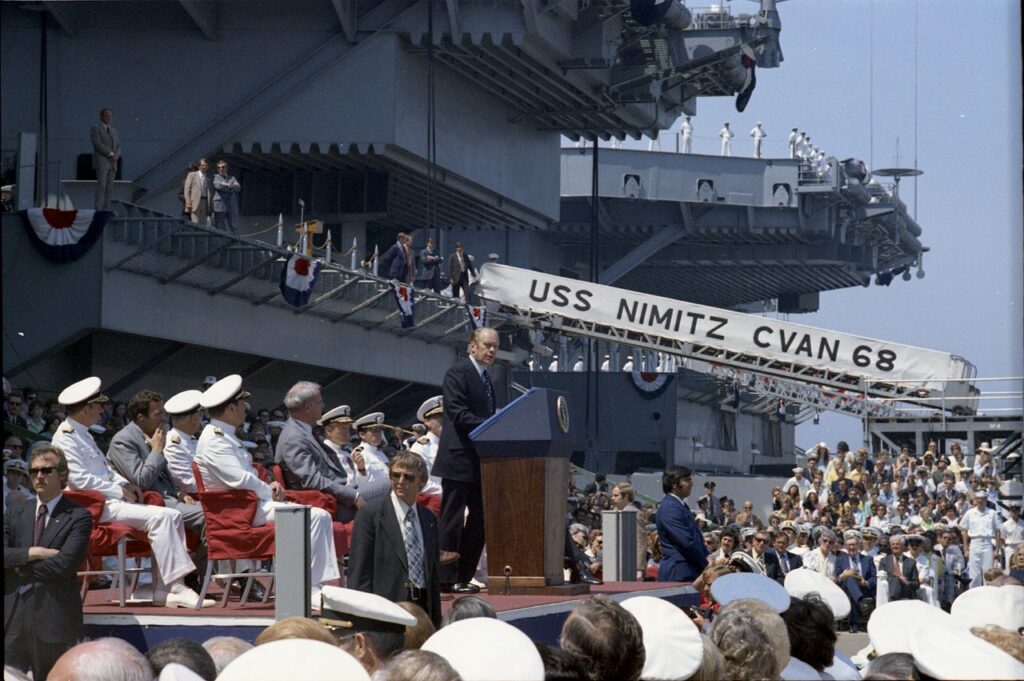 President Gerald R. Ford delivers remarks at the commissioning ceremony of the USS Nimitz in May 1975. (National Archives and Records Administration)
The hull for the USS Nimitz was laid down in 1968, and she was launched in 1972 as CVAN-68 (aircraft carrier, attack, nuclear powered), before being reclassified as CVN-68. She was commissioned on May 3, 1975, at Naval Station Norfolk by then-President Gerald R. Ford.
“Wherever the United States Ship Nimitz shows her flag, she will be seen as we see her now—a solid symbol of United States strength, United States resolve—made in America and manned by Americans,” Ford, himself a World War II Navy veteran, said during the ceremony.
USS Nimitz has remained in service throughout 10 presidential administrations: Ford, Jimmy Carter, Ronald Reagan, George H.W. Bush, Bill Clinton, George W. Bush, Barack Obama, Donald Trump, Joe Biden, and now Trump again.
The oldest operational supercarrier completed her final deployment last December, after operating in the Indo-Pacific before being deployed to the Middle East.
4. The Nimitz’ First Combat Operation Didn’t Go Too Well
The first combat operation involving USS Nimitz is almost certainly one that the Department of Defense would rather the world forgot about. That operation was “Operation Evening Light” in 1980—better known as “Operation Eagle Claw,” the failed mission to rescue the American hostages from Iran. The carrier had been deployed for 144 consecutive days at sea when RH-53 Sea Stallion helicopters launched from its deck.
Instead of rescuing the 52 American hostages held in Tehran, the mission failed due to several factors, including the combination of severe sandstorms, mechanical failures with the helicopters, inadequate planning, and poor inter-service coordination. The plan required at least six helicopters to succeed, but only five were operational by the time they reached “Desert One,” the desert staging area. President Jimmy Carter gave the order to abort the mission.
Then tragedy struck. During the withdrawal from Desert One, a helicopter collided with a C-130 transport, killing eight servicemen and requiring the abandonment of the remaining helicopters and equipment. The event was a humiliation for Carter, and contributed to his loss in the 1980 presidential election to former California governor Ronald Reagan.
5. The Nimitz’ First Aerial Combat Mission Was a Success
Things would soon turn around for the Nimitz. On August 19, 1981, two F-14A Tomcats from US Navy Strike Fighter Squadron 41 (VF-41) “Black Aces” shot down a pair of Libyan Su-22M3 (NATO reporting name “Fitter-G”) aircraft after the warship crossed into the waters that Libyan leader Muammar Gaddafi asserted were the North African nation’s territorial waters. In a fortuitous coincidence, the “Gulf of Sidra Incident,” as it is known, also marked the first combat operation involving the famed F-14 Tomcat.
The dogfight barely lasted a minute, but it marked the first Navy air combat engagement since the Vietnam War—an early crack in the “Vietnam syndrome” that had preoccupied US political and military leaders since 1975.
6. USS Nimitz Put a Lot of Miles on the Odometer
For decades, the US Navy’s recruiting campaign touted that sailors would “see the world,” and that was certainly the case with those who served aboard the USS Nimitz. Throughout the 1980 and 1990s, CVN-68 was regularly deployed worldwide:
- In 1988, the Nimitz provided security off the coast of South Korea during the Olympic Games in Seoul.
- In February 1991, CVN-68 supported Operation Desert Storm, relieving the conventionally-powered USS Ranger (CVN-61), and provided air support to coalition forces during the liberation of Kuwait.
- In 1995, the ship was deployed off the coast of Taiwan during a tense standoff with China.
- Following her refueling and complex overhaul from 1998 to 2001, the supercarrier took part in an around-the-world deployment departing from Naval Station Norfolk, Va.
- In 2003, during her 11th operational deployment, the carrier took part in Operation Iraqi Freedom, launching Carrier Air Wing 11 aircraft over Iraq and Afghanistan in support of Operation Enduring Freedom.
In total, USS Nimitz completed 28 active deployments over five decades in service, operating from Norfolk, San Diego, and Bremerton.
Her final at-sea journey will likely include port calls as the warship will operate in the US Southern Command’s (USSOUTHCOM’s) area of responsibility for much of its journey. That could even include CVN-68 participating in the upcoming South Seas 2026 exercises.
7. The Nimitz Became a Movie Star
The supercarrier made her film debut in the 1980 science-fiction historical drama The Final Countdown, in which the warship traveled back in time to December 6, 1941. The film was produced with the cooperation of the US Navy and the Department of Defense. Although it received mixed reviews, it saw moderate success at the box office. That film was notable for giving the F-14 Tomcat its first major screen appearance—six years before Tom Cruise made it far more famous in Top Gun. In The Final Countdown, which came out a year before the Gulf of Sidra incident, two F-14 Tomcats from VF-84 “Jolly Rogers” shot down Imperial Japanese Navy Mitsubishi A6M2 Zero fighters, which were actually modified North American T-6 Texan trainers.
In 2003, R. Lee Ermey, the former Marine drill instructor best known for his role as the merciless Gunnery Sergeant Hartman in Full Metal Jacket, visited CVN-68 for a segment on the History Channel’s Mail Call. Two years later, when CVN-68 commemorated its 30 years of active service, film crews spent an entire deployment on board for the PBS documentary Carrier, which provided an intimate look at life aboard the warship.
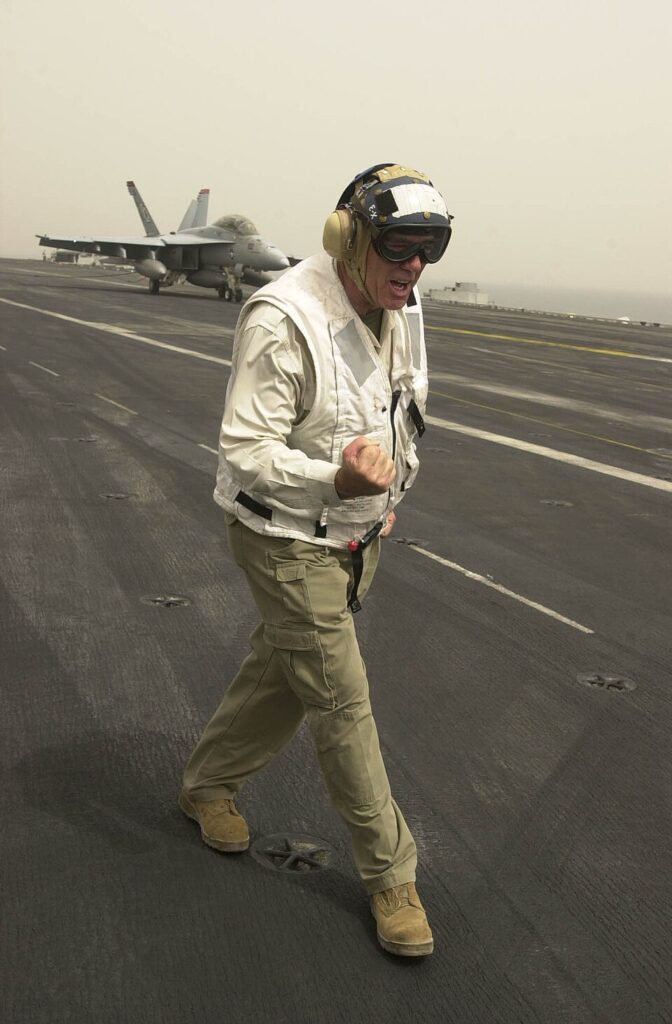 Actor R. Lee Ermey, a former drill sergeant in the US Marine Corps, poses on board the USS Nimitz. (US Navy/Photographer’s Mate 3rd Class Yesenia Rosas)
CVN-68 was also the focus of an episode of Little Mammoth Media’s children’s education series Big Adventure Series. “The Big Aircraft Carrier” provided insight into the workings of the carrier.
8. First-Ever Carrier Arrested Landing of the F-35C Was on CVN-68
Although the USS Nimitz never embarked a squadron of Lockheed Martin F-35C fifth-generation aircraft for any combat operations, the first-ever carrier arrested landing of the variant, operating with Air Test and Evaluation Squadron 23 (VX-23), took place on CVN-68 on November 3, 2014.
The aircraft carrier served as the platform for initial Developmental Testing (DT-I) and subsequent trials to integrate the multirole stealth fighter.
However, as the Nimitz-class required significant modifications, including costly structural updates such as enhanced jet blast deflectors and classified spaces, to effectively manage maintenance, spare parts, and data security for the F-35C, CVN-68 never deployed the Lightning II in large numbers.
The US Navy prioritized upgrading the USS Carl Vinson and USS George Washington (CVN-73) for early F-35C deployment.
9. USS Nimitz Has Operated with a Wide Range of Aircraft
Since being commissioned 51 years ago, USS Nimitz has operated with a very diverse mix of US Navy and USMC aircraft. That has included the F-4 Phantom, A-7 Corsair II, A-6E Intruder, F-14 Tomcat, F/A-18C Hornet, F/A-18E/F Super Hornet, E-6B Prowler, and EA-18G Growler.
In addition, the carrier has deployed with several early warning/reconnaissance aircraft, including the E-2C/D Hawkeyes, RA-5C Vigilantes, and RF-8G Crusaders. Its rotary wing aircraft have included MH-60S/R Seahawks, SH-60F, and HH-60H helicopters. C-2 Greyhounds have been deployed on the carrier to provide support and transport.
CVN-68 has hosted numerous squadrons throughout her service, primarily under Carrier Air Wing 17 (CVW-17) and CVW-11.
10. There’s No Chance the Nimitz Will Survive as a Museum Ship
There have been calls to see USS Nimitz preserved as a museum. Sadly, that simply isn’t possible. The same was very much true of USS Enterprise, and it comes down to the ship’s nuclear reactors. Removing those isn’t possible without essentially disassembling the ship, which is why the midlife refueling is such a time-consuming endeavor.
Another factor is also likely at play, namely security—which may explain why none of the US Navy’s aircraft carriers since USS Midway (CV-41) have been saved from the scrapyard and maintained as floating museums. The nuclear reactors certainly present problems, but the final two Kitty Hawk-class carriers were also sent to a scrapper, likely to ensure that Chinese and Russian “tourists” couldn’t glean any information about the layout of the US Navy’s current carriers.
So sadly, CVN-68 will be broken up. Yet that may not be the end of her story—for better or worse.
Next Up for the Nimitz: A Costly and Time-Consuming Recycling
One downside to nuclear-powered supercarriers is that scrapping and recycling them is far more complicated than conventional carriers. The US Navy sold the Kitty Hawk-class flattops for one penny each—which might seem like the ship breaking got a very good deal, but taxpayers likely wouldn’t want to hear that it will cost more than $1 billion to recycle the USS Nimitz.
Huntington Ingalls Industries was awarded a $33.5 million contract modification in February to begin planning and procure long-lead materials for the inactivation and defueling of CVN-68. That’s not for the actual work, but just for the planning phase—and it comes after millions more dollars were spent on pre-planning efforts!
Recycling the USS Nimitz involves five detailed phases that begin with the removal of sensitive equipment, munitions, aviation fuel, and other operational systems. The ship will also be stripped of useful parts that could be used on other supercarriers.
The warship will transfer to Newport News Shipbuilding for the removal of nuclear fuel from the reactors. Spent fuel will be sent to the Naval Reactors Facility in Idaho for secure storage and/or reprocessing. After that is completed, CVN-68 will be officially “inactivated,” allowing the hull to be prepared for final disposal. That includes the cleaning and sealing of the reactor compartments. Given the nature of the process, it is conducted in as controlled an environment as possible.
The sealed, low-level radioactive reactor compartments will then be transported to the Department of Energy’s Hanford waste-disposal facility in eastern Washington state. Hundreds of retired naval nuclear reactor compartments are already stored at Hanford’s Trench 94. In the coming decades, that number will grow as USS Nimitz and the other Nimitz-class carriers are retired.
At that point, the remaining non-nuclear sections of the Nimitz, which account for the majority of its structure, will be dismantled and cut up. Much of the steel, aluminum, and other metals will be recycled in accordance with Environmental Protection Agency (EPA) guidelines.
Ultimately, the disassembly process will take more than a decade to complete—far longer than it took to build the warship in the first place.
One company can offer an alternative use for those still viable reactors. Earlier this year, Texas-based HGP Intelligent Energy LLC presented an interesting proposal to the United States Department of Energy. The company has sought to employ two US Navy reactors capable of delivering 450 to 520 megawatts of power, which could be used to address the needs of artificial intelligence data centers.
HGP has proposed that the first plant be built at Oak Ridge, near the facility that helped develop the atomic bomb in World War II and later aided the development of the US Navy’s first nuclear propulsion reactors. It is unlikely that CVN-68’s reactors will be used, but it’s possible that other former Westinghouse A4W nuclear reactors could be used to power AI facilities.
Even as the career of USS Nimitz will conclude this spring, any parts or components that could be used on other Nimitz-class flattops will be recovered and saved. That will include “useful parts” that may no longer be manufactured, to help ensure the rest of the carrier fleet will remain in service for decades to come.
About the Author: Peter Suciu
Peter Suciu has contributed to dozens of newspapers, magazines, and websites over a 30-year career in journalism. He regularly writes about military hardware, firearms history, cybersecurity, politics, and international affairs. Peter is also a contributing writer for Forbes and Clearance Jobs. He is based in Michigan. You can follow him on Twitter: @PeterSuciu. You can email the author: Editor@nationalinterest.org.
The post 10 Things That Make the USS Nimitz Legendary appeared first on The National Interest.
Источник: nationalinterest.org