
«Данное сообщение (материал) создано и (или) распространено иностранным средством массовой информации, выполняющим функции иностранного агента, и (или) российским юридическим лицом, выполняющим функции иностранного агента»
 Topic: Air Warfare Blog Brand: The Buzz Region: Europe Tags: Black Sea, Eastern Europe, Iskander-M, Missiles, Odesa, Russia, Ukraine, and Ukraine War Why Russian Iskander-M Missiles Are Raining Down on Odesa January 2, 2026 By: Brandon J. Weichert
Share
Russia has made no secret that it hopes to conquer the port of Odesa from Ukraine—and has used advanced missiles and drones to soften the city’s defenses.
The War in Ukraine continues turning against the nation’s defenders—so much so that even some cheerleaders for the Ukrainian cause, such as Dr. Niall Ferguson of Stanford University’s Hoover Institute, are beginning to acknowledge that Ukraine cannot win on the battlefield.
If Western policymakers had admitted that painful truth three years ago, how much of Ukraine’s territory and innocent people could have been saved from destruction by the Russians?
Alas, it is better late than never to admit reality—and to advocate for policies predicated upon that reality, no matter how painful it might be.
Another tragic indicator of how badly things are now going for Kyiv’s defenders is an example from December 13 and 14th. On those days, the Russian Armed Forces launched a brutal (of many) offensives against the Ukrainians.
December’s Message from Moscow: Iskander-M Ballistic Missiles
But the Russians deployed a serious weapon amidst their 138 Shahed-type, Russian-made Gerbera drones: one Iskander-M ballistic missile, launched from Russia’s Rostov region.
According to Ukrainian military reports, their air defense systems shot down at least 110 of the 138 Russian drones that targeted various parts of the country. But the Iskander-M missile struck the vital Ukrainian port city of Odesa.
The combination of drones and the Iskander-M attacks were part of a larger Russian strategy of hitting Ukraine’s already strained energy grid. This mostly successful Russian attack knocked out key energy and port infrastructure in the Ukrainian port city and caused major blackouts there.
The Russians have made clear that so long as the Ukrainians refuse to negotiate a peaceful end to the war, their forces will keep pressuring the Ukrainian side with increasingly lethal attacks of the kind that the world witnessed on December 13-14.
The Iskander-M ballistic missile is among Russia’s most powerful weapons in their large (and growing) arsenal. Until recently, the Russians have kept these bigger systems in reserve. But the deployment of this destructive, massive weapon indicates that Moscow is committed to winning this war.
What’s more, it shows that Russia can wear down the Ukrainians. Recently, Russian leader, Vladimir Putin, declared that, if necessary, he was willing to achieve all Russia’s strategic goals in Ukraine militarily. Though, again, he insisted that he would prefer to craft a negotiated settlement with the West and their Ukrainian proxy.
Russia Wants to Conquer Odesa from Ukraine
To make clear his intention to secure the interests of Russia in Ukraine, though, Putin has escalated his attacks on Ukrainian energy networks and has targeted his ire on Ukraine’s last major port city, Odesa.
In fact, there is ample evidence to suggest that, if the war persists under current conditions, the Russian Armed Forces will strike hard at the port city of Odesa and will likely annex it into their growing Novorossiya region.
Should the Russians take Odesa, along with their Crimean holdings, they will have ensured that whatever remains of independent Ukraine will be little more than a landlocked rump state entirely beholden to Europe and the United States. Any hope of making Ukraine a vibrant, prosperous independent nation after the war would be seriously complicated by the Russian conquest of Odesa. But Russia will take this vital port city if Kyiv does not negotiate in good faith soon.
Understanding the Iskander-M Missile
Russia’s Iskander-M advanced tactical ballistic missile system (NATO designation SS-26 Stone) features a solid-fuel engine that ensures the missile achieves a hypersonic speed of around Mach 6 or 7. Iskander-M has a range of around 31-311 miles (50-500 km) and can carry a 1,058-1,543-pound (480-700 kg) warhead.
In terms of warheads, the Iskander-M can carry a High-Explosive (HE) Frag, Cluster, or Thermobaric (Fuel-Air) conventional warhead. These nasty weapons can also carry nuclear warheads.
An Iskander-M is considered to be a highly maneuverable warhead, with 30g maneuvers and even radar-reducing fins. Iskander-Ms employ an inertial navigation system (INS) as well as a GPS-style navigational system that relies upon Russia’s GLONASS navigation system as opposed to the American GPS constellation in orbit.
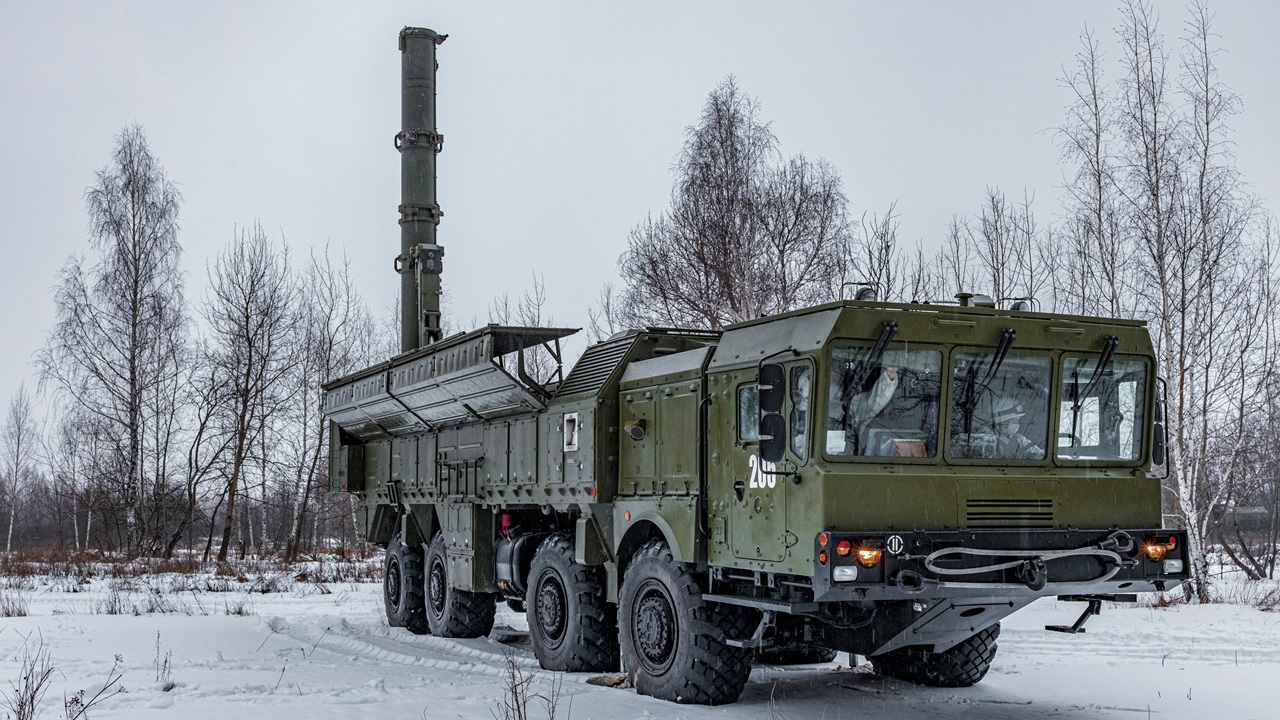
Iskander-Ms are launched from a Transporter Erector Launcher (TEL) known as an 9P78-1 TEL. The TEL itself is built upon an eight-by-eight MZKT-7930 all-terrain truck chassis that can transport up to two of these massive missiles. A crew of three operates the TEL and they take less than 16 minutes for launch prep.
In other words, from the moment they are ordered to launch, these forces can be in firing position within 16 minutes. If they are already in position, the three-person crews can fire the Iskander-M within five minutes of receiving the launch order.
Beside the TEL itself, Iskander-M launchers include a command post, an information center, and maintenance hub to ensure that these mobile units are constantly ready for battle.
The use of an Iskander-M missile, as with the previous deployment of Russia’s mighty Oreshnik hypersonic weapon, was a warning shot from Moscow to the West: if necessary, Russia will flatten whatever remains of Ukraine to achieve their objectives if real negotiations do not go forward.
Whether the Ukrainians are receiving the message remains unclear. What is certain is that Ukraine’s NATO backers in Europe and the United States are ignoring such warnings from Russia—much to Ukraine’s long-term detriment.
About the Author: Brandon J. Weichert
Brandon J. Weichert is a senior national security editor at The National Interest. Recently, Weichert became the host of The National Security Hour on America Outloud News and iHeartRadio, where he discusses national security policy every Wednesday at 8pm Eastern. Weichert hosts a companion book talk series on Rumble entitled “National Security Talk.” He is also a contributor at Popular Mechanics and has consulted regularly with various government institutions and private organizations on geopolitical issues. Weichert’s writings have appeared in multiple publications, including The Washington Times, National Review, The American Spectator, MSN, and the Asia Times. His books include Winning Space: How America Remains a Superpower, Biohacked: China’s Race to Control Life, and The Shadow War: Iran’s Quest for Supremacy. His newest book, A Disaster of Our Own Making: How the West Lost Ukraine is available for purchase wherever books are sold. He can be followed via Twitter @WeTheBrandon.
Image: Shutterstock / Vectorkel.
The post Why Russian Iskander-M Missiles Are Raining Down on Odesa appeared first on The National Interest.
Источник: nationalinterest.org