
«Данное сообщение (материал) создано и (или) распространено иностранным средством массовой информации, выполняющим функции иностранного агента, и (или) российским юридическим лицом, выполняющим функции иностранного агента»
 Topic: Military Administration Blog Brand: The Buzz Region: Americas Tags: China, Department of Defense (DoD), Donald Trump, Hemispheric Defense, and National Defense Strategy The New National Defense Strategy Could Be Trump’s Last Gamble January 28, 2026 By: Brandon J. Weichert
Share
The National Defense Strategy is a radical rethinking of America’s defense priorities—but seems unlikely to be fully implemented in the next three years.
President Donald Trump is committed to reorienting US foreign policy away from the neoliberal principles that have defined the post-Cold War system. According to Trump, no longer will the United States prioritize distant theaters around the world. Instead, it will now fixate on enforcing its security and interests in the Western Hemisphere first.
The Old Grand Strategy is Dead
Of course, there is some irony in announcing this strategy as the Trump administration prepares to strike Iran—and has continued full-bore support for Ukraine. Yet in principle, the Trump administration, between last year’s National Security Strategy (NSS) memo and now the National Defense Strategy (NDS) memo—released on January 23—seeks to move the US into a new era of national security.
The top priority of the 34-page document is securing America’s broken borders and its undefended maritime approaches. Next, the NDS calls for a reinvigoration of the national air and missile defense system by prioritizing the development and deployment of the Golden Dome for America by the end of Trump’s final four-year term in January 2029. Recognizing the wild developments in combat tactics and technology as seen in the Ukraine War, the NDS urges a more robust counter-unmanned aerial system (CUAS) system for key infrastructure and defense facilities.
Another interesting new element is the elevation of defending the homeland against Islamist terrorist groups. Ever since the Biden administration’s shambolic withdrawal from Afghanistan, fears have abounded among national security experts that al-Qaeda or some other Islamist organization, like ISIS, might initiate an October 7-type wave of terrorism against soft targets in the United States.
The “Donroe Doctrine”?
The big one, of course, came in the form of what some are unofficially referring to as the “Monroe Doctrine 2.0” (the New York Post has whimsically named it the “Donroe Doctrine”). Essentially, according to the NDS, the US will accept a greater and more direct responsibility for defending the Western Hemisphere from external threats—this includes the Panama Canal Zone, Greenland, and the Gulf of Mexico (referred to as “Gulf of America” in the NDS).
And it gets spicier still. Embedded within that call for a renewed Monroe Doctrine lies an explicit option that allows for the United States to exercise decisive, unilateral action if regional partners don’t “do their part.” We have seen this play out already in Greenland, where Trump has griped about Denmark’s reluctance to invest in its own territory’s defense and pontificated about seizing the island for the United States.
Whatever Trump may have stated at the recent World Economic Forum (WEF) meeting in Davos, Switzerland, about not using military force to bring Greenland under US control, the new NDS makes clear that this is precisely what the United States would do if Washington—without any qualification or stated metrics—were to determine that Danish officials did not “do their part” to adequately defend the area.
In other words, the Greenland crisis is not over. It is only beginning. And a similar crisis could be coming in Alberta, where the Trump administration appears to be gleeful at the prospect of an upcoming independence referendum.
But the biggest takeaway from the NDS is the explicit acknowledgement by the Trump team that homeland defense is now the organizing principle of US national security and foreign policy. It is not merely one task among many. Defending the homeland is the task. All other priorities flow out from there.
Is the New NDS “Soft” on China?
Much ado about the role of China in the NDS has been given in major media outlets. According to these publications, China’s importance as a major threat has been downgraded in the NDS. To be clear, in the order of the document, China is listed as the number two priority that US national defense must address.
What is true, however, is the language employed in describing that threat has drastically changed. The language now is much more cryptic than in previous iterations of this document.
During Trump’s first term, his foreign and national security policy team specifically outlined the ways in which China was the main strategic threat facing the United States. Similarly, although the language was somewhat different, the Biden administration defined China as the primary strategic threat the United States faced.
The new NDS recalibrates the issue and the language is much more passive than previous iterations of the NDS. In fact, the document specifically states—right there in the header—that the Trump administration will deter China in the Indo-Pacific “through strength, not confrontation.” That sounds very ambiguous, especially compared to previous NSS and NDS memos over the last decade.
Clearly, there is more than just a recalibration in tone and language. There is a reduction of focus and concern over the threat in the Far East. This is not because the threat is gone, but rather because the threat has outmatched the United States in many ways—notably in the domain of critical rare earth minerals and military overmatch in the First Island Chain.
Trump’s NDS reorients the US in the Indo-Pacific by viewing China as being at the center of long-term strategic competition. The document frames American policy toward China as being able to maintain a stable peace and fair economic relations, while avoiding direct efforts to humiliate or dominate China militarily. It also calls for strengthening US defense posture along critical geographical points, like the First Island Chain, promoting deterrence by denial, and encouraging regional partners to contribute more than they have to the security order.
Whatever the hawks in Washington want to tell themselves, this strategy is a clear break from what came before. It’s also a tacit admission that, at least for now, the trade war with China has not been as successful as the administration wants to claim.
After all, the administration got burned by China when Trump initiated his trade war last year. China was waiting for him. They were prepared to offset any loss of US trade with trade from the Global South, which Beijing had spent a decade or more cultivating.
That, paired with Beijing’s rare earth mineral dominance—and its ability to galvanize Argentina, Brazil, and other economies of the Global South to offset the loss of American soybeans during the trade war—ensured that the Chinese would come out ahead of the Americans in the trade war.
America No Longer Rules the World—and Can’t Act Like It Anymore
And with successive Pentagon and Washington, D.C.-based think tanks running in-depth wargame scenarios which consistently demonstrate the probability that the United States military would lose in a conflict with China over Taiwan, Trump is clearly taking on a more conciliatory tone with Beijing.
He is merely using his Western Hemispheric Defense concept as a brilliant cover both to save-face for America and to marshal the depleting US forces that are overstretched and overburdened due to the global commitments that have piled up for decades.
But that competition with China via strength rather than confrontation is a key phrase. Defending the homeland from missile attacks (via the Golden Dome) and carving out a regional defensive perimeter (Western Hemispheric Defense) will only get America so far when it comes to competing with China in the long term. The key is restoring America’s ailing industrial base—notably its dying defense industrial capacity.
To do that, the NDS outlines four primary goals for restoring the American defense industrial base: reshoring strategic manufacturing, empowering innovation, removing bureaucratic barriers to defense production, and coordinating allied industrial contributions to accelerate capability build-up. These steps are (rightly) presented in the text as a long-term investment that will sustain peace through strength.
So, the key to countering China in the summation of the Trump administration is indirect and protracted; it is industrial, commercial, and technological rather than militaristic, ideological, or through covert intelligence means. In that sense, the NDS is dynamic, flipping Washington’s preferred methods for competition away from the more government-centric approaches and to a more private sector and industrial mindset.
In other words, Washington is taking a page from China’s decades-old playbook—the playbook that built China into America’s greatest strategic challenger in almost a century.
Trump’s Strategy Requires Decades. It’s Got Three Years.
Ultimately, this document—put forward at the start of the second year of the Trump second term—requires consensus between both political parties. What’s more, it demands a close adherence to these principles and strategy long after Trump leaves office.
It may seem hard to believe, but Trump is already through an astonishing 25 percent of his final term in office. Has has less than three years left. In ten months, it is highly likely that the Republican Party will lose the midterm elections, narrowing his ability to act even further.
All this is to say that the Trump NDS and the preceding NSS memos, while cutting-edge and brilliant, are unlikely to have the impact that their architects intend for them to have simply because they’re running out of time. Plus, saying and doing are often two very different things.
Of course, it is entirely possible that Trump and his team will be able to achieve at least some of the things outlined in the NDS. That will be a victory for a beleaguered United States. Sadly, the US situation today is so dire—the crisis so deep—that we really need the entirety of this innovative strategy to take hold and be seen through across many years, if not decades.
In effect, the Trump administration is throwing the strategic equivalent of a Hail Mary, with the play clock winding down to zero. Let’s hope there’s a geopolitical Gerard Phelan down in the endzone ready to receive Trump’s grand strategic Hail Mary pass.
About the Author: Brandon J. Weichert
Brandon J. Weichert is a senior national security editor at The National Interest. Recently, Weichert became the host of The National Security Hour on America Outloud News and iHeartRadio, where he discusses national security policy every Wednesday at 8pm Eastern. Weichert hosts a companion book talk series on Rumble entitled “National Security Talk.” He is also a contributor at Popular Mechanics and has consulted regularly with various government institutions and private organizations on geopolitical issues. Weichert’s writings have appeared in multiple publications, including The Washington Times, National Review, The American Spectator, MSN, and the Asia Times. His books include Winning Space: How America Remains a Superpower, Biohacked: China’s Race to Control Life, and The Shadow War: Iran’s Quest for Supremacy. His newest book, A Disaster of Our Own Making: How the West Lost Ukraine is available for purchase wherever books are sold. He can be followed via Twitter @WeTheBrandon.
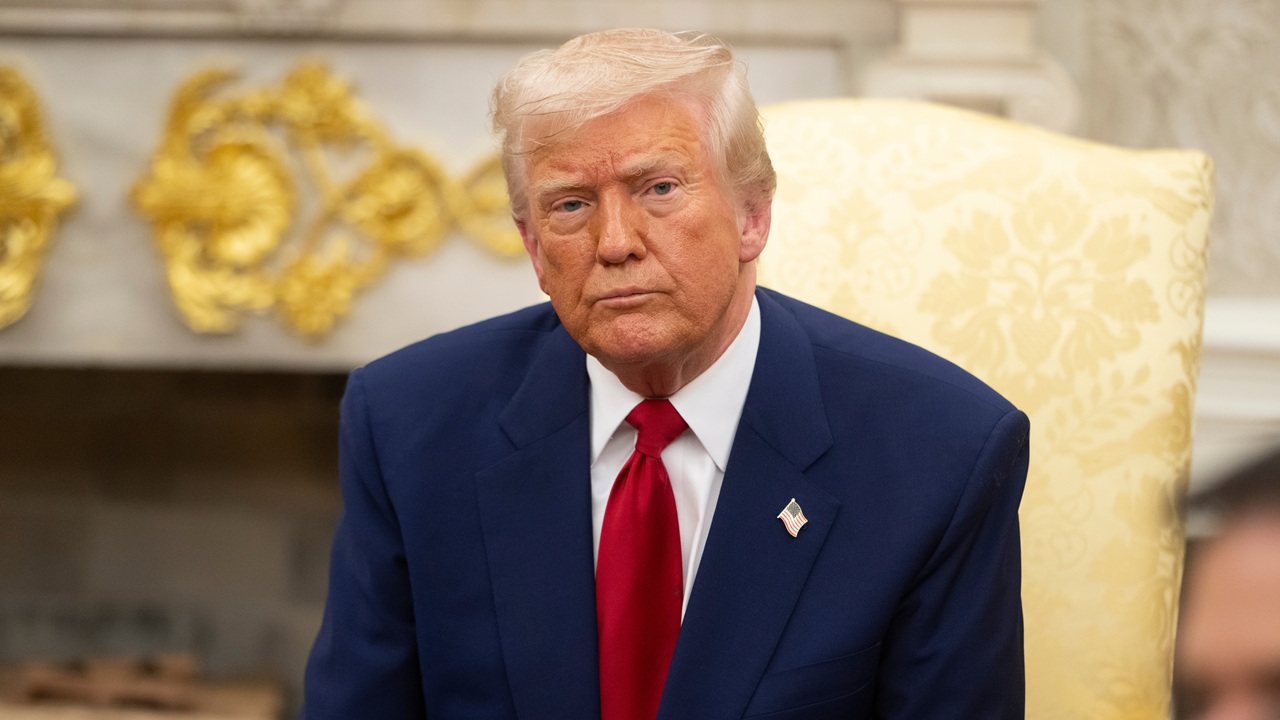
Image: Shutterstock / noamgalai.
The post The New National Defense Strategy Could Be Trump’s Last Gamble appeared first on The National Interest.
Источник: nationalinterest.org