
«Данное сообщение (материал) создано и (или) распространено иностранным средством массовой информации, выполняющим функции иностранного агента, и (или) российским юридическим лицом, выполняющим функции иностранного агента»
 Topic: Air Warfare, and Artificial Intelligence (AI) Blog Brand: The Buzz Region: Americas Tags: Drones, MQ-9 Reaper, North America, United States, and US Marine Corps The Marine Corps’ “Sky Guardian” Drone Is About to Get a Lot Smarter January 13, 2026 By: Stavros Atlamazoglou
Share
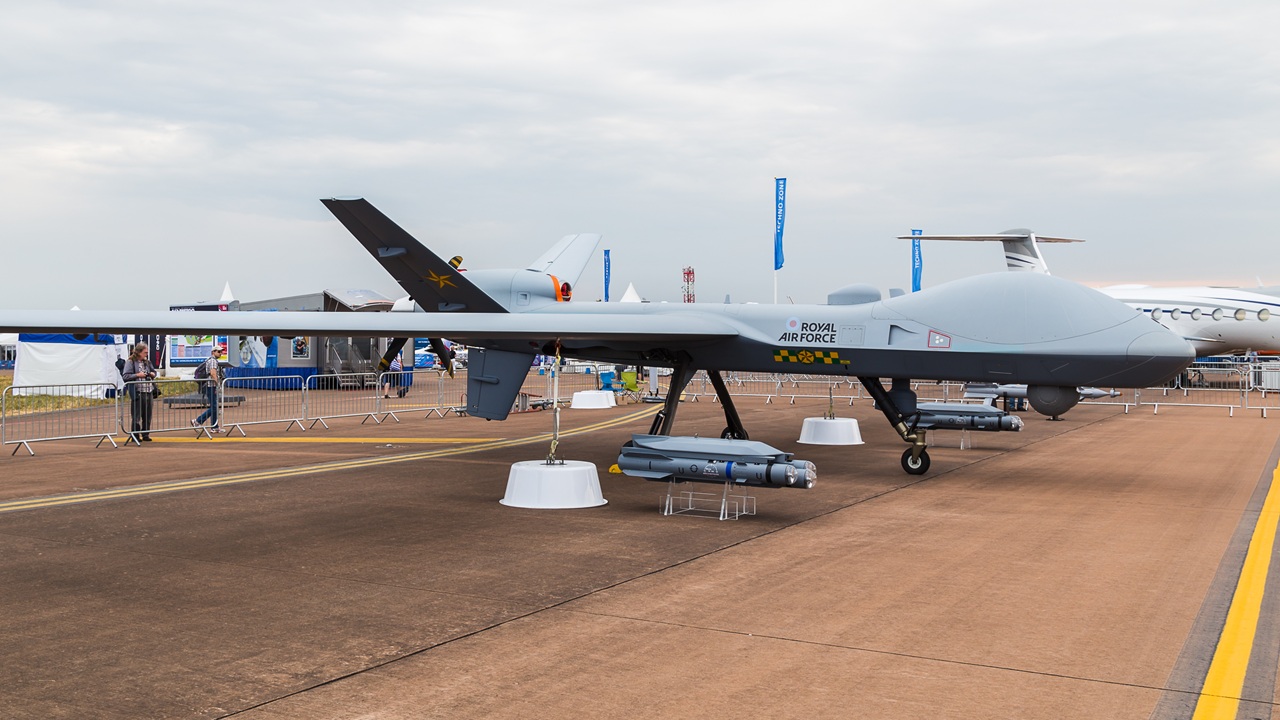
The MQ-9B Sky Guardian drone is an upgraded model of the MQ-9 Reaper, of War on Terror fame.
The US Marine Corps’ MQ-9B Sky Guardian drones are getting new “brains.”
The Marine Corps signed a contract with Ultra Intelligence & Communications (I&C) for new Knox-5 processors that promise to improve the unmanned aerial system’s data processing capabilities.
New “Brains” for the MQ-9B Sky Guardian
Marine Corps MQ-9B Sky Guardian drones will be getting a new “brain” in the form of Knox-5 processors.
The Knox-5 is an advanced processor designed to manage large and complex data flows in operational environments where connectivity is limited. It can support “cloud-native applications” even while deployed on the tactical battlefield. The processors feature 100-gigabit Ethernet connectivity, allowing the exchange of data across domains even in low-latency situations.
“Defense systems shouldn’t force operators into proprietary dead ends,” Mladen Brkic, the president of Ultra I&C’s Mission Solutions, said in a company press release.
“Knox breaks that cycle. Platform operators can swap modules, update software and integrate new capabilities as missions change — flexibility built for operational reality,” the executive added.
According to Brkic, the Knox-5 processor follows a modular, “future-ready” design that can incorporate future advanced technologies quickly and efficiently, while also supporting evolving architectures and mission-defined payloads.
Under the contract, I&C will deliver nine Knox-5 processors. If the Marine Corps is pleased with the results, there will likely be an additional contract. The service has a small but robust fleet of MQ-9B Sky Guardians, mainly deployed in the Indo-Pacific area of operations.
Unmanned aerial systems are playing an increasingly important role on the battlefield, allowing commanders to gather intelligence before an operation, launch munitions, and conduct post-strike assessments. Drones are an essential part of modern warfare.
What to Know About the MQ-9B Sky Guardian Drone
| Drone | MQ-9 Reaper (Base Model) | MQ-9B Sky Guardian (Upgrade) |
| Year Introduced | 2007 | ~2020 |
| Number Built | 300+ | Unknown; low tens |
| Length | 36 ft 1 in (11 m) | 38 ft (11.7 m) |
| Wingspan | 65 ft 7 in (20 m) | 79 ft (24 m) |
| Weight (MTOW) | 10,494 lb (4,760 kg) | 12,500 lb (5,670 kg) |
| Engine | One Honeywell TPE331-10 turboprop engine (900 hp) | One Honeywell TPE331-10 turboprop engine (900 hp) |
| Top Speed | 300 mph (482 km/h) | 240 mph (390 km/h) |
| Range | 1,200 mi (1,900 km) | 6,900 mi (11,100 km) |
| Service Ceiling | 50,000 ft (15,240 m) | 40,000 ft (12,200 m) |
| Loadout | 7 hardpoints, approx. 2,400 lb (1,088 kg) total payload capacity | 9 hardpoints, approx. 4,760 lb (2,155 kg) total payload capacity |
The MQ-9B Sky Guardian is a medium-altitude, long-endurance unmanned aerial system that can operate autonomously or be remotely controlled by human pilots. It can track targets in a surveillance role, but can also launch precision munitions, such as the AG-114 Hellfire air-to-ground missile, if necessary.
The MQ-9B is derived from the MQ-9 Reaper, the far more famous variant of the drone, which has won fame and infamy in equal measure for its diverse range of roles during the War on Terror. The Reaper remains the US military’s primary drone for kinetic and intelligence, surveillance, and reconnaissance (ISR) missions. Indeed, since replacing the older MQ-1 Predator, the MQ-9 Reaper has served as the eyes and ears of the US military and Intelligence Community for decades.
However, the MQ-9 drone is not indestructible; it prioritizes range, endurance, and flexible operating conditions over stealth, giving it few defenses against adversaries with air defense systems. For example, the Houthis in Yemen, whose air defense is relatively unsophisticated, have nonetheless managed to shoot down a number of MQ-9 unmanned aerial systems participating in the campaign against them. In a potential near-peer conflict with Russia or China, the MQ-9 drone fleet would be far more vulnerable due to the advanced anti-air systems those militaries have.
Upgrades like the one the Marine MQ-9B Sky Guardians are about to receive can make them more effective on the battlefield—and, among other things, increase their survivability.
About the Author: Stavros Atlamazoglou
Stavros Atlamazoglou is a seasoned defense journalist specializing in special operations and a Hellenic Army veteran (national service with the 575th Marine Battalion and Army HQ). He holds a BA from the Johns Hopkins University and an MA from the Johns Hopkins’ School of Advanced International Studies (SAIS). His work has been featured in Business Insider, Sandboxx, and SOFREP.
Image: Shutterstock / Jason Wells.
The post The Marine Corps’ “Sky Guardian” Drone Is About to Get a Lot Smarter appeared first on The National Interest.
Источник: nationalinterest.org