
«Данное сообщение (материал) создано и (или) распространено иностранным средством массовой информации, выполняющим функции иностранного агента, и (или) российским юридическим лицом, выполняющим функции иностранного агента»
 Topic: Naval Warfare Blog Brand: The Buzz Region: Americas Tags: Arleigh Burke-class Destroyers, Defense Industry, Destroyers, North America, Shipbuilding, Ships, United States, and US Navy The Arleigh Burke Flight III Upgrades: Too Little, Too Late? January 2, 2026 By: Brandon J. Weichert
Share
The new destroyer is a badly needed addition to the US Navy’s surface fleet—and shows that America’s ailing shipyards can occasionally produce good results.
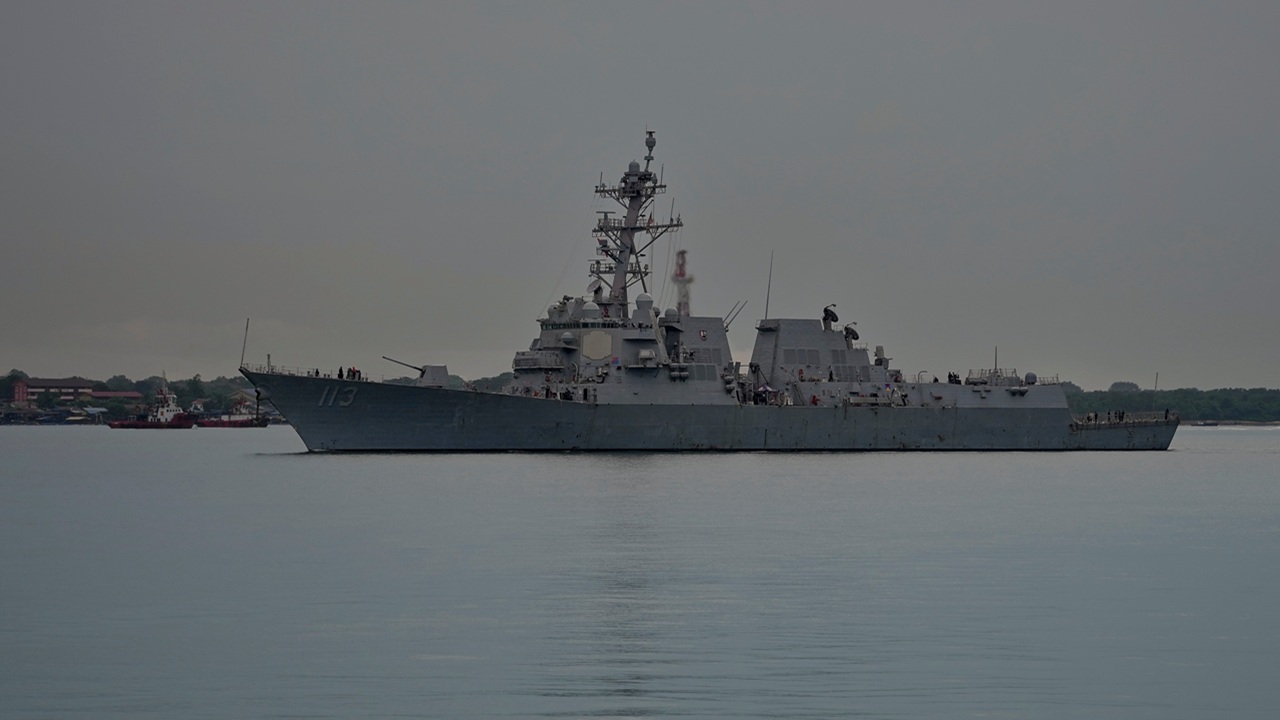
The United States Navy has a shipbuilding crisis that it has been contending with for years. Now, finally, a bright spot has appeared as the Navy has begun testing its first Flight III Arleigh Burke-class destroyer, the USS Jack H. Lucas.
Of course, this doesn’t ameliorate the overall shipbuilding crisis in the Navy. It does, however, give a modest boost to the Navy’s overall surface warfare fleet.
The Arleigh Burke-Class Destroyer’s Specifications
- Year Introduced: 1991
- Number Built: 74
- Length: 505-510 ft, depending on variant
- Beam (Width): 66 ft
- Displacement: 9,000 tons
- Engines: Four General Electric LM2500 gas turbines (26,250 bhp each)
- Top Speed: ~30 knots (35 mph)
- Range: ~4,400 nmi (5,100 mi)
- Armaments: 5-inch Mk 45 gun; Harpoon anti-ship missiles; Aegis Combat System; Mk 45 or 46 torpedoes; Tomahawk cruise missiles (96 VLS cells)
- Crew: 303-323, depending on variant
Why the USS Jack H. Lucas Actually Matters
Jack H. Lucas was first commissioned in October 2023, the Navy’s new destroyer is named after World War II-era Medal of Honor recipient, Jacklyn “Jack” H. Lucas, the youngest Marine to ever earn the award.
At the time of its commissioning, the Jack H. Lucas was designated as the Navy’s initial operation and evaluation campaign ship. Therefore, this specific Flight III Arleigh Burke-class destroyer is being used to validate any technologies that will undergird the rest of the Arleigh Burke-class fleet.
Key to the Flight III model of the Arleigh Burke-class destroyer is the upgraded AN/SPY-6(V)1 Air and Missile Defense Radar. It has been dubbed as a “major leap” from earlier SPY-1 radar variants. More sensitive and with longer range than previous models, Flight III Arleigh Burkes will be able to track faster, smaller, and more complex threats at once.
In the current maritime threat environment, when hypersonic anti-ship ballistic missiles and drone swarms are increasingly prevalent, having such a detection system will be critical for the ship’s survival.
The Flight III’s Biggest Upgrade Is Its Radar
AN/SPY-6(V)1 required major changes in the design of the Arleigh Burke Flight III deck. To support the new features of the warship, the Navy improved the overall structure, enhanced the cooling capacity of the ship, and installed an improved power plant, all to better accommodate the major energy demands and output of the new radar system.
The Defence Post, an online trade publication, further notes that the new Arleigh Burke-class Flight III ships incorporate the “Aegis Combat System Baseline 10, enabling improved integrated air and missile defense and enhanced ballistic missile defense performance.”
All of which are essential, considering the primary mission of the Arleigh Burke-class destroyers are sea control generally but these warships perform a vital task when included in a carrier strike group. They are the equivalent of a blocking tackle on an NFL football team.
They protect the quarterback.
In this case, the quarterback is the aircraft carrier at the center of that carrier group. Arleigh Burke-class detection, tracking, and defensive capabilities are critical for forming a protective envelope around the carrier and ensuring that the carrier can continue to perform its primary mission—the launching and recovery of warplanes at sea.
And the inclusion of the Aegis Combat System Baseline 10 on the new Flight IIIs amplifies the ability of the Arleigh Burke-class to do its job of better defending the carriers.
A Rare Bright Spot in a Dark Shipbuilding Era
Testing of the Jack H. Lucas is not just about ensuring that the new SPY-6 radar works properly (although that is important). The Navy must determine how the new radar works alongside existing combat systems, what its power consumption looks like over prolonged use, and the Navy must work through maintenance needs.
Information collected from these stress tests will be applied to the larger fleet—and that information cannot be collected soon enough, not as the situation between China and Taiwan appears set to explode, which will undoubtedly rope in the US Navy’s surface warfare fleet.
The greater question is whether these warships are even going to make a difference, considering the way in which naval warfare is increasingly going to be dominated by unmanned systems and submersibles.
Still, the new radar system alone might save American lives, as the Navy will be threatened by hypersonic anti-ship missiles and drones.
About the Author: Brandon J. Weichert
Brandon J. Weichert is a senior national security editor at The National Interest. Recently, Weichert became the host of The National Security Hour on America Outloud News and iHeartRadio, where he discusses national security policy every Wednesday at 8pm Eastern. Weichert hosts a companion book talk series on Rumble entitled “National Security Talk.” He is also a contributor at Popular Mechanics and has consulted regularly with various government institutions and private organizations on geopolitical issues. Weichert’s writings have appeared in multiple publications, including The Washington Times, National Review, The American Spectator, MSN, and the Asia Times. His books include Winning Space: How America Remains a Superpower, Biohacked: China’s Race to Control Life, and The Shadow War: Iran’s Quest for Supremacy. His newest book, A Disaster of Our Own Making: How the West Lost Ukraine is available for purchase wherever books are sold. He can be followed via Twitter @WeTheBrandon.
Image: Shutterstock / DLeng.
The post The Arleigh Burke Flight III Upgrades: Too Little, Too Late? appeared first on The National Interest.
Источник: nationalinterest.org