
«Данное сообщение (материал) создано и (или) распространено иностранным средством массовой информации, выполняющим функции иностранного агента, и (или) российским юридическим лицом, выполняющим функции иностранного агента»
 Topic: Air Warfare, and Artificial Intelligence (AI) Blog Brand: The Buzz Region: Europe Tags: Drones, Eastern Europe, Russia, Ukraine, and Ukraine War Tap, Click, Kill: AI-Powered FPV Drones in the Ukraine War January 2, 2026 By: Brandon J. Weichert
Share
As electronic jamming disrupts the connection between FPV military drones and their pilots, they will increasingly rely on artificial intelligence to make independent targeting decisions.
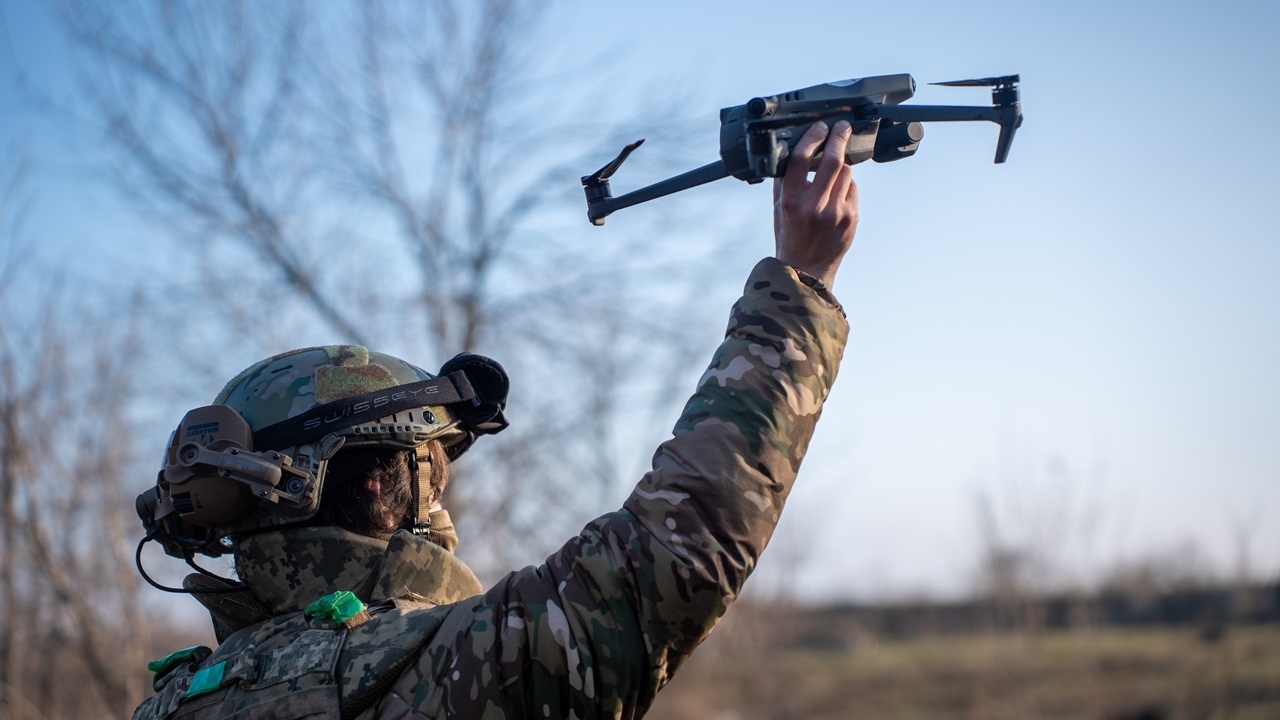
Drones have defined the Ukraine War. Both sides in that conflict have relied upon drones as key force multipliers—especially since the frontlines have been largely static for years. With conventional forces bogged down and ground forces lumbering along, the drones have been decisive.
It isn’t only the physical drones, though, that are essential. It’s the software on those drones that is the difference maker.
The Software Inside the Drone War
Take the Auterion Short-Range Loitering Munition (SLM), ten-inch (or the SLM-10) stack. This is a reference design kit created by software firm Auterion for an affordable, simple first-person view (FPV) quadcopter that employs Auterion’s artificial intelligence-powered autopilot to overcome electronic jamming and conduct precision strikes against Russian targets in Ukraine.
Auterion’s core technology is Skynode S. This is the AI-powered system that runs many Ukrainian FPVs. Auterion’s reference design allows for the mass production of FPVs utilizing Auterion’s software. It is for standardization in the production phase of the development of drones.
Skynode S is designed for a ten-inch quadcopter that carries up to a six-pound (or 3 kilogram) payload, that is meant for GPS-denied/degraded environments. Skynode S can run a small FPV drone that has a 3.3-pound (1.5 kg) payload and a maximum range of 15.5 miles (or 25 kilometers).
Skynode S will run an FPV with a low-cost MIPI camera, like an IMX 900. There is a “software defined” (SW) data link for flexible, automated management on the Skynode S-run small quadcopter FPVs in Ukraine.
The Skynode S runs what’s known as a T&I application (Track and Intercept). In essence, the T&I app is essential for guiding any FPV drone utilizing Auterion’s software to its designated static—even if GPS is denied and the communications link is severed.
This relatively new application, according to the Auterion company page, “uses the integrated compute module and a visual sensor to deploy a new flight mode [to a Ukrainian FPV].”
What’s more, the Auterion website explains that the new T&I app “enables operators of all skill-levels to tap or click and engage targets in contested environments.”
Standardization at the Speed of Modern War
Historians remark how the Napoleonic Wars, with their instances of mass conscription, were the beginnings of the “democratization of warfare.” The American Civil War, the trench warfare of World War I, the the massive aerial bombardment during World War II, the targeting of major population centers with nuclear weapons during the Cold War, and the rise of terrorism in the so-called Global War on Terrorism, in which enemy combatants blended in with civilian populations, continued this democratization of warfare trend begun so long ago by Napoleon.
Now, Auterion’s new T&I application makes anti-tank warfare on the modern battlefield so simple, anyone who can tap and click a computer screen can conduct wildly effective—and deadly—anti-tank warfare.
The AI Arms Race Has Already Begun—In Ukraine
Despite the relatively static nature of the front in the Ukraine War, tank warfare has been a key element of the fight since the start of the war. Both Russia and Ukraine have employed anti-tank weapons with increasing accuracy. Yet the real tank killer has been the FPV drones—specifically “loitering munitions,” or kamikaze drones.
Horrifying videos recorded by Russian troops hiding underneath their tanks have gone viral on social media platforms depicting how these Ukrainian kamikaze drones have been critical for stunting some of the Russian advances with armor.
In these videos, the Russian troops take cover underneath their tanks after a swarm of nightmarish FPVs (likely under the control of Auterion’s Skynode S AI-powered software) surround the tank and begin their hellish attacks.
These Auterion software-controlled FPVs are especially lethal. As a result, the American government has a contract to send over 33,000 of those AI-guidance kits to Ukraine to significantly scale up their AI-enabled drone capabilities.
Thus, destroying Russian tanks is only the beginning. The Ukrainians and Americans are using the need to destroy armor on the frontlines to streamline and expand the weaponization of AI.
About the Author: Brandon J. Weichert
Brandon J. Weichert is a senior national security editor at The National Interest. Recently, Weichert became the host of The National Security Hour on America Outloud News and iHeartRadio, where he discusses national security policy every Wednesday at 8pm Eastern. Weichert hosts a companion book talk series on Rumble entitled “National Security Talk.” He is also a contributor at Popular Mechanics and has consulted regularly with various government institutions and private organizations on geopolitical issues. Weichert’s writings have appeared in multiple publications, including The Washington Times, National Review, The American Spectator, MSN, and the Asia Times. His books include Winning Space: How America Remains a Superpower, Biohacked: China’s Race to Control Life, and The Shadow War: Iran’s Quest for Supremacy. His newest book, A Disaster of Our Own Making: How the West Lost Ukraine is available for purchase wherever books are sold. He can be followed via Twitter @WeTheBrandon.
Image: Shutterstock / seeasign.
The post Tap, Click, Kill: AI-Powered FPV Drones in the Ukraine War appeared first on The National Interest.
Источник: nationalinterest.org